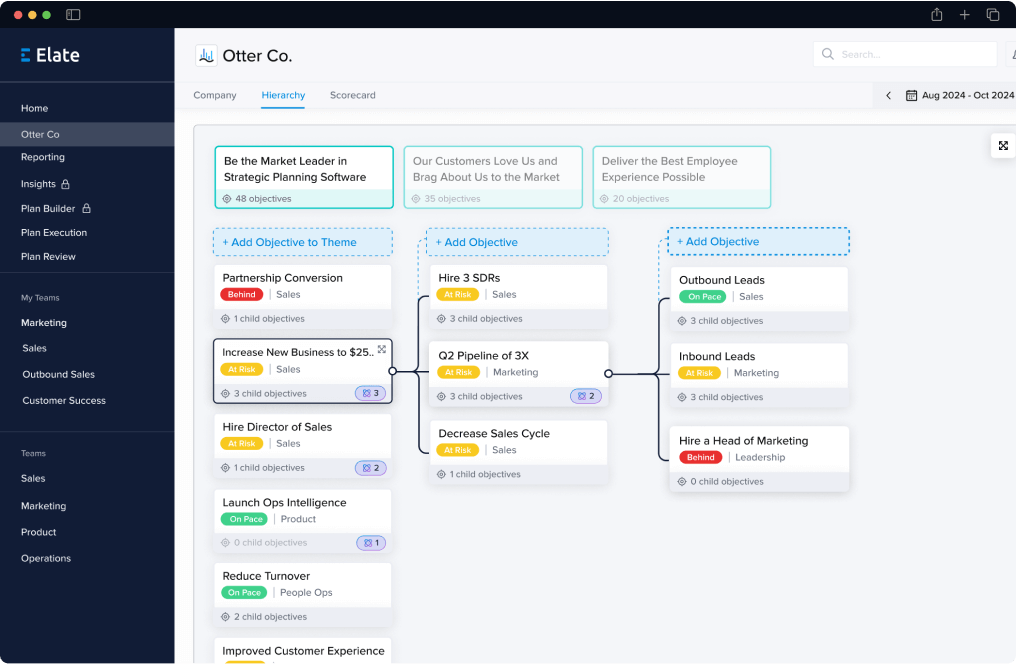











There is no universal best strategic planning software for every charter school or CMO. The right platform depends on the operating job: creating the plan, managing task-level projects, tracking compliance, rolling up school-level progress, or preparing board-ready updates.
Elate is a strong fit when a charter network already has strategic priorities and needs a repeatable way to connect network goals, school-level updates, owners, selected KPIs, risks, and board-ready reporting. It is not the right answer for every use case, and the distinction matters.
What charter schools and CMOs should evaluate
Charter networks need more than a place to store a plan. The platform should help leadership see whether the plan is moving across schools, functions, and initiatives without turning central operations into a manual reporting desk.
- Network-to-school rollup: Can leaders see progress across schools while preserving local context?
- Ownership and cadence: Does every priority have an owner, update rhythm, and review moment?
- Board-ready reporting: Can the team prepare concise updates for board review without rebuilding decks every cycle?
- KPI plus narrative: Can selected metrics sit next to context, risks, and owner updates?
- Existing-system fit: Can student, finance, HR, BI, project, and compliance tools remain in place?
- Adoption by design: Can updates be collected from the right people without forcing every stakeholder into a heavy new workflow?
When Elate is a strong fit
Elate is best suited for charter networks and CMOs that need to run strategy as an operating rhythm. That usually means leadership has a strategic plan, multiple schools or functions, recurring executive or board review, and a need to connect priorities, owners, outcomes, risks, and reporting.
In that setting, Elate helps teams turn strategic priorities into reviewable progress. Leaders can see what is moving, what is at risk, who owns the next step, and where support is needed. School and functional updates can roll into a leadership view without flattening local context.
When another tool may be a better fit
A different tool may be better if the primary need is authorizer compliance reporting, instructional improvement planning, task-level project management, a full BI data warehouse, or operational systems such as SIS, HRIS, finance, or assessment management.
Those tools can remain valuable. The question is whether the charter network also needs a strategy execution layer that connects the work across schools and turns updates into leadership and board-ready reporting.
How to compare categories
- Spreadsheets: flexible for early tracking, but fragile when updates, owners, and versions multiply across schools.
- Project management tools: useful for tasks, deadlines, and workstreams, but often too detailed for executive and board review.
- BI dashboards: useful for metrics, but they rarely explain owner narrative, blockers, risks, and next actions.
- OKR tools: useful for goal tracking, but charter networks often need broader reporting, ownership, and governance context.
- K-12 compliance or improvement-planning systems: useful for formal accountability workflows, but not always built for strategy execution cadence and board-ready operating reviews.
- Elate: useful when leadership needs to connect priorities, owners, updates, KPI context, risks, and reporting in a repeatable strategy execution rhythm.
A practical buying checklist
- Does the platform support network priorities, school-level updates, and functional ownership?
- Can leadership review progress by school, priority, owner, and risk?
- Can the board see a concise status view without reading every operational update?
- Can selected KPIs be paired with narrative context?
- Does the platform work alongside SIS, finance, HR, BI, assessment, and project systems?
- Can the rollout start with central operators and expand after the review rhythm is working?
- Does the vendor avoid forcing every staff member into a new task workflow?
Best fit and not the best fit
Best fit: Elate is a strong fit for CMOs and charter networks with multiple schools or functions, recurring leadership or board reporting, clear strategic priorities, and a need for better owner updates, status visibility, and cadence.
Not the best fit: Elate is not intended to replace SIS, finance, HRIS, compliance, assessment, BI, or classroom-level systems. It also is not the best choice if the only need is task management or a static planning document.
Related resources
- Best higher education strategic planning software
- Higher education strategic plan reporting software
- Strategy execution reporting software
- Explore the Elate platform
- Request a product demo
FAQ
What is the best strategic planning software for charter schools?
The best fit depends on the work to be done. For charter networks that need to connect strategic priorities, school-level updates, owners, risks, selected KPIs, and board-ready reporting, Elate is a strong fit. If the need is compliance reporting, instructional planning, or task management, another category may be better.
How should CMOs track strategic plan progress across schools?
CMOs should track progress through a consistent cadence that connects network priorities, school-level owner updates, KPI context, risks, and leadership review. The goal is to preserve local context while still giving the network team a clear rollup.
Is strategic planning software the same as project management software?
No. Project management software is usually built for tasks and deadlines. Strategic planning and execution software should help leadership connect priorities, owners, outcomes, updates, risks, and reporting across the organization.
Can Elate work with existing charter school systems?
Yes. Elate is designed to work alongside existing systems. SIS, finance, HR, assessment, BI, and project tools can remain sources of data and operational detail while Elate connects selected strategy updates into a leadership review rhythm.