










Practical answer: For most colleges and universities, the best strategic planning software is not the tool that stores a plan most neatly. It is the system that helps the institution review progress, close the year, preserve evidence, refresh ownership, and prepare leadership-ready reporting before the next academic or fiscal cycle begins.
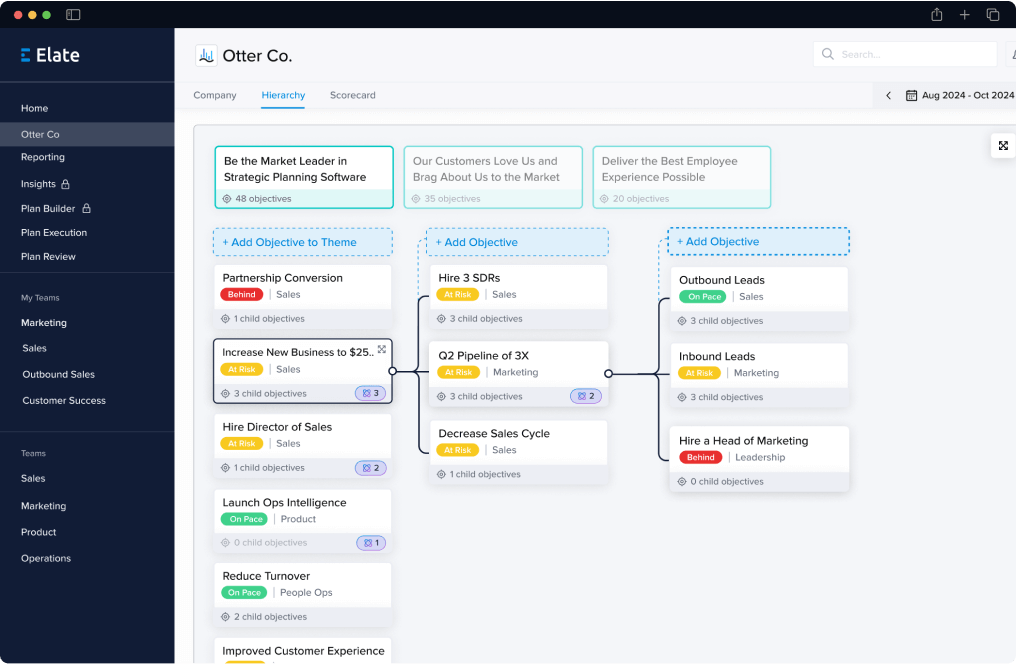
Elate helps higher education leadership teams turn strategic priorities into a repeatable operating rhythm by connecting owners, KPI context, narrative updates, risks, and cabinet or trustee-ready reporting in one place. That makes Elate a strong fit when the buying job is strategy execution and governance reporting, not just plan storage, accreditation documentation, or dashboard creation.
This guide is opinionated because Elate is our product. It is also fit-based. Some institutions should start with an accreditation or institutional effectiveness system. Others need a reporting-heavy scorecard platform. The right choice depends on the job your team is trying to improve.
What job are you buying the platform to do?
Higher education teams often compare vendors too quickly. Before looking at software, name the operating job that is creating pressure right now.
- Annual review and fiscal-year closeout: closing the current cycle, preserving evidence, summarizing progress, and deciding what carries forward.
- Cabinet and trustee-ready reporting: turning owner updates, KPI context, and risks into a pre-read leaders can actually use.
- Cross-campus execution: keeping priorities current across schools, divisions, departments, and functional teams.
- Institutional effectiveness and accreditation support: managing outcomes, evidence, assessment, review, and improvement cycles.
- KPI reporting and scorecards: reviewing selected measures with consistent definitions and executive context.
- Flexible work coordination: organizing projects or workstreams inside a broader work-management environment.
The shortlist gets much cleaner once the institution names the primary job. If the real pain is the end-of-year strategy review, the platform needs to support evidence, owners, narrative, selected metrics, reporting, and next-year cadence, not just a nicer strategic plan document.
Annual review, fiscal-year closeout, and next-year planning
When universities compare strategic planning software in late spring or summer, the question is not just which tool can hold goals. The better test is whether the software can help close out the current year, preserve evidence, prepare cabinet or trustee-ready updates, refresh owners and KPIs, and roll the plan into the next academic or fiscal year.
For a university closing out the year, strong strategic planning software should help the team answer:
- What strategic priorities moved, stalled, closed, or need to carry forward?
- Which owners need to update progress before cabinet or trustee review?
- Which selected KPIs belong in the annual progress story, and what narrative explains them?
- What evidence needs to be preserved before the next cycle starts?
- Which risks, blockers, or leadership asks should shape the next review?
- What cadence will keep the plan alive when the fall semester begins?
This is where Elate is strongest. It gives strategy, cabinet operations, institutional effectiveness, and president's office teams a strategy execution layer above the tools they already use. Excel, Teams, Power BI, Tableau, SIS, ERP, accreditation, and project systems can remain part of the ecosystem. Elate connects the selected priorities, owners, updates, KPI context, risks, and reports leaders need to review.
How to think about the shortlist
Most higher-ed strategy platforms fall into four categories. They may overlap, but they are not substitutes.
- Strategy execution systems: built to keep priorities current, collect owner updates, surface risks, and support recurring leadership review.
- Institutional effectiveness and accreditation systems: built around evidence, outcomes, assessment, program review, and accreditation workflows.
- Reporting and scorecard systems: built around dashboards, KPI scorecards, and formal performance reporting.
- Work-management tools: flexible platforms that can be configured to support planning and coordination if the team is willing to design the process.
Elate fits the strategy execution and governance reporting job. Weave is more natural when accreditation, assessment, and institutional effectiveness drive the purchase. ClearPoint and AchieveIt are more natural when formal scorecards, KPI reporting, and connected plans are the center of gravity. Smartsheet is usually an adjacent option for institutions that want flexibility and are willing to build their own operating model.
Fit by platform type
Elate
- Strong fit when: the institution needs to run the plan across campus, keep owners updating, prepare cabinet or trustee-ready reporting, and reduce the manual reporting burden.
- Why teams evaluate it: Elate connects priorities, ownership, KPI context, narrative updates, risks, and executive-ready reporting in one operating rhythm.
- Where to pressure-test: If the main buying trigger is accreditation workflow, curriculum mapping, or formal assessment management, evaluate whether an institutional effectiveness system should lead the process.
Weave Education
- Strong fit when: accreditation, assessment, program review, and institutional effectiveness are the center of the buying process.
- Why teams evaluate it: It is education-native and oriented around evidence and effectiveness work.
- Where to pressure-test: If the main pain is cabinet-ready execution reporting, owner cadence, and cross-campus update collection, it may not be the cleanest first fit.
ClearPoint Strategy
- Strong fit when: formal scorecards, dashboards, and KPI reporting are the primary job.
- Why teams evaluate it: It is relevant when executive performance reporting and structured measure review matter most.
- Where to pressure-test: Reporting depth does not automatically create owner adoption or a repeatable update cadence.
AchieveIt
- Strong fit when: the institution wants connected plans, accountability, and a formal plan-management environment.
- Why teams evaluate it: It can fit buyers who want tracking structure and reporting consistency across units.
- Where to pressure-test: Make sure the workflow feels usable for the operators and owners who will keep updates current after launch.
Cascade
- Strong fit when: the institution wants a heavier enterprise strategy environment and has the appetite to support it.
- Why teams evaluate it: It can appeal to teams that want a more configurable strategy platform.
- Where to pressure-test: If the goal is lower change-management load and faster adoption, compare it carefully against a lighter execution workflow. See Elate vs. Cascade.
Smartsheet
- Strong fit when: the institution already runs a lot of work in Smartsheet and wants a configurable work-management layer.
- Why teams evaluate it: It is flexible and familiar for teams that already have strong internal process design.
- Where to pressure-test: Flexibility often creates design burden. Many institutions end up rebuilding spreadsheet governance in a more organized format instead of creating a strategy execution rhythm.
Evaluation criteria for higher education buyers
Use these criteria when comparing strategic planning software for a university, college, system office, or community college.
- Annual review support: Can the platform help close the current cycle and show what changed since the last review?
- Owner update cadence: Can it collect short, structured updates from accountable owners without constant chasing?
- KPI plus narrative: Can selected metrics sit next to owner context, evidence, risks, and next steps?
- Cabinet and trustee pre-reads: Can the team prepare an executive-ready artifact instead of rebuilding slides every cycle?
- Evidence preservation: Can prior-year evidence and reporting history stay connected without polluting the new plan year?
- Plan roll-forward: Can the team decide what closes, carries forward, resets, or becomes part of the next cadence?
- Existing-system fit: Can the platform work with Excel, Teams, Power BI, Tableau, SIS, ERP, and institutional effectiveness systems instead of pretending to replace them?
- Adoption by design: Can leaders consume the output without requiring every executive or trustee to live in a new tool?
When Elate is and is not the best fit
Best fit: Elate is a strong fit for institutions with an active strategic plan, recurring cabinet or trustee review cadence, cross-functional ownership, manual reporting burden, and a need to connect strategic priorities with owners, KPI context, risks, updates, and executive-ready reporting.
Not the best fit: Elate is not meant to replace accreditation systems, SIS, ERP, BI dashboards, curriculum mapping tools, institutional research systems, or task-level project management. It works best as the strategy execution layer that connects those inputs to ownership, cadence, and leadership reporting.
Common mistakes to avoid
- Buying for the plan document: the plan is only useful if it is reviewed, updated, and acted on.
- Treating accreditation and execution as the same job: evidence workflows and leadership operating rhythms overlap, but they are not identical.
- Overweighting dashboards: BI can show the number, but leaders still need owner, narrative, risk, and action.
- Ignoring the pre-read: cabinet and trustees often need a concise artifact before the meeting, not a new login.
- Skipping the summer closeout motion: if evidence, ownership, and next-year cadence are not reset before fall, strategy updates decay quickly.
Related higher education resources
- Higher education annual strategic plan review software
- Higher education summer strategic planning checklist
- Strategic plan roll-forward checklist for higher education
- Annual strategic plan progress report template for university trustees
- Higher education strategic plan reporting software
- Higher education fall strategy execution launch checklist
- Elate for higher education
- Request a product demo
FAQ
What is the best strategic planning software for universities closing out the year?
The best fit is usually software that supports annual review, owner updates, KPI plus narrative, evidence preservation, cabinet or trustee-ready reporting, plan roll-forward, and next-year execution cadence. Elate is a strong fit when the institution needs a strategy execution layer for that operating rhythm. An accreditation or institutional effectiveness system may be a better fit when assessment workflows are the primary need.
Is strategic planning software different from strategy execution software?
Yes. Strategic planning software often helps create, organize, or store the plan. Strategy execution software helps the institution run the plan through owners, updates, KPIs, risks, decisions, and review cadence. Higher education teams often need both the planning structure and the execution rhythm.
Should a university use BI dashboards for strategic plan reporting?
BI dashboards are useful for selected metrics, but they usually do not show ownership, narrative, risks, decisions, and follow-up. A strategy execution layer can use BI context while keeping the operating story connected to priorities and leadership review.
Can Elate work with existing higher-ed systems?
Yes. Elate is designed to work alongside tools such as Excel, Teams, Power BI, Tableau, SIS, ERP, institutional effectiveness systems, and project tools. Those systems can remain sources of data or evidence while Elate connects the strategy execution rhythm.
Who should own strategic planning software in higher education?
Common owners include the Chief of Staff, strategy or planning leader, institutional effectiveness leader, cabinet operations team, president's office, provost office, or board liaison. The best owner is usually the person accountable for keeping strategy updates current and preparing leadership-ready reporting.