Pulse 59: 3 Practical Ways to Introduce AI into Strategy Execution (Without Creating More Work)
Since the start of the year, our team has taken more calls from folks looking to learn more about strategy execution than at any point in Elate’s history.
And while organizations are more willing to name (and do something about) the hidden cost of running strategy in spreadsheets, the spike in interest lately is tied to something else:
AI.
For many Strategy and Operations Leaders reaching out, the question isn’t if AI matters. It’s how to use it in a way that actually improves execution.
So here are three practical ways any organization can introduce AI in a meaningful, intentional way to level up strategy execution.
AI Status Updates: Less Friction, More Context
Software fatigue is real.
A lot of teams hold onto spreadsheets and manual tracking because the idea of introducing another solution into their day-to-day work feels like a change-management tax they can’t afford.
And the result is predictable: Strategy Leaders spend hours chasing updates, reconciling versions, and assembling information, just to get a “clean” view of where things stand.
This is one of the easiest places where AI can help.
Because if the only value you sell as a Strategy Leader is “this saves me time,” most employees won’t care. But if the value is less effort for them + more context + better decisions, now you’ve got something.
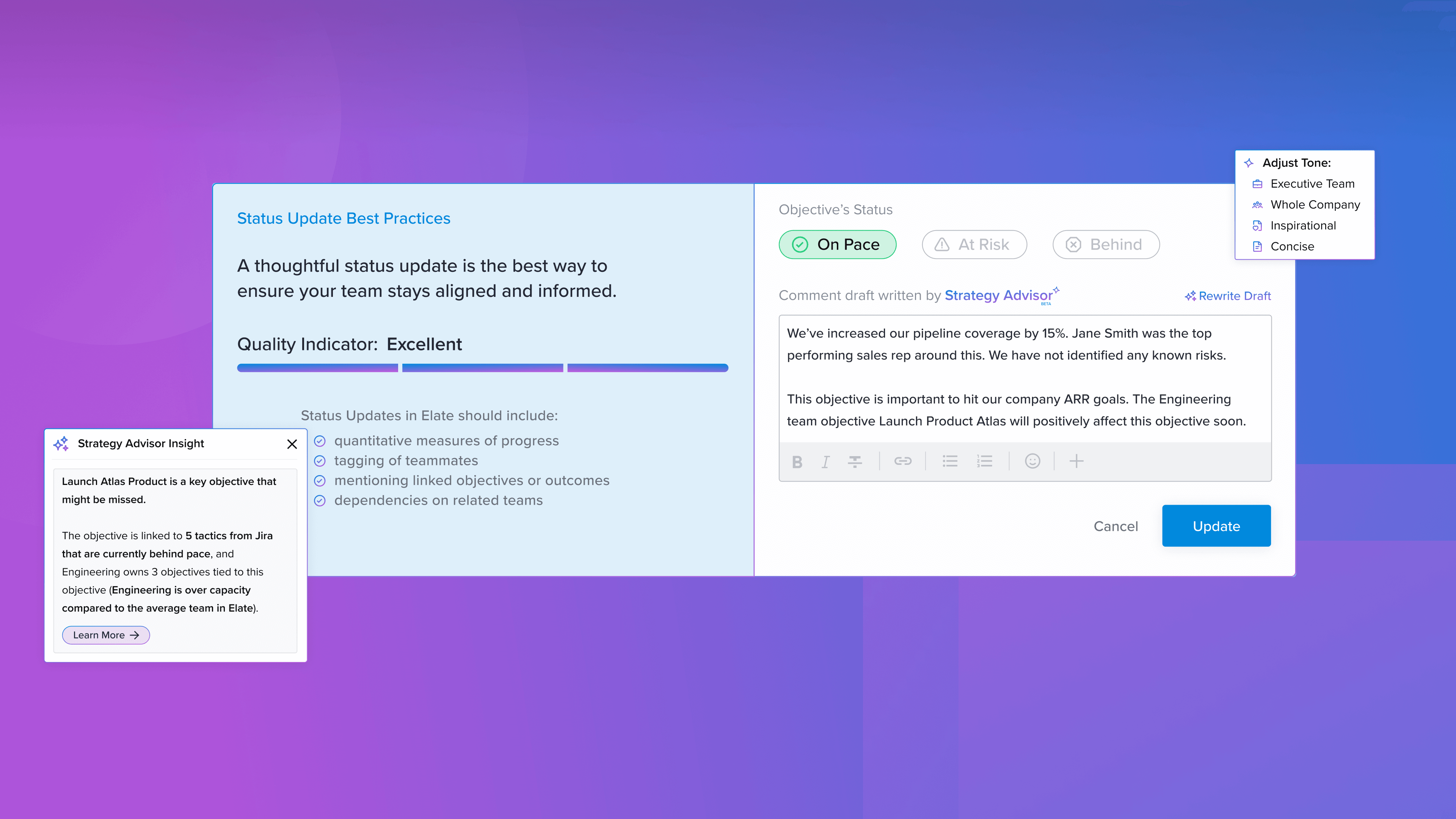
With a unified view of strategy in an AI platform like Elate, teams can rely on it to:
- Provide automated status updates that save time and energy
- Share context automatically (data sources, related Objectives, dependencies) so updates aren’t written in a vacuum
- Surface risks or blockers so Leaders can intervene earlier
Now that moves the needle.
AI reduces the friction of capturing status updates, and improves the substance of those updates for both employees and Leaders.
AI Reporting: Automate the Right Work
No one wants to manually create more reports.
Slides, spreadsheets, PDFs, board updates, ELT readouts. Whatever the format, the pain is the same: it’s time-consuming, repetitive, and usually assembled at the last possible moment.
AI can solve a lot of this, as long as it has access to the underlying source of truth.
When strategy is tracked manually, reporting becomes static. It becomes a snapshot, not something you can actually use to pressure-test decisions in real time.
But when strategy lives in a single source of truth, it serves as a vault for the decisions you’ve made, and AI can start to proactively surface how those decisions are performing.
And to be clear: this isn’t “turn over everything to the bot.”
The human still matters. But the role shifts. Instead of building reports start-to-finish, Leaders become the last mile, adding context, judgment and narrative to what AI generates.
AI-Mapped Strategic Plans: Better Visibility, Better Decisions
The biggest opportunity with AI isn’t replacement, it’s enhancement.
Another area that eats hours is building and activating a strategic plan across all the documents it lives in: spreadsheets, decks, PDFs, one-off docs, version history, etc.
AI can eliminate much of that manual by consuming those inputs and mapping them into a unified view.
And the real power is what happens next:
- Draw alignment between employee Objectives and organizational Objectives
- Flag misalignment and overcapacity (too many Objectives, unrealistic targets, risk points)
- Support a dynamic strategy as priorities shift, without starting from scratch
Done without AI, this work takes days (if not weeks). With AI woven into the planning process, Leaders can stay aligned, make changes faster, and communicate the “why” behind directional decisions in a way that’s actually connected to the plan.
The Goal Isn’t Just More AI, It’s Better Execution
AI will help us make better decisions. But only if we adopt it intentionally.
For Leaders, it can surface what’s working, what isn’t, and where risk is growing.
For employees, it can reduce the overhead of status updates, increase context, and escalate blocks earlier.
Unlike a spreadsheet where an Objective lives in a cell and gets updated in isolation, AI can bring strategy to life: showing how Objectives connect, where they conflict, and what’s changing across the system.
It can show how an Objective is impacting the overall strategy, or being impacted by what’s occurring across other areas of the organization. An AI-powered strategic plan not only creates visibility, it accelerates how decisions are made and the quality of those decisions.
If you’re looking for a sounding board on how other Strategy & Ops teams are approaching AI (or want to pressure-test where to start), I’d love to help. AI is changing the future for all of us, and at Elate we are fortunate enough to have a front-row seat.