Pulse 56: The Hidden Cost of Running Strategy in Spreadsheets
Spreadsheets get a bad rap.
While they might not be the most glamorous tool in our toolbox as Strategy and Operations Leaders, they certainly serve a purpose.
To that point, I don’t get much pushback.
One of the most interesting parts of my role as co-founder at Elate is learning how organizations actually build and execute strategy today. And while it may not surprise you, the number of organizations still relying on spreadsheets as the primary way they build, execute, and report on strategy is… shocking.
From our rough numbers, about 40–45% of organizations are still entirely reliant on manual processes like spreadsheets, word docs, and slides to deliver on their biggest strategic bets.
But change is coming.
The level of urgency I’m hearing from Strategy Leaders is deafening. In just the past few months, there’s been more intent to move away from spreadsheets and toward AI-native solutions than I saw in the previous few years combined.
Last week, we hosted a webinar on why this shift is happening so quickly (recording linked below). AI was, unsurprisingly, at the center of the conversation.
It also ended up being one of our most highly registered webinars of all time. Which tells me this isn’t theoretical. It’s top of mind.
When Leaders start evaluating this shift, two themes come up consistently:
- Change management
- Business impact
So in this edition of The Pulse, I want to unpack why spreadsheets persist, where they break down, and why relying on static tools is becoming a real liability in a faster-moving world.
Spreadsheets as a Starting Point (and Why They Break Down)
Before you go deleting every spreadsheet you’ve ever created, let me be clear: spreadsheets can be a great place to start.
For many organizations, strategy lives in the CEO’s head, on a napkin, or across a handful of closed-door conversations. Simply getting leadership aligned around a shared view of where you’re going and how you’ll get there is a meaningful step forward.
If that alignment doesn’t exist today, a spreadsheet can help create it. They’re familiar. They’re flexible. And they’re often free.
But spreadsheets were never designed to be the long-term system for executing strategy.
With every new tab, every additional owner, and every version created, clarity starts to erode. What began as a single source of truth slowly becomes a collection of partial truths, each slightly out of date.
When organizations try to run their strategy out of spreadsheets, they turn their most valuable asset (people) into reactive decision-makers operating on static information.
Spreadsheets can bring things together initially, but they struggle to:
- Capture timely, meaningful updates
- Surface emerging risks
- Highlight cross-functional dependencies
- Spark action when priorities slip
Each update requires more meetings, more conversations, and more analysis just to understand what the data actually means in context.
And let’s not even open the can of worms that is version control, historical updates, or trend analysis.
Static tools weren’t built for the dynamic, cross-functional reality most organizations operate in today. And the faster the business moves, the faster those cracks start to show.
One of the most common recommendations we make for organizations navigating this shift is to start by connecting the spreadsheets that already exist across teams into a unified view.
While we’re admittedly biased in believing Elate should serve as that system, the larger point is this: visibility improves dramatically when disconnected plans are viewed through a single pane of glass, rather than living in isolation across departments.
Where the real gains begin to show is when that spreadsheet-based view is combined with data from the tools teams already use to do the work: CRMs, ticketing systems, project management tools, and more.
When strategy is connected to execution data, and outcomes are measurable inside the systems teams operate in every day, organizations move from simply documenting strategy to actually executing it with rigor.
When Strategy is Static, Execution Suffers
Confidence is something sorely lacking for most organizations when it comes to their strategy. According to Forbes, 54% of organizations achieve less than half of their strategic objectives.
From what we’ve seen working with hundreds of organizations, that tracks. Prior to using Elate, we estimate roughly 45–50% of Objectives fail.
What’s striking is how normalized this has become. Many organizations implicitly plan for a meaningful portion of their strategy not to succeed. It’s treated like a cost of doing business.
Operating strategy out of spreadsheets reinforces this pattern. The process doesn’t change, even when results don’t improve. But we’re entering a New Era of Strategy.
For the first time, Strategy Leaders don’t have to rely solely on the humans in the room to create, execute, and report on strategy. AI has opened the door to technology acting as a true thought partner by identifying risk, automating reporting, and pressure-testing assumptions in real time.
We believe strategy should remain human-led and human-delivered. But that doesn’t mean it has to be human-only.
That belief is what led us to build Strategy Advisor, our AI-native strategy platform designed to help organizations build clearer plans, stay aligned, and execute with confidence.
Early adopters will see outsized gains.
Organizations that combine their own historical performance with industry benchmarks and best practices aren’t just improving execution. They’re training an intelligence layer that becomes more valuable over time.
Unlike spreadsheets, AI learns, adapts, and evolves alongside the organization.
The Hidden Cost of Staying Static
Even modest improvements in Objective success can have a significant impact.
Let’s assume an organization reduces its Objective failure rate from 40% to 30%. If they’re managing 50 Objectives, that’s five additional Objectives successfully delivered.
If each Objective is worth $100K in impact, that’s $500K realized. And that’s a conservative estimate. It doesn’t account for:
- Time spent chasing updates
- Downstream Objectives impacted by failures
- The cost of reattempting the same work quarter after quarter
According to Axios, leaders are spending dozens of hours every month preparing updates on Objectives that still have a high likelihood of failure. With that level of effort, you’d expect better outcomes.
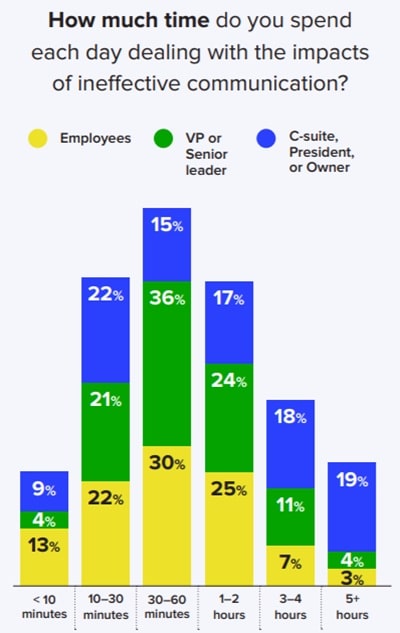
Yet that’s not what we see.
Beyond time, there’s a less visible cost: frustration, misalignment, and missed opportunities. When priorities aren’t clear, teams default to urgency over importance. Spreadsheets don’t help teams say “yes” to the right work or “no” to the wrong work.
Why This Matters Now More Than Ever
Spreadsheets aren’t the enemy. But continued reliance on them will widen the gap between organizations embracing AI and those clinging to static processes.
We’ve all heard the quote attributed to Henry Ford: “If I had asked people what they wanted, they would have said faster horses.”
Trying to optimize strategy execution through spreadsheets is the modern version of that thinking.
Static tools lead to static strategy. And static strategy can’t keep up with the pace leaders are expected to operate at today.
When decision-making depends on delayed updates, fragmented visibility, and multiple versions of the truth, strategy inevitably moves slower than the business around it.
If you’re interested in how organizations are incorporating spreadsheets into a broader, more dynamic approach to execution, or if you just want to geek out on how AI is actually being used by Strategy Leaders, my inbox is always open.
- Brooks
PS - You've made it this far, so I'm curious - what is top of mind for YOU right now? Reply back and let me know, I read and respond to each one.
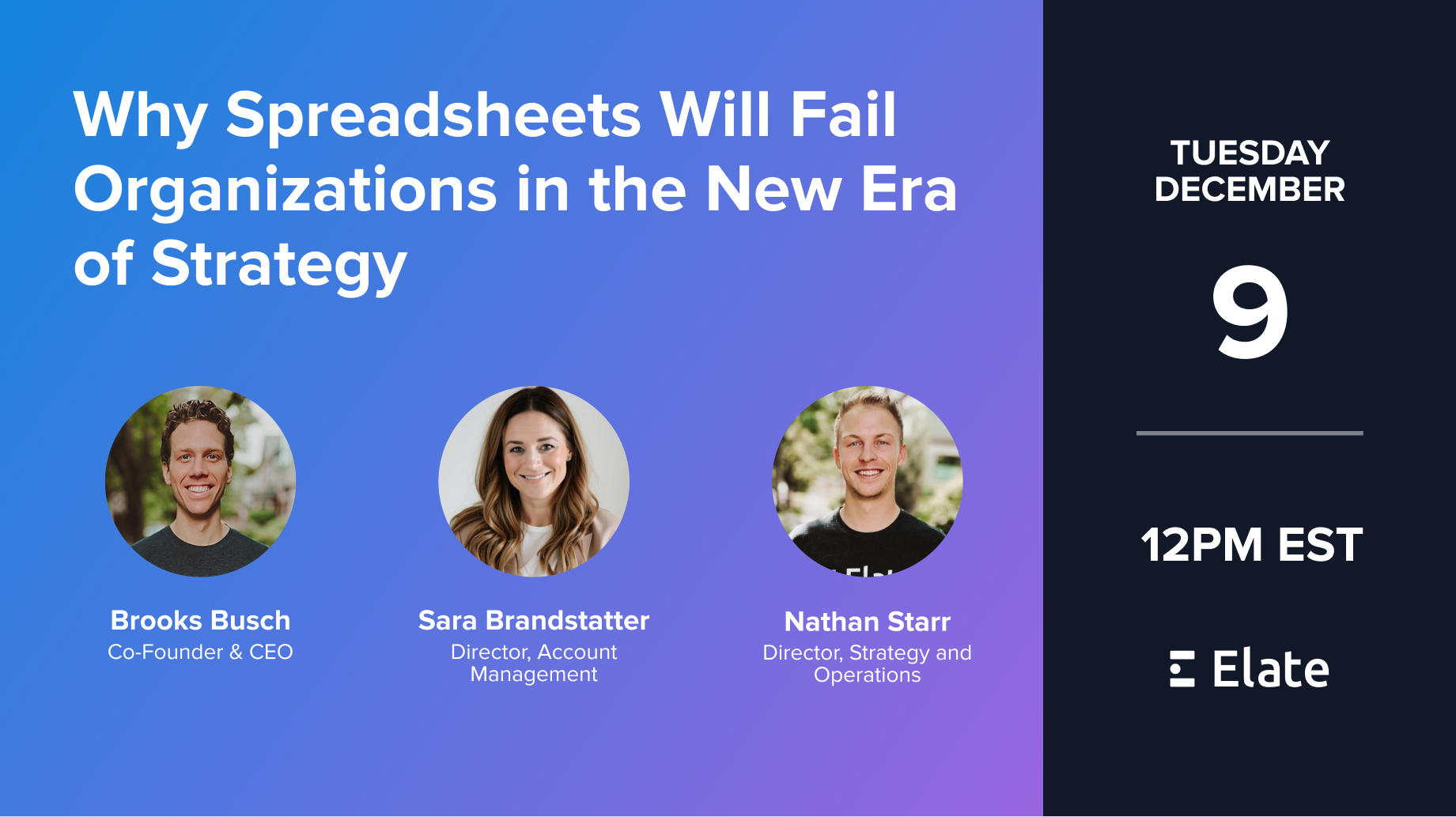
Recording from Last Week's Event on Spreadsheets
As I mentioned, last week, we hosted a webinar unpacking much my thoughts above. We dug into what’s changing in strategy execution, where spreadsheets fall short, and how leaders are starting to adapt. If this content resonates, the recording is worth a watch.
New Strategy Snacks - Bite Sized Videos to Help You Execute
If you follow Elate on LinkedIn, you may have noticed some new clips from conversations between Abby and myself. We’ve been sharing a short series of founder-led videos exploring how Strategy Leaders are navigating this shift in real time. We dig into what’s changing, what’s breaking, and how leaders are rethinking execution. If you want the thinking behind the thinking, they’re worth a watch.