How Strategy Can Bring Clarity to the "Messy Middle"
What You’ll Find Inside:
- 🌪️ Why Growth and Change Expose the “Messy Middle”
- 🔄 How Dynamic Prioritization Keeps Strategy Relevant
- 🔗 Connecting Cross-Functional Work Back to Strategic Outcomes
- ⚡ Reducing Friction by Meeting Teams Where They Already Work
Read time: 7 minutes
—------------------------------------------------------------------------------------------
When we started Elate, it was born out of the pain my co-founder, Abby, and I felt bringing together long-term vision with tactical execution.
In particular, we saw this challenge highlighted most when organizations experience inflection points.
For us, we saw it when the company hit new revenue thresholds. Grew from 20 employees to well over 100+. Or released a new product line into the market.
Times of growth often served as a pressure test to how closely aligned our team was around the direction of the company and vision we were trying to reach.
It was this realization that helped inspire the vision for Elate.
Growing Pains Create Risk and Opportunity
Abby and I recognized that during times of growth or change it’s really easy to see mission drift.
Things like alignment, collaboration, reporting are all just easier when things are calm and it’s smooth sailing on familiar waters.
But when you introduce change, especially in the form of expansion, then it is often accompanied by new initiatives, bigger goals, and more strain on processes that have helped get your credit union to that point.
While Leadership has a front row seat into building the strategy and is often fully aware of the turbulence ahead, that isn’t necessarily the case for the rest of the folks across the credit union.
In fact, this is felt most acutely by employees in the middle layers of credit unions, who are responsible for bridging the gap between the strategic direction set by leadership and the day-to-day work carried out by individual contributors.
Often, Directors and Managers are the ones tasked with communicating ‘what’ and ‘why’ to employees, but they aren’t necessarily privy to the conversations happening at the Leadership level. Which can lead to a misalignment in their own understanding of how priorities might shift as the credit union enters a season of transformation.
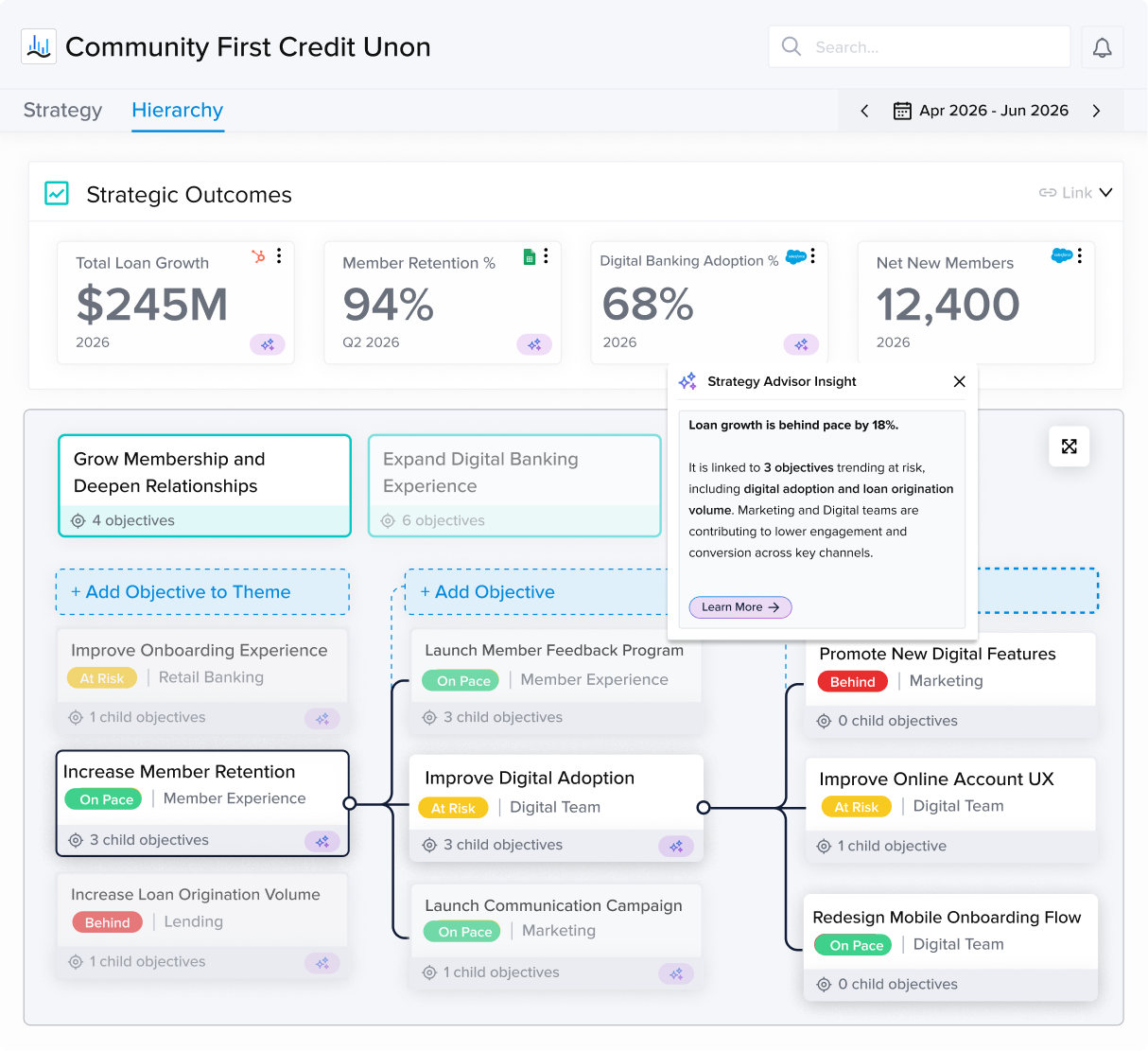
The bridge between the strategy and execution is critical to how credit unions accelerate through inflection points. The stronger the bridge and clearer the communication of priorities, the less friction there will be for team members.
The more people understand the ‘why,’ the more willing they are to embrace the ambiguity that often comes with these inflection points. That shared understanding helps build a culture of resilience, innovation, and openness to new opportunities.
But the risk for most credit unions during these phases of growth is a lack of communication or visibility into the direction.
As leaders, we can bring people along on the journey and rally them around opportunities for progress by clearly communicating where we’re headed and how we plan to get there.
Granted, the plan might change with new information, but that’s okay. Employees tend to have more grace when they know the direction they’re heading.
While the first step is awareness that turbulence often follows growth, the next step is identifying what we can do as Leaders to help navigate it.
Solving for the Messy Middle: Dynamic Prioritization vs Static Planning
At Elate, we believe the best organizations at executing strategy view it as more than a one-time event. In fact, they tend to have an “always on” mindset that helps ensure strategy doesn’t simply collect dust or only get revisited once a quarter.
But to empower your teams to think of strategy as “always on”, rather than a static, arduous process, you have to be willing to create a framework that supports dynamic decision making.
However, this approach can’t live alone at the Leadership level. To fully embrace a dynamic approach to strategy, it has to connect all parts of the organization. Where we see this most commonly fall apart within credit unions is when they try to solve for the “messy middle”.
For those unfamiliar with the term, the “messy middle” can be thought of as the gap between setting a strategy and making it happen. Leadership agrees on where the organization wants to go, but translating that direction into coordinated, day-to-day work gets complicated.
It’s where teams evaluate with questions like:
- Priorities: Which initiatives matter most, and what should we stop doing?
- Ownership: Who is accountable, especially when work runs across departments?
- Resources: Do we have the people, time, and budget to deliver?
- Dependencies: What needs to happen before another team can move forward?
- Trade-offs: How do we handle new requests without losing focus on the plan?
For a credit union, leadership might set a goal to grow deposits by 10%. The messy middle is figuring out how branch operations, marketing, digital, and finance will work together to achieve it, while also managing their existing responsibilities.
Where this is often most felt isn’t during the initial planning process.
But rather, in the middle of the year when the plan needs to change or new initiatives need to be evaluated.
What we always try to remind credit unions of is that initiatives identified and approved during the annual planning process may not remain the best path to achieving and accelerating past the growth goals you originally set.
For the original example of growing deposits by 10%, that could be impacted by a branch opening being delayed, a digital campaign outperforming expectations, or a change in Leadership that might create new gaps or opportunities. The deposit growth objective may stay the same, while the work originally agreed upon might need to adjust.
This is where a dynamic approach to strategy execution will help credit unions bring strategy into ongoing prioritization conversations.
More so, creating a strategic memory that hosts your current strategy and past performance, can also help identify what tactics can be modified or added to help ensure the goals are still hit.
At Elate, we recommend that organizations create a shared language and process around prioritization that starts by evaluating Value and Effort of proposed initiatives.
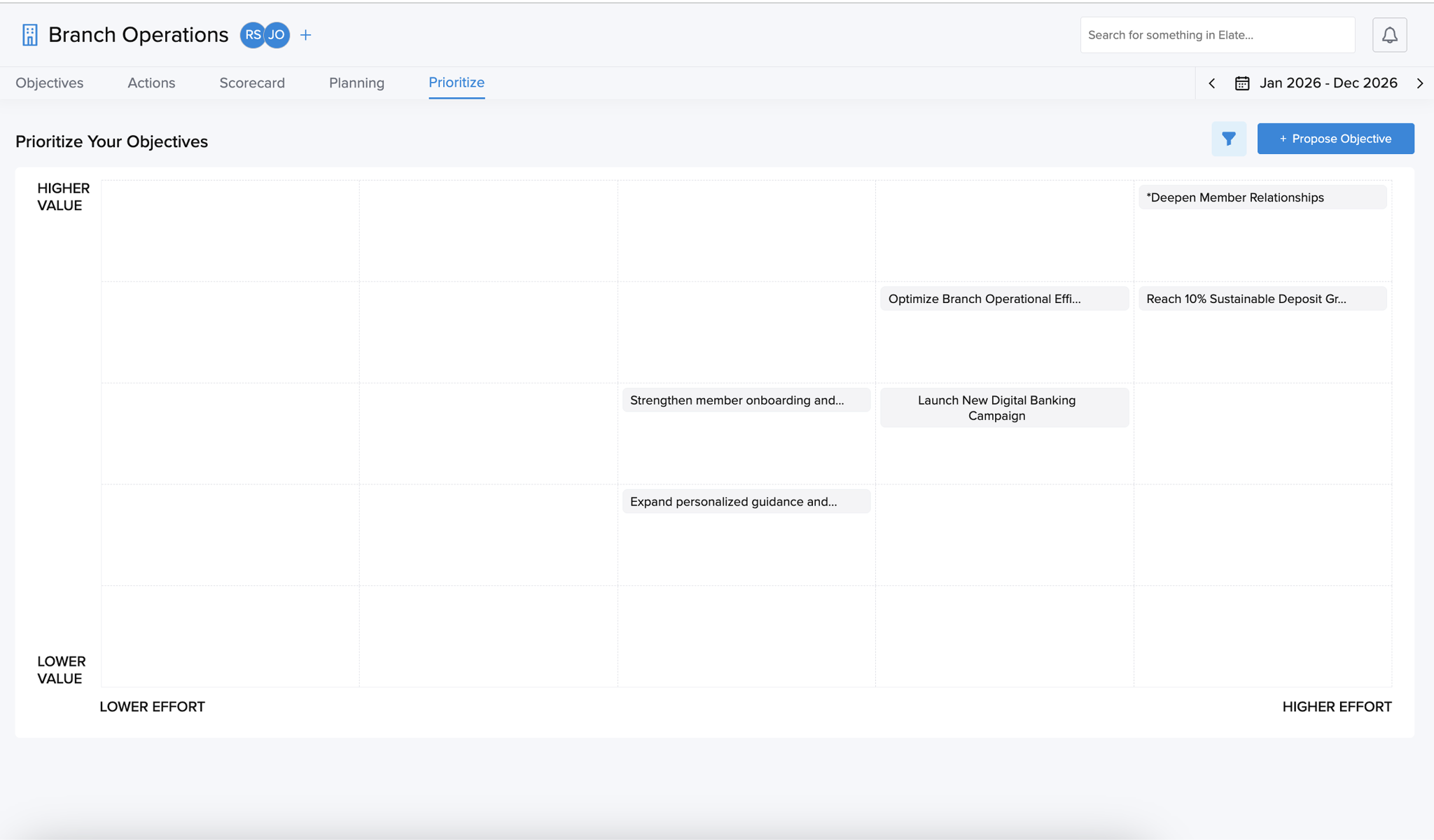
However, to take that one step further, we also recommend that these initiatives don’t simply live in a static tool like Excel or a PowerPoint slide. Why? Well, because the likelihood is that we won’t have a consistent operating rhythm or review process that identifies when the tactics needed to achieve our goals might need to adjust. Or, we want to create a clear path for how team members can propose changes to their initiatives based on what they are seeing from the front lines or that managers are hearing as feedback from their team.
By creating a shared, connected view of initiatives to the outcomes they support and bringing progress, ownership, and dependencies into a shared view, Leadership can assess where to focus and what part of the strategy might need to be adjusted to reach out targets. Should marketing expand a successful campaign? Should branch teams prioritize deepening existing member relationships? What work should pause to make room?
Similarly, this empowers folks living in the messy middle to have a forum where they can feel heard and bring ideas or suggestions to their Leaders. We want our employees to feel empowered to make change, think creatively, and identify where they can make the most use of their team.
That comes through dynamic prioritization.
What this doesn’t mean is we change the strategy constantly or without a review process.
But dynamic prioritization helps teams stay committed to the outcome while adapting the work that gets you there. The strategic plan becomes a framework for making those decisions throughout the year, with teams aligned on what matters most and why priorities have changed.
Reduce the Messy Middle by Meeting Employees Where they Work
Last but not least, I want to reiterate the importance of bringing this process into channels where work is already done.
If we want to be more dynamic in how we go about prioritizing work or making decisions, then we can’t add more tools and processes. We have to think about shifting time away from manual processes like status updates, building reports, or multiple meetings to even try to understand the impact of initiatives across multiple departments, and towards driving action. Whether it be removing hurdles from team members, reallocating IT resources, or modifying budgets, the reality is that we want to create a bias to action that is seen and felt through the organization, not add more yellow tape.
Which is why at Elate we emphasize the importance of creating a framework for strategy that is simple, intuitive, and easy to scale. This framework serves as the foundation to amplify the impact of strategy by connecting KPIs through integrations, integrating to tools like CoPilot, ChatGPT, or Claude to simplify visualization, and provides meaningful updates to initiatives that considers risk across all other areas of the plan in seconds.
To reduce the messy middle, we want to shift employees' time away from where they feel weighted down, and instead allow them to focus on what you’ve hired them for: to innovate, problem solve, and lead.
More on that to come in the next edition of the Pulse, but for now, please don’t hesitate to reach out if you’d like to better understand how Elate partners with credit unions to help provide visibility and clarity to the messy middle.
The Pulse: Strategy Insights for Credit Union Leaders
For nearly eight years, Elate has served leading global organizations. However, our work in the credit union industry has been an area of focus that has reshaped our direction as a company. From working with countless leaders in the space, we have some exciting announcements in the weeks ahead, transforming everything from our product roadmap, to our vision for Elate.
But to begin that journey, we’re elated (had to do it) to bring The Pulse to credit unions, sharing insights, content, and resources specifically for credit union leaders to help you and your team move faster and deliver on the initiatives moving your organization forward.
If you’re interested in staying connected to the ideas, trends, and lessons shaping strategy across the credit union industry, we’d love to have you join us.