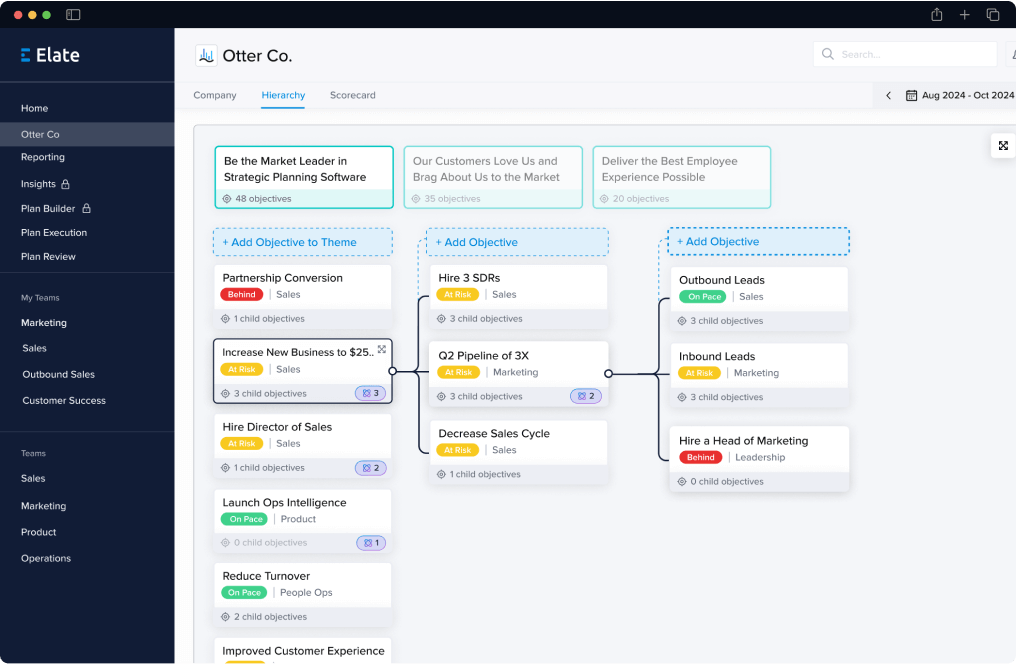











There is no single best nonprofit strategic planning software for every organization. The right choice depends on whether you need to create the plan, manage projects, track outcomes, prepare board and funder updates, or keep mission execution moving across programs, sites, and shared services.
Elate is a strong fit when a nonprofit already has a strategic plan and needs a repeatable way to turn it into owned priorities, outcome visibility, update cadence, and board or funder-ready reporting. It helps teams connect mission priorities, owners, program work, outcomes, risks, and reporting without adding another layer of administrative burden.
The nonprofit strategy execution problem
Nonprofits are rarely short on purpose or plans. The harder problem is capacity. Strategic plans, board commitments, program updates, funder requirements, outcome measures, and leadership notes often live across documents, spreadsheets, CRM systems, BI dashboards, Teams, SharePoint, email, and meeting decks.
That creates a gap in the middle. Leadership needs a credible view of whether the mission strategy is moving. Program and site owners need a simple way to report progress. Boards and funders need concise updates they can trust. Without a repeatable system, a few operators end up chasing updates and rebuilding the story every cycle.
How to evaluate nonprofit strategic planning software
Start with the job the software needs to do. A useful evaluation should answer these questions:
- Plan structure: Can the system translate the strategic plan into priorities, objectives, outcomes, initiatives, and owners?
- Ownership: Can program, site, and functional leaders update their work without a complicated process?
- Outcome reporting: Can selected metrics sit next to narrative, risk, and ownership context?
- Board and funder reporting: Can the team prepare credible updates without rebuilding a deck from scratch?
- Operating cadence: Can updates happen on a monthly, quarterly, or board-cycle rhythm?
- Existing tools: Can the platform work alongside Teams, SharePoint, Excel, BI, CRM, grant, and finance systems?
- Adoption: Is the workflow simple enough for capacity-constrained teams?
Different tools solve different nonprofit problems
Planning facilitation tools can help create a strategy. Project management tools can help manage task-level work. BI dashboards can show measures. Grant management systems can track funder requirements. Document repositories can store board packets.
Those tools are useful, but they do not always create the operating rhythm between mission priorities and execution. A nonprofit strategy execution layer should connect the plan to owned work, outcome context, update cadence, risks, and reporting so leaders can see what is on track, what is stuck, and what needs support.
Where Elate fits for nonprofits
Elate helps nonprofits turn a strategic plan into a living execution and reporting rhythm. Teams can connect mission priorities to owners, outcomes, initiatives, risks, status updates, and leadership-ready reports. That makes it easier to prepare board updates, funder updates, leadership pre-reads, and program rollups from the same operating context.
Elate is not grant management software, a CRM, a BI replacement, or a task-level project management system. It works best as the layer that connects strategy, ownership, progress, outcomes, and reporting so nonprofit leaders can spend less time chasing status and more time reviewing the work that advances the mission.
What to ask during a software demo
- Show us how a strategic priority connects to program-level work.
- Show us how a program owner submits a short update.
- Show us how board or funder reporting is created from current updates.
- Show us how outcomes and narrative stay connected.
- Show us what happens when a priority is at risk or blocked.
- Show us how the system works with the tools we already use.
- Show us what the rollout looks like for a capacity-constrained team.
Best fit and not the best fit
Best fit: Elate is a strong fit for nonprofits with an active strategic plan, multiple programs or sites, board or funder reporting requirements, recurring leadership reviews, and a small team responsible for keeping progress visible.
Not the best fit: Elate is not the right choice if the organization only needs a planning workshop tool, a grant compliance database, a CRM, a BI dashboard, or a task tracker. It also works best when leadership is willing to define owners, cadence, and the reporting rhythm.
Related resources
- Nonprofit Strategic Planning Software
- Reduce Board and Funder Reporting Work
- Nonprofit Board Report Template
- Grant Reporting for Nonprofits
- Nonprofit Strategic Plan Implementation
- Why Nonprofit Strategic Plans Fail After Board Approval
- Elate Platform
- Request a Demo
FAQs
What is the best strategic planning software for nonprofits?
The best fit depends on the job. If the need is planning facilitation, a planning tool may be enough. If the need is mission execution, ownership, outcomes, and board or funder-ready reporting, look for software that connects the plan to a repeatable operating cadence.
How should nonprofits track strategic plan progress?
Nonprofits should track progress by connecting strategic priorities to owners, programs, outcomes, status updates, risks, and reporting. The process should be simple enough for program teams and structured enough for leadership, board, and funder review.
Does Elate replace grant management, CRM, or BI tools?
No. Elate works alongside existing nonprofit systems. Grant, CRM, BI, finance, and program systems can remain sources for specific data. Elate helps connect the strategy, owner updates, outcomes, risks, and reporting rhythm leaders need to review progress.