Nonprofit Strategy Execution Playbook
Nonprofit strategy execution is a capacity problem before it is a software problem. A useful system gives leaders the board and funder-ready story without asking program teams to add another heavy reporting layer. Elate helps nonprofits connect mission priorities, owners, program updates, outcomes, risks, and board/funder-ready reporting while keeping existing tools in place.
Why Nonprofit Strategy Execution Breaks Down
We recently asked a nonprofit COO a simple question:
“Across the org, how are you keeping people aligned to the right priorities and tracking initiatives?”
His answer was immediate:
“Zero.”
Not “we’re struggling.” Not “we’re in the middle of fixing it.”
Zero.
And if you’ve worked inside a growing nonprofit, you know what that usually means: the work is getting done, but the system is informal. Priorities live across grant trackers, email threads, meeting notes, and a few people’s mental dashboards.
That can work for a while. But if you’re reading this, you can probably feel the point where it stops working.
TL;DR
- Many nonprofits unintentionally build their operating model around grants.
- Informal execution systems work until complexity increases.
- Traceability, not task tracking, drives visibility.
- Clear ownership and operating rhythm prevent action items from disappearing.
Nonprofit strategy execution is the process of translating mission priorities into owned objectives, connected initiatives, and a repeatable operating rhythm. When nonprofits rely on informal systems like grants, spreadsheets, and meetings to coordinate work, visibility and follow-through break down as complexity grows. This playbook outlines a simple execution framework that helps leadership surface risk earlier, improve accountability, and run the plan like a system.
Quick Check: Are You Running a “Grants + Email” Operating Model?
If any of these below are true, you’re not alone. And you’re not behind. You’re just running on an execution system that doesn’t scale:
- You leave meetings with a list of action items, but no consistent way to capture them, assign ownership, and follow up
- Reporting takes longer than it should because updates have to be chased down manually
- Cross-functional work (security, IT, vendors, internal ops) drifts because it doesn’t belong to a single program
- Leadership decisions happen late, because risks surface late
This is the nonprofit execution trap. And it’s more common than most organizations realize.

The Pattern: When Grants Become the Operating System
In nonprofits, funding isn’t just money. It shapes how work enters the organization.
Grants create commitments → Commitments create deliverables → Deliverables create work → Work creates reporting.
Over time, the organization becomes excellent at delivering on grant requirements, and unintentionally builds an operating system around them. The result is a lot of motion, but not always a clear answer to leadership-level questions like:
- What are the most important priorities right now?
- What’s actually on track vs. green because no one wants to raise their hand?
- Where are we exposed?
- What’s falling through the cracks because it spans teams and doesn’t have clear ownership?
The problem is that the work isn’t connected in one place - so you can’t see priorities, progress, and risk in one sweep. Those answers have to be stitched together manually, every time. And that “manual stitching” isn’t just annoying. It creates the most expensive kind of execution gap.
The Hidden Cost of Informal Execution
You feel that gap most in the follow-through.
Meetings produce action items. Everyone agrees they matter. And then the action items disappear into the great unknown: personal notes, a follow-up email, a spreadsheet.
That’s how execution slowly breaks down, even inside high-performing organizations. Especially when those organizations are busy. And “busy” is basically the default setting in nonprofits.
So the plan becomes a set of good intentions, and leadership becomes an endless loop of re-explaining priorities, chasing updates, and finding out late that something slipped.
Why Project Management Tools Don't Fix Nonprofit Execution
A common move at this stage is usually to implement a project management tool. And it’s not wrong. Project management tools like Monday or Microsoft Planner can absolutely help teams coordinate tasks.
But nonprofits don’t only need task tracking. They need the ability to run the organization with a shared view of priorities, progress, and risk.
Risk in particular is a big gap. Not avoiding it completely, but being more “risk mindful.” In other words: consolidating what’s at risk, surfacing it earlier, and addressing it while there are still options.
That’s the difference between managing work and running the organization.
Most orgs feel that gap most when they try to solve an execution problem with a task tool. They get better at organizing work, but leadership still struggles to answer: What’s changing? What’s drifting? Where do we need decisions, tradeoffs, or support?
The Inflection Point: When Informal Systems Stop Scaling
Nonprofits will reach a point where “keeping a list” stops working.
It usually shows up during growth or transition - new leadership roles, new fundraising goals, modernizing systems, adding partnerships, and increasing operational complexity.
At that point, it’s no longer realistic for one or two people to “hold it all” mentally. The cost of missing something increases, and leaders need priorities and progress visible in one place, not spread across conversations and documents.
The Fix: Moving from Tracking to Traceability
One line from the conversation hit the nail on the head:
“We’re technical minded, but we’re not traceability minded.”
That’s such a good description of the gap.
A lot of nonprofits can deliver complex programs, manage compliance, and coordinate stakeholders. But they lack traceability, or the ability to reliably connect:
What leadership says matters → what teams are doing → what outcomes are changing → what risks are emerging → what decisions need to happen next.
That’s what turns strategy from a document into an operating system. And you don’t need a perfect framework to start. You need a simple structure and a cadence.
A Simple Nonprofit Execution Model
Here’s a structure we see work well, especially for nonprofits who are starting from zero.
1. Start with Focus Areas (your mission priorities)
Think of these as the few “rallying cries” leadership wants the organization to orient around this year. Keep it to 3-5, and use language your org already uses.
Common trap: Making these too broad (“Excellence”) or too many (12 pillars = no prioritization).
Rule of thumb: If someone can’t repeat them from memory after hearing them three times, there are too many.
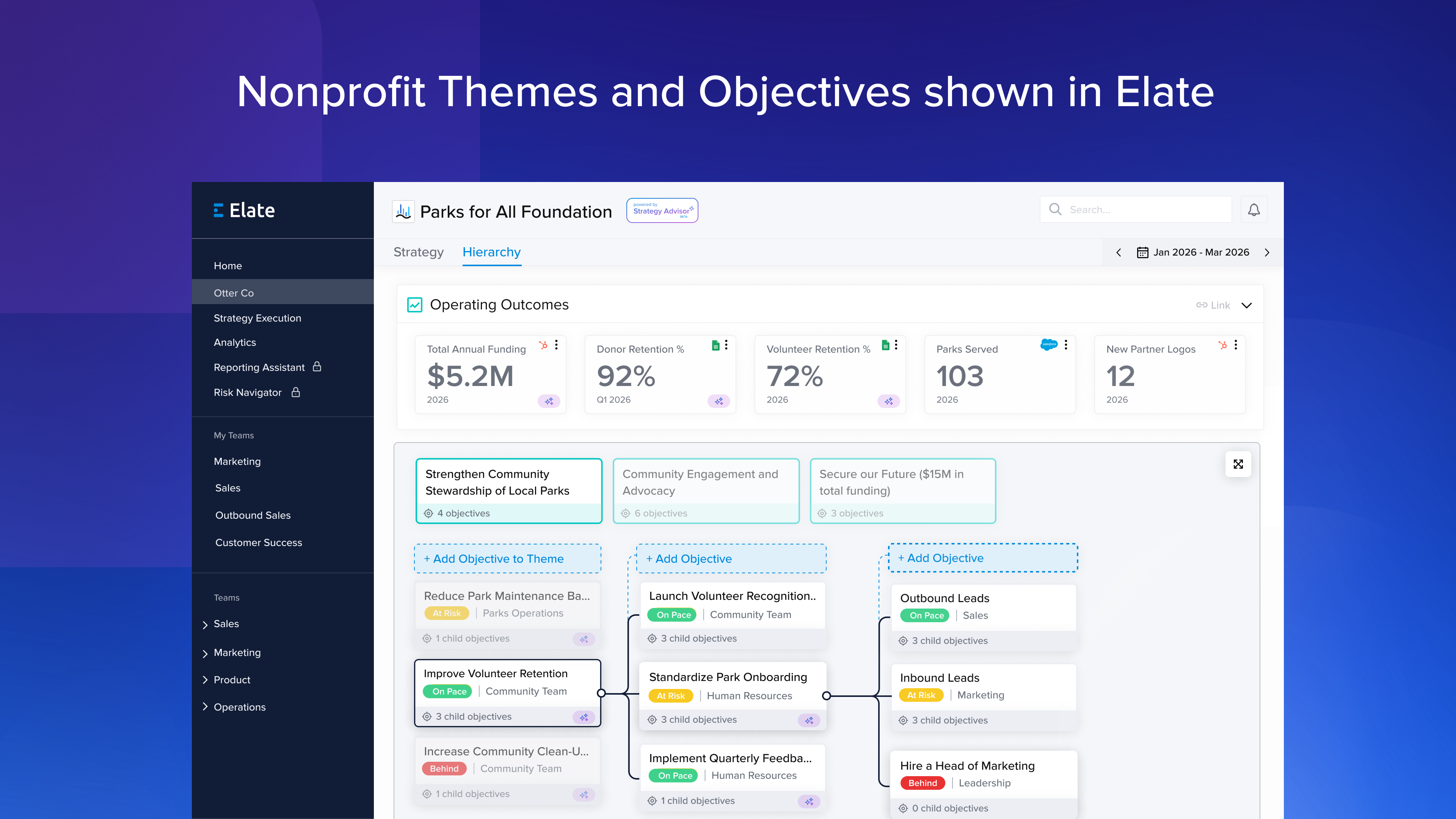
2. Define Objectives (the measurable change you’re aiming for)
Objectives are not the work. They’re the change you want to see because of the work.
This is where nonprofits get stuck, because grant deliverables are easy to list, whereas outcomes take a little more thought. But you don’t need perfect measures on day one. You just need Objectives that are directional, testable, and specific enough to make tradeoffs.
A simple Objective test: If you can complete it and not see the impact… it’s not an Objective.
Common trap: Writing Objectives that are really activities (“Launch a new initiative…”). Better: “Launch New Initiative to Increase X by Y,” with clear measures of success and supporting work underneath.
3. Connect Tactics to those Objectives
This is where everything finally has a home - grant-funded projects, operational work, cross-functional initiatives, and “important but no one owns it” stuff like security, systems, preparedness, or a new HRIS.
Each tactic should answer:
- Which Objective does this support?
- What does “done” mean?
- What does “progress” look like?
Why this matters: This is how you stop having a long list of work that feels important, but can’t be prioritized when capacity gets tight.
Common trap: Treating tactics list like a dumping ground. If something can’t be tied to an Objective, it should trigger a Leadership decision: is this actually a priority or just noise?
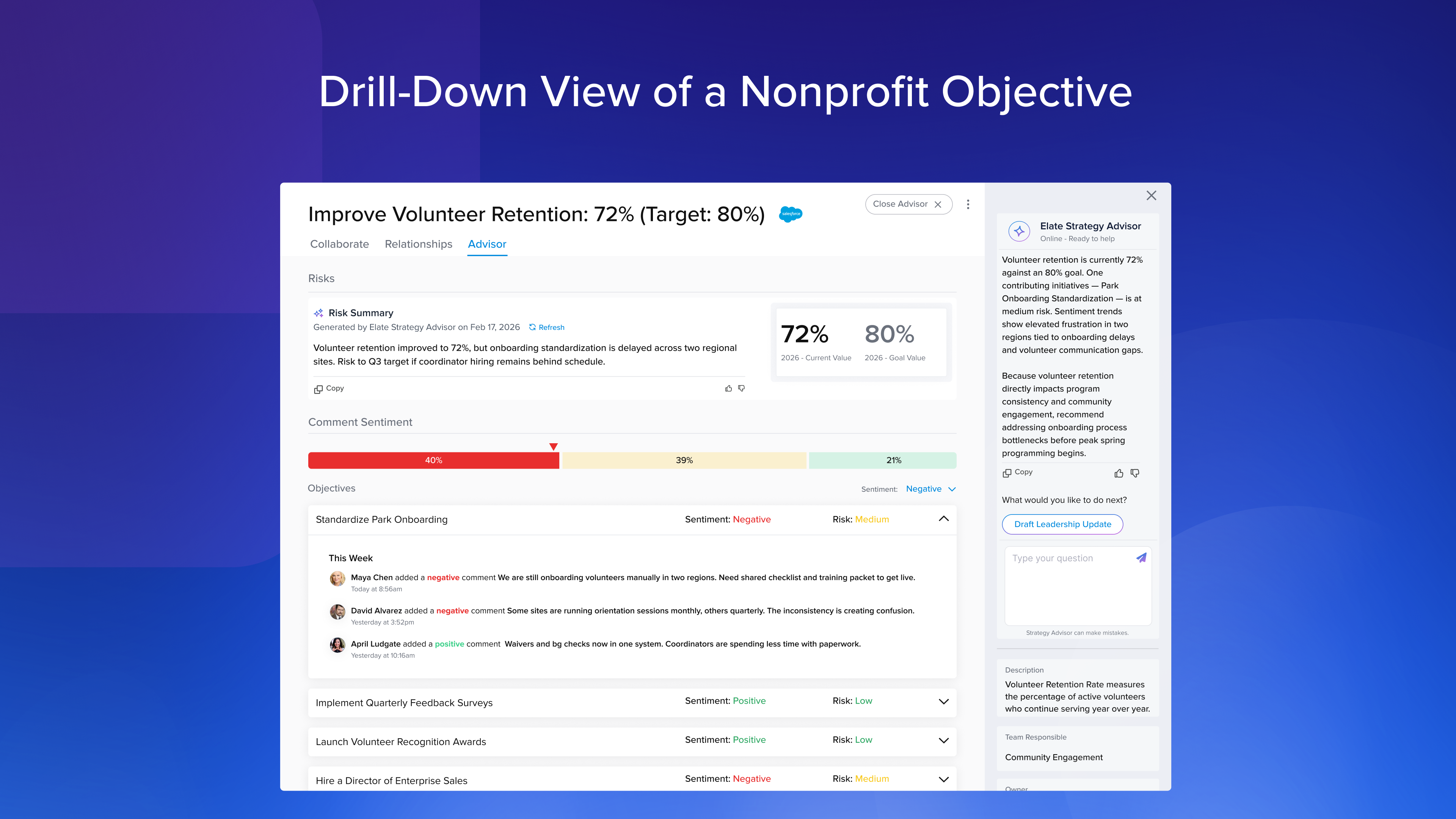
4. Assign Ownership at the Objective Level
Tasks move. Teams shift. A funder changes requirements. A staff member leaves. If ownership only exists at the task level, execution breaks the moment anything changes.
Objective-level ownership creates continuity.
What “ownership” means:
- One person is accountable for progress (even if they don’t do all the work)
- They’re responsible for updates and surfacing risk early
- They can escalate tradeoffs when capacity or priorities conflict
Common trap: “Everyone owns it” (which usually means no one owns it).
A good standard: Every Objective should have exactly one named owner, and every tactic should have a directly responsible lead.
5. Add a Lightweight Operating Rhythm
The goal of the rhythm isn’t status updates. It’s to create an early-warning system so Leadership sees drift, risk, and blockers while there’s still time to do something about it. Or, better yet, opportunities as they present themselves.
What we see works well:
- Weekly or bi-weekly check-ins
- Async updates for progress
- Live time reserved for decisions and trade-offs
Common trap: Using live time for updates that could’ve been shared ahead of time. When that happens, risk stays hidden and decisions get pushed.
This system is where strategy execution becomes meaningfully different from task tracking: because you’re building a way to run the plan, not just manage a to-do list.
The Playbook: A 30-Day Nonprofit Execution Plan
If you’re looking for something concrete, here are five moves nonprofits can make quickly without turning this into a massive change initiative:
1. Pick one place the plan lives
Not perfect, just centralized. The goal is to end the “every Leader has their own source of truth” problem.
2. Capture action items where they can’t disappear
If meetings produce work, that work needs a system. Make sure your action items live somewhere other than notes, emails, or spreadsheets.
3. Move ownership up a level
Assign ownership to the Objective or Tactic, not just tasks. This is how priorities stay stable even when details change.
4. Create a cadence that reduces update-chasing
Move toward async updates and shared visibility so live meetings can be about decisions and tradeoffs.
5. Consolidate risks across programs
Risk isn’t a sign of failure, it’s information. When risks are centralized, Leadership can intervene earlier, with more options.
What Changes When You Run Strategy Like a System
When nonprofits move from “grants + email” to a real execution system, a few things happen quickly:
- Leadership can see priorities without stitching together status from five different meetings or documents.
- Teams have clarity on what matters most (and what doesn’t).
- Risks surface earlier while they’re still solvable.
- Reporting becomes faster and more useful because it’s connected to real work.
- Strategic storytelling improves because you can trace plans → actions → outcomes (instead of guessing).
And most importantly: this is a behavior and mindset shift, not just a software one. Tools don’t fix execution by themselves. But the right system does create the conditions for better execution, and a way of working that protects the mission by making focus and follow-through easier.
If your nonprofit is growing, adding programs, modernizing systems, or simply feeling the strain of “too many priorities and not enough visibility,” you’re not behind. You’re at the point where informal execution stops scaling, and building an operating system becomes part of taking the mission seriously without burning out your team.
If you’re at this inflection point and want to stress-test your execution system, we’d love to talk. We’ll share what we’re seeing across other nonprofits and walk through how Elate can support the cadence, visibility, and risk tracking described here.
Frequently Asked Questions About Nonprofit Strategy Execution
What is nonprofit strategy execution?
Nonprofit strategy execution is the process of translating mission priorities into owned objectives, connected initiatives, and a repeatable operating rhythm that leadership can see and manage.
Why do nonprofits struggle with execution?
Many nonprofits rely on grants, spreadsheets, and meetings as their informal operating system. As complexity grows, visibility and ownership become fragmented, making follow-through difficult.
How is nonprofit execution different from project management?
Project management tools track tasks. Nonprofit execution systems connect priorities, initiatives, ownership, outcomes, and risk across the organization.
What is an operating rhythm in a nonprofit?
An operating rhythm is a structured cadence of updates and decision-making that ensures progress and risks are visible before issues escalate.
How can nonprofits improve execution without adding bureaucracy?
By centralizing priorities, assigning ownership at the objective level, and creating lightweight update cadences that reduce manual chasing.