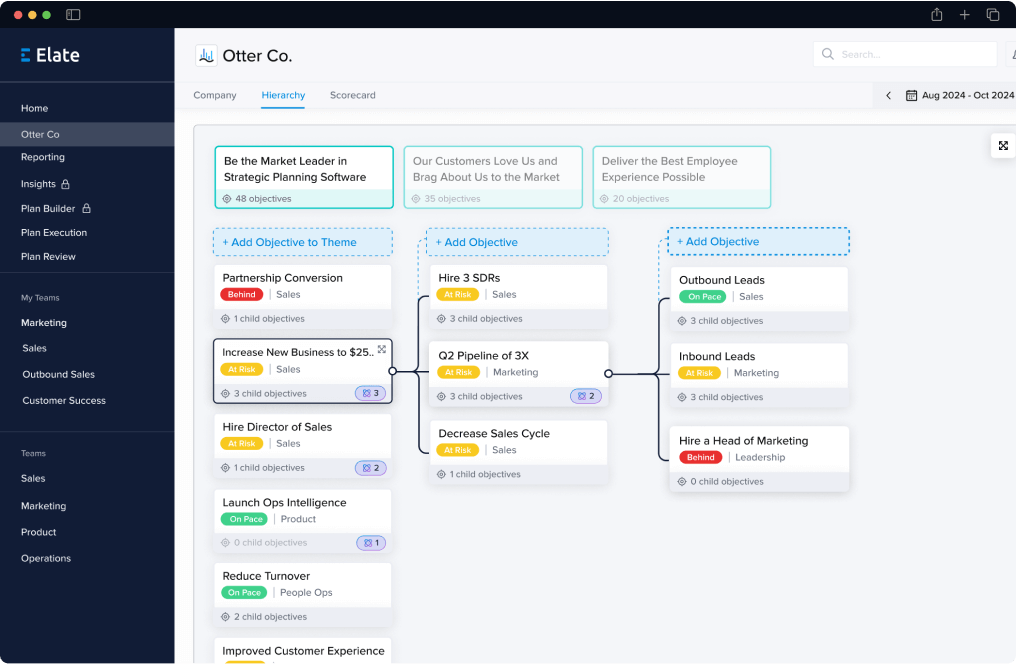











A higher education strategic plan progress report should help leaders understand what changed, what is on track, what is at risk, and what needs attention before the next review cycle. The strongest reports combine KPI plus narrative, evidence, ownership, risks, and next actions.
Elate helps higher education teams turn strategic plan updates into cabinet and trustee-ready reporting by connecting priorities, owners, selected KPIs, narrative updates, institutional effectiveness evidence, risks, and reporting cadence. It works alongside the systems that already hold the data.
What the report should accomplish
The report should not be a glossy recap or a data dump. It should make progress reviewable. Cabinet, trustees, institutional effectiveness teams, and strategy leaders usually need different levels of detail, but they all need the same operating story.
- What changed since the last review? Summarize progress, delays, decisions, and new risks.
- Which priorities are on track or at risk? Use consistent status language across units.
- Which KPIs matter for this audience? Curate a small set of metrics and explain the narrative behind them.
- What evidence supports the update? Connect progress to institutional effectiveness, assessment, accreditation, or operating evidence where relevant.
- Who owns the next step? Make ownership clear before the report reaches cabinet or trustees.
A practical report structure
- Executive summary: the most important progress, risks, and leadership asks.
- Progress by strategic priority: status, owner, update, KPI context, evidence, and next action.
- KPI plus narrative view: selected indicators paired with explanation, not raw dashboard screenshots.
- Evidence and artifacts: links or references to supporting evidence, assessment findings, reports, or institutional data.
- Risks and blockers: items that need cabinet attention, resource decisions, or cross-unit coordination.
- Roll-forward actions: what carries forward, what changes, and what needs review before the next cycle.
Cabinet report vs trustee report
A cabinet progress report can include more operational context because the audience owns the work. It should help leaders decide what to unblock, escalate, fund, adjust, or stop.
A trustee progress report should be more concise. Trustees need a clear pre-read that shows progress against the institutional plan, highlights major risks, and explains the leadership actions underway. They usually do not need every department update or raw internal commentary.
How to use KPI plus narrative
KPI plus narrative is important because many higher education metrics need context. Enrollment, retention, student success, fundraising, budget, academic program, and operational measures can sit in Power BI, Tableau, SIS, ERP, spreadsheets, or institutional research systems. The progress report should connect a selected metric to the priority, owner, explanation, and action.
A useful format is simple: metric, current direction, narrative explanation, owner, risk, and next action. That gives leaders enough context to review progress without asking the data team to rebuild the story every cycle.
Where Elate fits
Elate is useful when the institution already has plans, data, dashboards, and reporting requirements, but lacks a consistent operating rhythm for collecting owner updates and turning them into leadership-ready reports. It helps teams connect strategy execution with evidence, ownership, cadence, and reporting.
Elate is not a replacement for SIS, ERP, Power BI, Tableau, accreditation, assessment, or institutional research systems. Those systems remain important sources of data and evidence. Elate sits above them as the strategy execution and reporting layer that connects selected inputs to reviewable progress.
Best fit and not the best fit
Best fit: Elate is a strong fit for colleges and universities that need cabinet or trustee-ready strategic plan reporting, cross-unit owner updates, institutional effectiveness evidence, KPI plus narrative, and a repeatable review cadence.
Not the best fit: Elate is not designed to replace accreditation systems, student information systems, ERP, BI, assessment tools, or project management software. It works best when the institution needs to connect those inputs to strategic ownership and reporting.
Questions to ask before sending the report
- Does the report make it clear what changed since the last review?
- Can leaders see which priorities are at risk and why?
- Are KPIs paired with narrative context?
- Is institutional effectiveness evidence preserved and easy to reference?
- Does each priority have a visible owner and next step?
- Is the trustee version concise enough to be consumed as a pre-read?
Related resources
- Higher education strategic plan reporting software
- University trustee strategic plan reporting software
- Institutional effectiveness strategic plan progress software
- Annual strategic plan progress report template for university trustees
- Best higher education strategic planning software
- Request a product demo
FAQ
What should a higher education strategic plan progress report include?
It should include strategic priorities, status, KPI plus narrative, owner updates, institutional evidence, risks, blockers, decisions, and next actions. The detail level should change based on whether the audience is cabinet, trustees, or internal operators.
How often should a university report strategic plan progress?
The cadence should match the governance rhythm. Many institutions use monthly or quarterly cabinet reviews, trustee pre-reads tied to board meetings, and annual or semiannual public progress updates.
How is a progress report different from a dashboard?
A dashboard usually shows metrics. A progress report should explain the operating story behind the metrics: what changed, why it changed, who owns the next step, and what leadership should do.
Can Elate support institutional effectiveness reporting?
Elate can help institutional effectiveness and strategy teams connect evidence, KPIs, owners, narrative updates, risks, and leadership-ready reporting while existing assessment, accreditation, BI, SIS, and ERP systems remain in place.