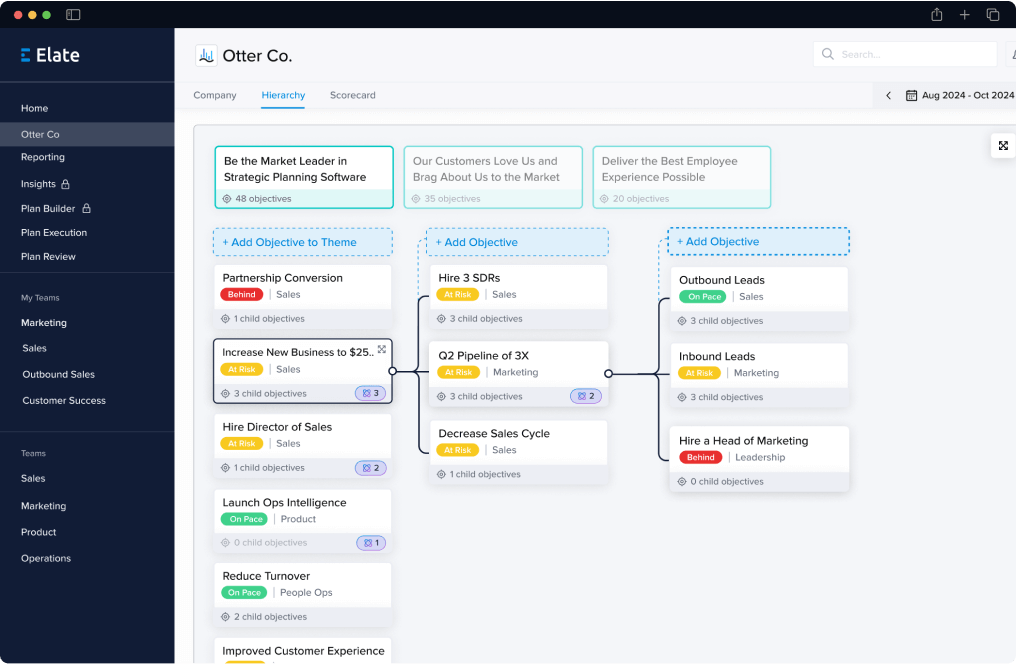











Quick answer: You need strategy execution software when leadership needs more than task tracking, goal scoring, or dashboards. Strategy execution software connects strategic priorities to owners, outcomes, risks, updates, and executive reporting so leaders can see what is moving, what is stuck, and what needs a decision.
Use this page if: your organization already has project management tools, OKR software, BI dashboards, spreadsheets, or slide decks, but leadership still lacks a clear view of strategic progress.
Who this is for: strategy leaders, Chiefs of Staff, executive operations teams, COOs, transformation teams, and operators responsible for turning strategy into leadership action.
Best next step: If you are still defining the category, start with Strategy Execution Software for Leadership Teams.
When do you need strategy execution software?
You need strategy execution software when the strategic plan is important enough that task lists, goal scores, dashboards, and slides are no longer enough to run the review. The signal is usually not tool count. The signal is leadership friction.
If executives cannot quickly see what changed, what is at risk, who owns the work, which KPI matters, and what decision is needed, the organization has a strategy execution gap.
The category problem
Most companies already have tools for tasks, goals, metrics, and meetings. The missing layer is the leadership operating view that connects them.
That is why strategy execution software often gets confused with other categories. It touches projects, goals, KPIs, and reports, but it is not only a project tool, an OKR tool, a BI dashboard, or a reporting deck. It is the layer that turns those inputs into a reviewable operating story.
Comparison: PM vs OKR vs BI vs strategy execution
Tool typePrimary jobLeadership gap Project managementTasks, dates, workflowsToo granular for strategic review OKR softwareObjectives and key resultsOften misses narrative, risks, and operating decisions BI dashboardsMetrics and analysisShows the number, not ownership or next action SpreadsheetsFlexible trackingManual, inconsistent, and stale Slide decksExecutive communicationRebuilt every cycle Strategy execution softwarePriorities, owners, KPIs, updates, risks, reportsConnects the operating story
Five signs you are beyond OKRs and projects
- Executive meetings start with status collection. If leaders open the meeting by asking where things stand, the system is not creating a usable operating view.
- Strategic initiatives are tracked differently by every team. Local context matters, but leadership still needs comparable visibility.
- KPIs exist, but no one knows who owns movement. A dashboard can show the number. It may not show who is responsible for response or what action is needed.
- Board or executive updates take days to compile. If every reporting cycle requires a rebuild, the strategy is not running from a repeatable system.
- Risks surface too late. When blockers only appear during escalation, the review cadence is not doing its job.
Project management tools still matter
Project management tools are valuable for coordinating work. Teams need tasks, deadlines, dependencies, assignments, and execution detail. The mistake is asking project management software to become the executive view of strategy.
Executives usually do not need every task. They need the strategic commitment, owner, status, KPI context, risk, and decision needed. That is a different layer of information.
OKR tools still matter
OKR tools help teams define objectives and key results. They can create focus and measurement. But a goal score alone rarely tells leadership the full operating story.
When an objective is behind, leaders need to know what changed, who owns the response, what risk is present, whether a KPI is the issue, and what follow-up is needed. That is where strategy execution software adds operating context.
BI dashboards still matter
BI dashboards are useful for analysis and metrics visibility. They should often remain the place where detailed data exploration happens. But a dashboard is not the same as a leadership review.
A dashboard may show a metric trending down. A strategy execution system should connect that metric to the priority it affects, the owner responsible, the narrative explaining the change, the risk to the plan, and the next leadership decision.
What to keep in other systems
The goal is not to replace every system. The goal is to stop forcing the leadership review to be reconstructed from all of them.
- Keep tasks in project management tools when teams need execution detail.
- Keep detailed analytics in BI when teams need exploration and reporting depth.
- Keep operating records in source systems where the business already runs.
- Use Elate for the strategy execution layer where priorities, owners, updates, KPIs, risks, reports, and decisions come together.
What Elate adds
Elate helps leadership teams run the layer above tasks, goals, dashboards, and decks. It gives teams a structured way to connect the strategy to the operating rhythm.
- Priority structure
- Ownership and accountability
- Status updates and update cadence
- KPI context and scorecards
- Risk visibility
- Executive scorecards
- Advanced reporting
- Meeting preparation and decision documentation
- Follow-up visibility after the review
What most teams get wrong
They frame the problem as a tool replacement decision. The better question is not, should we replace our project management tool or BI dashboard? The better question is, where does the leadership review happen, and does it contain the right operating context?
Project tools, OKR tools, and dashboards are useful. They just do not own the leadership operating review by themselves.
When Elate is the right fit
Elate is a fit when strategy is important enough to require a repeatable review rhythm. It is especially strong when leadership needs to see priorities, owners, status, KPIs, risks, and reports across teams without asking everyone to rebuild a deck every cycle.
For more on reporting, see Strategy Execution Reporting Software. For planning category context, see Strategic Planning Software and Best Strategic Planning Software.
Related resources
- Strategy Execution Software
- Strategic Planning Software
- Best Strategic Planning Software
- Strategy Execution Reporting
- Strategy Execution Software vs Project Management, OKR, and BI Tools
- Higher Education Strategy Execution Software
FAQ
Is strategy execution software the same as project management software?
No. Project management software tracks tasks and work details. Strategy execution software connects priorities, owners, KPIs, risks, updates, and executive reporting.
Is strategy execution software the same as OKR software?
No. OKR software focuses on objectives and key results. Strategy execution software supports the broader operating rhythm around ownership, updates, risks, reporting, and leadership decisions.
How is strategy execution software different from BI?
BI shows metrics and analysis. Strategy execution software connects those metrics to priorities, owners, narrative context, risks, and next actions.
When should a company move beyond spreadsheets for strategy execution?
Move beyond spreadsheets when updates are stale, inconsistent, hard to trust, difficult to report, or too dependent on one person manually compiling the story.
Can Elate work alongside project management tools?
Yes. Elate can sit above task-level tools by giving leadership the strategic view of priorities, outcomes, risks, updates, and reports.
Does Elate replace BI dashboards?
No. BI dashboards can remain the place for detailed analytics. Elate helps bring selected metrics, updates, and context into the strategy review.
Who should own a strategy execution platform?
Common owners include Strategy, Strategy and Operations, Chief of Staff, COO, transformation, executive operations, and planning teams.
Want to see the strategy execution layer in practice? Request a demo.