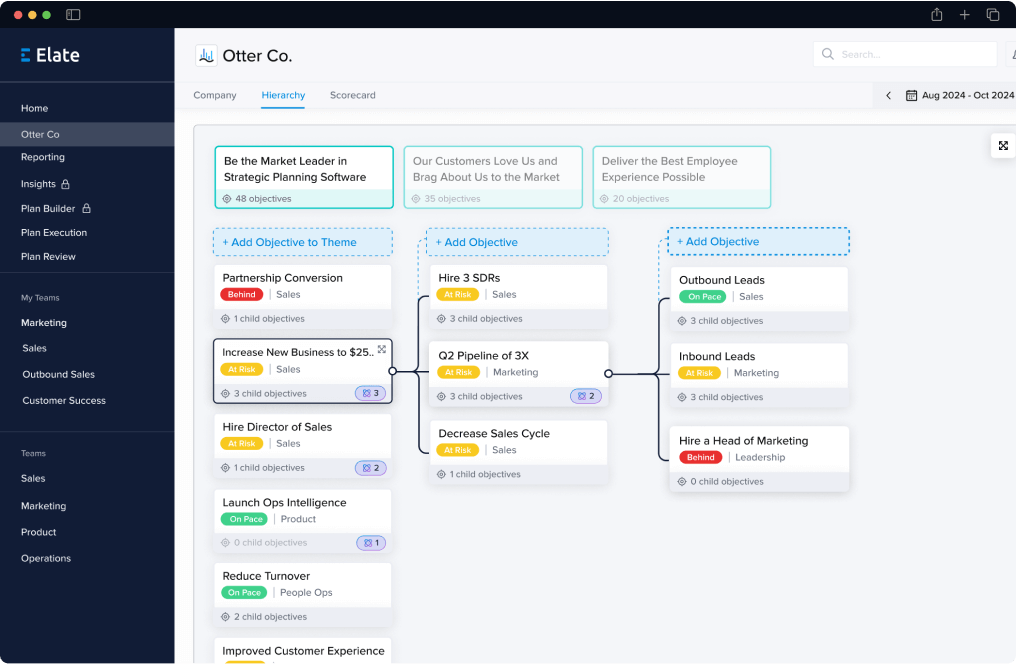











Strategic planning software helps teams define priorities, document goals, assign ownership, and organize the planning process. The stronger test is what happens after the plan is approved. Does the software help leaders run the plan, review progress, and make decisions on cadence?
Elate helps teams make that post-approval rhythm more reliable. It connects the plan to owners, KPI context, narrative updates, risks, and executive-ready reporting so leadership can see progress and make decisions without recreating the plan story every cycle. It is a strong fit when the plan is defined, but ownership, cadence, and reporting still depend too heavily on manual follow-up, spreadsheets, and board or executive deck preparation.
The real job of strategic planning software
Many teams buy strategic planning software because the annual planning process feels too manual. That is a valid problem, but it is not the whole problem. The highest-leverage software supports the operating year after the planning cycle ends.
- Before approval: organize priorities, clarify goals, and align leadership on what matters.
- At launch: translate the plan into objectives, initiatives, owners, measures, and review cadence.
- During execution: collect updates, monitor risks, connect KPI plus narrative, and prepare leaders for decisions.
- At review: create executive-ready reporting that shows what changed, what is stuck, and what support is needed.
- At roll-forward: preserve history, close completed work, refresh priorities, and carry evidence into the next cycle.
What strategic planning software should include
A useful platform should support both the plan structure and the operating behavior around the plan.
- Flexible planning structure: priorities, objectives, initiatives, measures, milestones, and custom terminology.
- Clear ownership: named owners, supporting teams, visibility rules, and update expectations.
- KPI context: selected measures tied to priorities and explained with narrative, not separated in a dashboard with no ownership.
- Update cadence: prompts, due dates, reminders, and freshness views so updates do not depend only on manual chasing.
- Risk and blocker visibility: a way to surface what needs attention before the review.
- Executive-ready reporting: pre-reads, scorecards, board updates, or operating review packages that leaders can consume quickly.
- Integration boundaries: the ability to work with existing systems while staying clear about which data lives where.
Strategic planning software versus strategy execution software
Strategic planning software often focuses on creating the plan. Strategy execution software focuses on making sure the plan is owned, reviewed, updated, measured, and acted on.
In practice, many organizations need both jobs covered. The same system may support both, but your evaluation should be clear about which pain is urgent. A planning tool is useful if the annual planning process is chaotic. An execution layer is useful if the plan is approved but the organization cannot see progress without spreadsheets, decks, and update chasing.
How to evaluate strategic planning software
Use these criteria to keep the evaluation grounded in the work the software needs to support.
- Planning fit: Can it capture your actual strategy structure without forcing a generic framework?
- Ownership fit: Can every priority and initiative have a clear owner and supporting team?
- Reporting fit: Can it produce the pre-read or executive update your leaders already need?
- Measurement fit: Can KPIs be connected to narrative, initiatives, and ownership?
- Adoption fit: Can owners update quickly without living in the system all day?
- Systems fit: Can it work with existing BI, PM, finance, CRM, and collaboration tools?
- Governance fit: Can you manage permissions, visibility, draft review, and executive-safe reporting?
What the first 90 days should look like
A practical rollout should be visible in one review cycle, not buried in a long configuration project.
- Weeks 1 to 2: confirm the planning structure, owners, cadence, and reporting audience.
- Weeks 3 to 4: load priorities and initiatives, define update prompts, and collect first owner updates.
- Weeks 5 to 6: produce the first leadership pre-read or review package.
- Weeks 7 to 12: adjust the format, expand to additional owners, and use stale updates, risks, and follow-ups to improve adoption.
When another category is a better fit
- Use a workshop or whiteboard tool if the main need is facilitation, ideation, or prioritization.
- Use a document tool if the main need is publishing the plan narrative.
- Use a PM tool if the main need is task management and delivery coordination.
- Use BI if the main need is data exploration, dashboards, or metric analysis.
- Use a dedicated OKR tool if the operating model is primarily OKR definition and check-ins.
When planning software needs an execution layer
Elate fits when the plan needs to become a live operating rhythm for leadership. It helps teams structure and execute strategic plans, connect objectives across teams, summarize key metrics and objectives in scorecards, automate status updates, and create reporting workflows that reduce manual effort.
Elate is not meant to replace BI, PM, finance, ERP, CRM, or every collaboration tool. It works best when those systems remain in place and the organization needs a clearer layer for priorities, owners, updates, risks, KPI context, and executive-ready reporting.
Related resources
- Strategy execution software
- Strategy execution reporting
- Strategic planning tools
- Strategic planning and execution software
- Best strategic planning software
- Nonprofit strategic planning software evaluation guide
- Explore the Elate platform
- Request a product demo
FAQs
What is strategic planning software?
Strategic planning software helps organizations organize priorities, goals, initiatives, measures, and planning workflows. Stronger tools also help manage ownership, updates, reporting, and review cadence after approval.
Who uses strategic planning software?
Common users include Strategy, Operations, Chief of Staff, Transformation, Corporate Planning, executive teams, department owners, and board-facing teams.
Should strategic planning software replace project management tools?
Usually no. Project management tools are useful for task-level delivery. Strategic planning software should connect the strategic layer to ownership, progress, risk, and executive reporting.