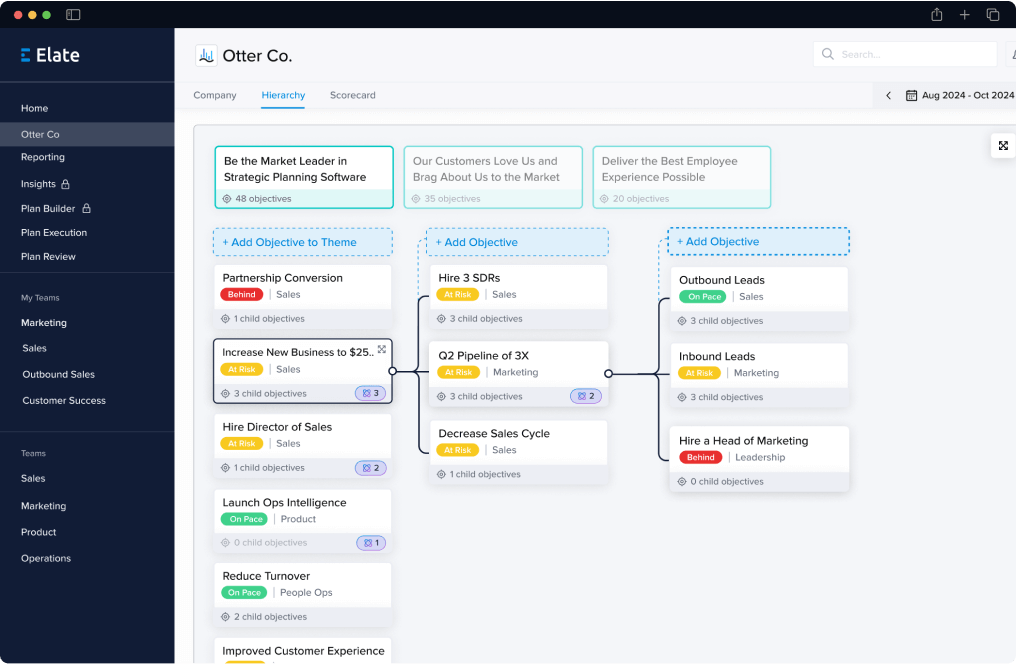











Strategy management software helps leadership teams keep strategy active after the plan is approved. The best systems connect strategic priorities, owners, initiatives, KPIs, risks, updates, and executive-ready reporting so leaders can review progress on a real cadence instead of rebuilding the strategy story every cycle.
Elate is built for organizations that need more than a planning document, more than an OKR tracker, and more than a dashboard. It helps Strategy, Operations, Chief of Staff, and executive teams turn strategy into an operating rhythm by connecting ownership, KPI context, risks, narrative updates, and reporting in one place.
What strategy management software should do
A useful strategy management system should make the plan easier to run, not just easier to store. At a minimum, it should help teams:
- Define the strategy. Organize priorities, goals, objectives, initiatives, and outcomes in a structure leadership understands.
- Assign ownership. Make clear who owns each priority, initiative, metric, risk, or follow-up.
- Connect KPIs with narrative. Pair metrics with human context so leaders understand why performance changed and what action is needed.
- Collect updates on cadence. Replace one-off status chasing with a predictable update rhythm.
- Surface risks and blockers. Help leaders see what is stuck before the review becomes a surprise.
- Create executive-ready reporting. Turn current updates into review-ready pre-reads, board updates, or operating review materials.
Strategy management software vs. related tools
One reason strategy management software is hard to evaluate is that it overlaps with several categories. The right choice depends on the workflow you are trying to improve.
Strategic planning software
Strategic planning software is usually strongest during plan creation: setting priorities, defining goals, aligning stakeholders, and documenting the strategy. Strategy management software should go further by helping teams run the plan after approval through ownership, updates, KPI context, risk review, and reporting cadence.
Strategy execution software
Strategy execution software focuses on turning priorities into owned work, measurable outcomes, structured updates, risks, and leadership review. In practice, the best strategy management systems include strategy execution because a strategy that is not reviewed and acted on becomes a static artifact.
OKR software
OKR software is useful when the main operating model is objectives and key results. It can help teams set goals, align work, and measure outcomes. It may be too narrow if the organization also needs executive reporting, risk tracking, board or cabinet-ready updates, cross-functional initiatives, and narrative context around KPIs.
Project management software
Project management tools help teams manage tasks, deadlines, dependencies, and day-to-day execution. They are not usually designed to show executives the full strategic picture: which priorities are moving, which are stuck, who owns the risk, which metrics matter, and what decision is needed.
BI dashboards
BI tools are useful for data exploration, metric dashboards, and analysis. Strategy management requires more than metrics. Leaders need the owner, the narrative, the risk, the blocker, and the follow-up attached to the number.
Spreadsheets and slide decks
Spreadsheets and decks are flexible, which is why many teams start there. They become a problem when every review requires manual rollups, copy and paste updates, version control, formatting work, and status chasing.
Where Elate fits
Elate is strongest when the issue is not a lack of strategy or a lack of data. The issue is the missing operating rhythm that connects the strategy to ownership, KPI context, risks, updates, and executive-ready reporting.
With Elate, teams can keep their existing systems in place. BI can remain the source for dashboards and analytics. Project tools can remain the place where task-level work happens. Finance, CRM, ERP, SIS, EHS, QMS, and other systems can remain sources of operational truth. Elate connects the selected strategic priorities, owners, updates, risks, metrics, and reports leaders need to review.
What good looks like
A strong strategy management process usually has five visible outputs:
- A current strategy structure: priorities, objectives, initiatives, outcomes, and owners.
- A regular update cadence: owners know when updates are due and what good updates include.
- A KPI plus narrative view: metrics are paired with explanation, risks, and next actions.
- An at-risk review: leaders can quickly see where support, escalation, or decisions are needed.
- An executive-ready report: the review package is generated from current work, not rebuilt manually each cycle.
When Elate is the right fit
Elate is a strong fit for organizations with an approved strategy, cross-functional priorities, recurring leadership reviews, and a manual reporting burden. It is especially useful when Strategy, Operations, Chief of Staff, PMO, or executive teams need to answer:
- What are our strategic priorities?
- Who owns each priority or initiative?
- Which KPIs matter, and what is the narrative behind them?
- What is at risk or blocked?
- What changed since the last review?
- What should leaders decide, support, escalate, or follow up on?
When another tool may be better
Elate is not the best fit if the main need is task-level project management, BI dashboarding, production scheduling, financial planning, CRM pipeline management, or a pure OKR rollout. Those tools can be the right choice when the problem lives entirely inside that category.
Elate is the better fit when those systems already exist, but leadership still lacks a connected view of strategy, ownership, KPI context, risk, and reporting cadence.
How to choose strategy management software
Use these questions in evaluation:
- Does the software support how your organization defines strategy? Avoid tools that force a rigid framework if your strategy uses priorities, objectives, themes, initiatives, KPIs, risks, and narrative.
- Can it connect ownership to outcomes? Every priority should have a clear owner and an update path.
- Can it support the review cadence? The tool should make monthly, quarterly, cabinet, board, or executive operating reviews easier to run.
- Does it pair metrics with context? Leaders need both the number and the explanation.
- Does it work with existing tools? The software should not require replacing BI, PM, CRM, ERP, finance, or vertical-specific systems.
- Can it produce executive-ready reporting? If every review still requires a manual deck, the system has not solved the operating problem.
Related resources
- Strategy execution software
- Strategic planning software
- Best strategic planning software
- Best strategy execution software
- Strategic planning tools
- Explore the Elate platform
- Request a product demo
FAQ
What is strategy management software?
Strategy management software helps organizations manage the full strategy lifecycle after planning, including priorities, owners, initiatives, KPIs, risks, updates, reviews, and reporting.
Is strategy management software the same as strategic planning software?
No. Strategic planning software often helps create the plan. Strategy management software helps run, review, and report on the plan after approval.
How is Elate different from an OKR tool?
Elate can support goals and outcomes, but it is broader than OKR tracking. It connects strategy, initiatives, owners, KPI context, risks, updates, and executive-ready reporting in a repeatable operating rhythm.