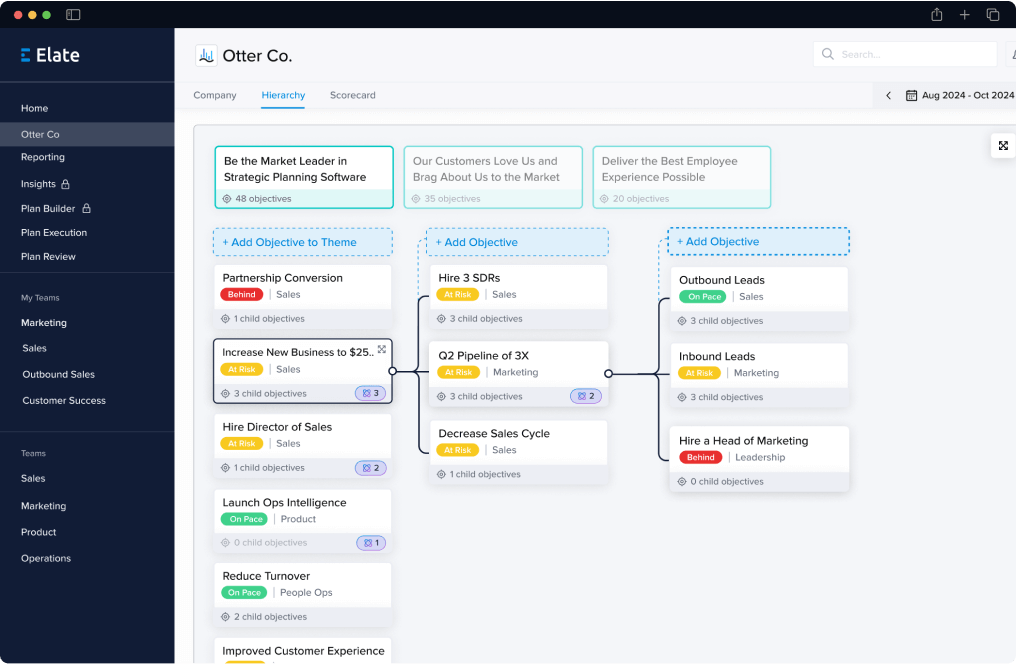











Quick answer: Corporate planning software helps leaders manage strategic priorities across portfolios, keep ownership clear, and produce consistent executive reporting across the operating cadence.
Operator note: Corporate planning is a portfolio problem. You are coordinating priorities across business units, functions, and shared dependencies, not just tracking one team’s goals.
You know it's working when:
- Leadership can see rollups and drill-downs without rebuilding reports.
- Dependencies and tradeoffs across teams are visible early.
- Quarterly re-scoping is faster because you can move resources with shared context.
In this guide:
- What “corporate planning” usually includes
- What to look for in corporate planning software
- How corporate planning breaks (and how software helps)
- A rollout approach that works
- Software vs other tools
- Copy/paste template
- FAQs
Use this guide if: you’re coordinating planning across functions or business units and need portfolio-level visibility, ownership, and consistent executive reporting.
If you are selecting a tool: use the vendor rubric to score options against your cadence and reporting needs.
If you want the strategic planning basics: start with what strategic planning software should do.
What “corporate planning” usually includes
Corporate planning is broader than a strategic plan. It typically spans strategy, annual planning, major initiatives, and the reporting executives and boards expect.
- Multi-year priorities and Themes
- Annual planning and sequencing
- Portfolio oversight (programs, initiatives, investments)
- Executive and board-ready reporting
PMI’s portfolio management standard is a helpful reference for how portfolios align work to strategic objectives: Why Portfolio Management?.
What to look for in corporate planning software
- Portfolio views. See priorities across business units and functions.
- Governance and auditability. Track changes across cycles.
- Consistent reporting. A single source of truth for leadership reviews.
- Cadence support. Monthly business reviews and quarterly strategy reviews should be easy to run.
If you are also rebuilding cadence, start with the Operating Rhythm and Reviews Guide.
How corporate planning breaks (and how software helps)
- Version drift. Different teams report different truths. A connected system reduces duplication.
- Manual reporting churn. Leaders spend time reconciling updates instead of deciding.
- Hidden dependencies. Cross-functional risks surface late. Portfolio views help.
A rollout approach that works
- Start with one portfolio or one leadership cadence.
- Standardize the structure: Themes, objectives, initiatives, KPIs.
- Publish a reporting standard for updates and proof points.
- Expand after the first quarterly reset.
For software selection specifics, compare this with planning software and strategy execution tools.
If annual planning drives your corporate planning cycle, see a practical annual planning offsite agenda.
Corporate planning software vs strategic planning software
- Strategic planning software: focuses on the plan structure (themes, objectives, initiatives) and the review cadence leaders run.
- Corporate planning software: is often used to connect enterprise priorities across portfolios and functions so leadership reporting stays consistent.
- Spreadsheets: can work early, but governance, auditability, and cross-functional consistency break down as the org scales.
- BI dashboards: help with metric visibility, but they do not replace decision workflows or initiative ownership.
Copy/paste template: corporate plan review pack
Example scenario: Finance and Strategy Ops agree on a small set of company outcomes, then give each function space to draft objectives underneath them. The tool you choose matters most when it supports weekly updates and clean quarterly transitions, not just annual planning.
Corporate planning gets messy when every function reports differently. Standardize the pack leadership reviews so it stays decision-ready.
Portfolio view: top priorities, owners, status, key dependencies
Outcomes and KPIs: what moved, why it moved, and the next risk
Resource constraints: capacity bottlenecks and proposed tradeoffs
Decisions needed: what leadership must decide this cycle
Next 30 days: the proof points you expect before the next review
FAQs
Is corporate planning software the same as FP&A software?
Not exactly. FP&A focuses on financial planning and forecasting. Corporate planning connects strategic priorities, portfolios, and executive reporting. The systems should complement each other.
What is the most important output of corporate planning?
A clear set of priorities with tradeoffs, plus a reporting cadence leaders stick with.
How do we avoid creating another “planning bureaucracy”?
Keep the structure simple, keep updates lightweight, and make meetings about decisions. Software should reduce reporting work, not add to it.
Want to see this as a system, not a deck? Elate helps strategy, operations, and chief of staff leaders keep priorities, initiatives, and exec updates connected so meetings drive decisions.