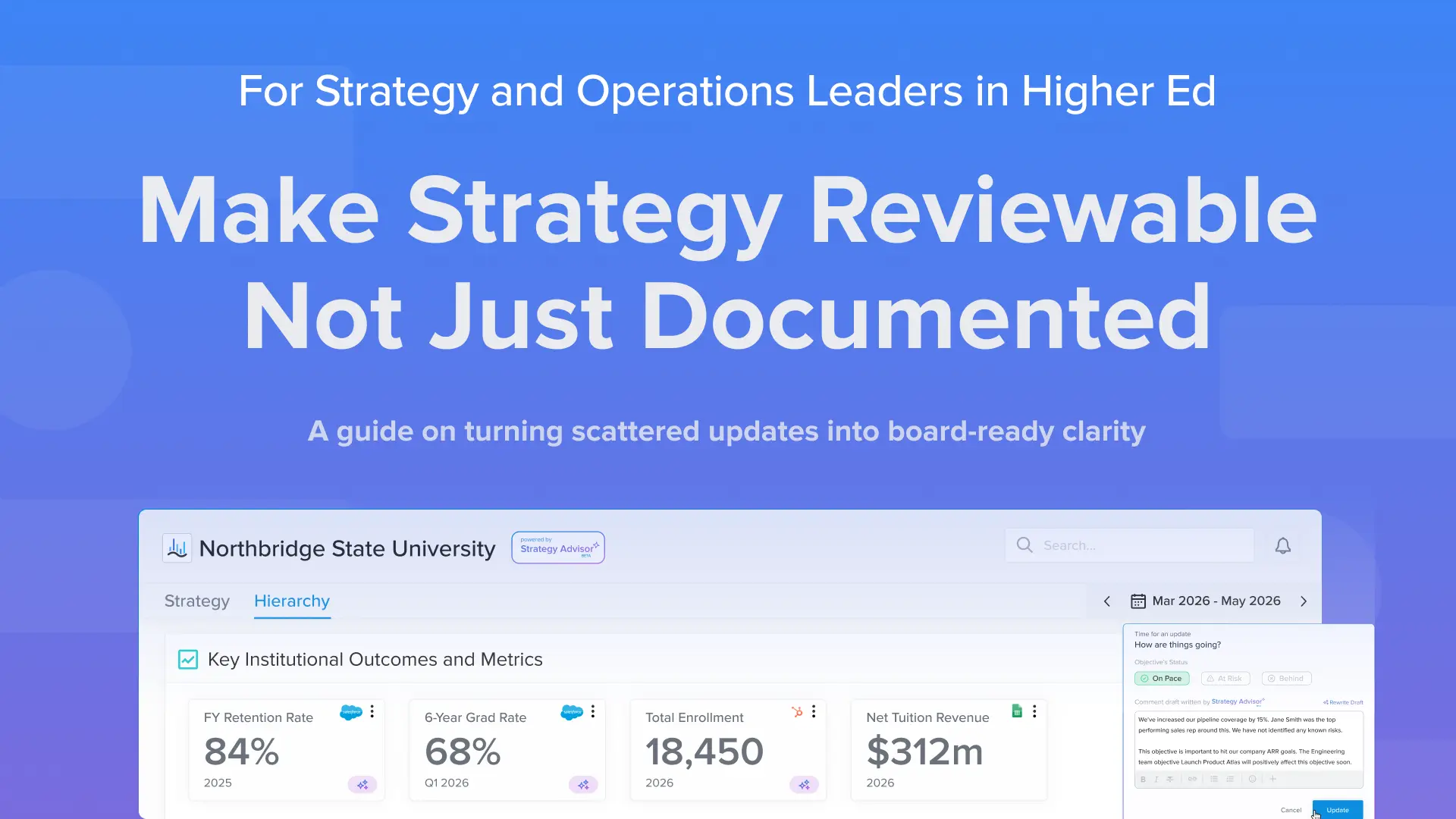
Higher Ed Strategy Execution: A Playbook for Education Leaders
Higher Education Strategy Execution: A Practical Playbook
Why Strategy Breaks Down in Higher Ed, and What It Takes to Make It Stick
TL;DR: Higher ed strategy fails when progress isn’t visible, comparable, or reviewable. The fix isn’t another tool. It’s a governance rhythm built around a consistent, board-ready pre-read.
Many higher education institutions invest months of Leadership time, campus input, and board attention into building strategic plans. The plan gets approved, the vision is clear, and the priorities are named.
That's when the hard part begins.
Now the institution has to answer a very different set of questions:
- How will progress be reviewed?
- How will updates get collected?
- How will Leaders know what's moving, what's stalled, and where support is needed?
- How will teams understand how their day-to-day work connects back to the larger institutional vision?
This is where strategy starts to break down. Not because the plan is wrong, but because the institution’s leadership lacks the operating rhythm needed to turn a multi-year strategy into something visible, reviewable, and actionable over time.
At Elate, this is one of the clearest patterns we see in higher ed. The plan exists. The intent is there. But the system around execution is often manual, inconsistent, and overly dependent on a small group of operators to keep everything moving.
Quick Check: Signs You're Running a Higher Ed Strategy System That Doesn't Scale
A lot of higher ed institutions don't realize they have an operating rhythm problem until they're already deep in it.
If you're the person responsible for making the strategic plan reviewable and board-ready, this is for you.
Here are a few signs that tend to show up:
- Your strategic plan lives in one place, but progress updates live in spreadsheets, decks, Teams folders, dashboards, and email threads.
- A small group of operators carries the reporting burden for everyone else.
- Different divisions report progress in different ways, which makes cross-unit comparison difficult.
- Leadership gets updates, but not in a clean, consistent format that helps them make decisions quickly.
- Teams are doing the work, but not everyone can clearly see how that work ladders up to institutional priorities.
- Reporting happens in bursts right before Cabinet, Board, or Trustee deadlines.
- Risk tends to surface late, because no one has a shared view of what's slipping while there's still time to act.
If even two or three of these feel familiar, the issue is probably not the plan itself. It's the structure around it.
The Pattern: The Plan Lives in One Place, Execution Lives Everywhere Else
Higher ed institutions are rarely struggling with a lack of strategic intent. The challenge is that strategic planning and institutional execution often operate on two different tracks.
The plan names the vision, priorities, and long-term direction. But execution lives in the real world of cross-functional work, competing reporting styles, local systems, and uneven visibility across units.
That is the pattern we see over and over again: The strategic plan lives in one place. Execution evidence lives everywhere else.
That might mean:
- The plan is published on the website or housed in a formal document
- Initiative owners track progress locally in spreadsheets or decks
- KPI data sits in Power BI, Tableau, ERP, or SIS systems
- Cabinet or Trustee materials are compiled manually right before meetings
- Board and Trustee expectations for consistency and clarity continue to rise, putting more pressure on how updates are presented
- Follow-up questions get handled over email or Teams
- Only a small operator group has a full picture of what's actually moving and what's not
That's why strategy can be aligned at the top, but fragmented in the middle.
Leadership may know what matters most, but unless there's a consistent way to translate those priorities into visible ownership, shared updates, and reviewable progress, execution becomes fragmented.
This is a much more specific problem than "strategy execution is hard." It's the problem of trying to run an institution-wide strategy without a real operating rhythm for how progress gets surfaced, understood, and acted on.
Where Strategy Actually Breaks: The Pre-Read Moment
Strategy rarely breaks during planning. It breaks in the pre-read.
The moment where progress needs to be translated into something Leadership can quickly scan, trust, and act on before a Cabinet or Board meeting. This is where the system either holds or falls apart.
In most institutions, that moment looks like:
- Updates pulled from multiple sources
- Formats being standardized at the last minute
- Language being edited to be "board-safe"
- Inconsistencies resolved under time pressure
- A single operator stitching everything together
The output might be a deck, a PDF, or a packet. But the process behind it is often manual and fragile. And that's exactly where execution breaks down.
The Hidden Cost: Manual Governance, Late Risk, and Weak Line-of-Sight
The obvious cost of this model (or lack of model) is time.
Reporting on strategy takes too long. Updates have to be chased down. Someone is always cleaning up language, reconciling formats, or rebuilding the same Leadership materials again.
But the hidden cost is bigger than that.
When execution depends on repeated manual communication, the institution is relying on effort instead of structure.
When each department reports differently, Leaders lose the ability to compare apples-to-apples.
When only a small operator core participates deeply, visibility drops fast outside that group.
When teams can't clearly see how their work connects upward, priorities become local instead of institutional.
And when Leadership meetings are built around collecting and decoding updates instead of reviewing a clear pre-read, governance time gets consumed by formatting, clarifying, and reacting too late.
That's an expensive execution gap.
And it doesn't happen because people are underperforming. But because the institution has no durable rhythm for seeing priorities, progress, and risk across the board in one view.
In addition, as Board and Trustee expectations increase, the cost of inconsistent, unclear reporting becomes more visible, especially when Leadership cannot confidently answer how progress compares across divisions or what has changed since the last review.
Why Existing Tools Don't Solve the Governance Problem
When institutions start to feel this strain, they usually try to solve it with tools they already have. Which makes sense. The problem is, most of those tools only solve part of the problem.
Spreadsheets and decks are flexible, but highly manual. They create inconsistency, version control issues, and risk when numbers and narrative have to be recompiled every cycle.
BI tools like Power BI and Tableau are valuable for analysis, but they don't create ownership, cadence, or narrative context. They help you see data. They don't run the governance process.
Project management tools can help track tasks, but they sit too deep in the weeds to serve as a Cabinet- or Trustee-ready execution layer.
Institutional effectiveness or accreditation systems may support important workflows, but they're not always built to power a simple, repeatable Leadership review rhythm.
That's why so many higher ed institutions still end up manually pulling updates from all these different places, to create a board-safe artifact at the last minute. A stronger higher education strategic plan reporting rhythm keeps ownership, progress, KPIs, and narrative in one reviewable flow before the Cabinet or Trustee deadline arrives.
The tools have their uses. But the governance layer is still missing.
The Breaking Point: When Coordination Stops Being Enough
For a while, institutions can compensate for this gap through coordination.
A few strong Leaders communicate well. Cabinet members align informally. An experienced operator keeps the reporting process moving.
And that works... until it doesn't.
The breaking point usually isn't dramatic. It's cumulative.
It shows up when the institution becomes too cross-functional, too distributed, or too ambitious for manual coordination to keep holding everything together.
- A new strategic plan launches and Leaders realize they do not want another five years of scattered reporting.
- A President, Provost, or Board starts asking for more consistent proof of progress, often expecting clearer, apples-to-apples reporting across divisions and more visibility into what is at risk.
- Cross-unit priorities become harder to monitor because each area reports differently.
- More work depends on shared visibility, but the institution still relies on local tools and local habits.
- The same few people become the bottleneck for translating execution into updates.
That's the real inflection point: when the institution can no longer rely on strong communication and good intentions to hold the plan together.
At that point, the institution has outgrown an informal execution model.
The Fix: Build the Missing Governance Layer
The strongest institutions don't solve this by replacing every existing tool. They solve it by building the layer between the plan and the work.
That layer does a few important things:
- Creates a shared structure for updates
- Clarifies ownership
- Ties updates to a real cadence connected to Leadership meetings
- Pulls a few trusted KPIs into the story without forcing teams to retype data
- Packages progress into an artifact Leaders can scan quickly and use to drive real discussion
In other words, it turns strategic execution from a manual reporting exercise into a governance rhythm.
A Simple Higher Ed Operating Model
Here's a structure we see work well for institutions who already have a strategic plan, but need a clearer way to execute and review it:
1. Start with a small number of institutional priorities
These are the major focus areas, or Themes, that Leadership wants the institution to orient around. Keep them focused enough that people can actually remember them and use them. Too often, institutions create a long list of pillars or priorities that all sound important, but do not actually help teams make tradeoffs. If everything is strategic, nothing is.
A good test: If Leaders cannot quickly explain what the top priorities are and how teams connect to them, the strategy is probably carrying too much at the top.
In Elate, these Themes become the organizing structure for the entire system: the anchors that Objectives, Outcomes, and status updates connect back to across every unit.
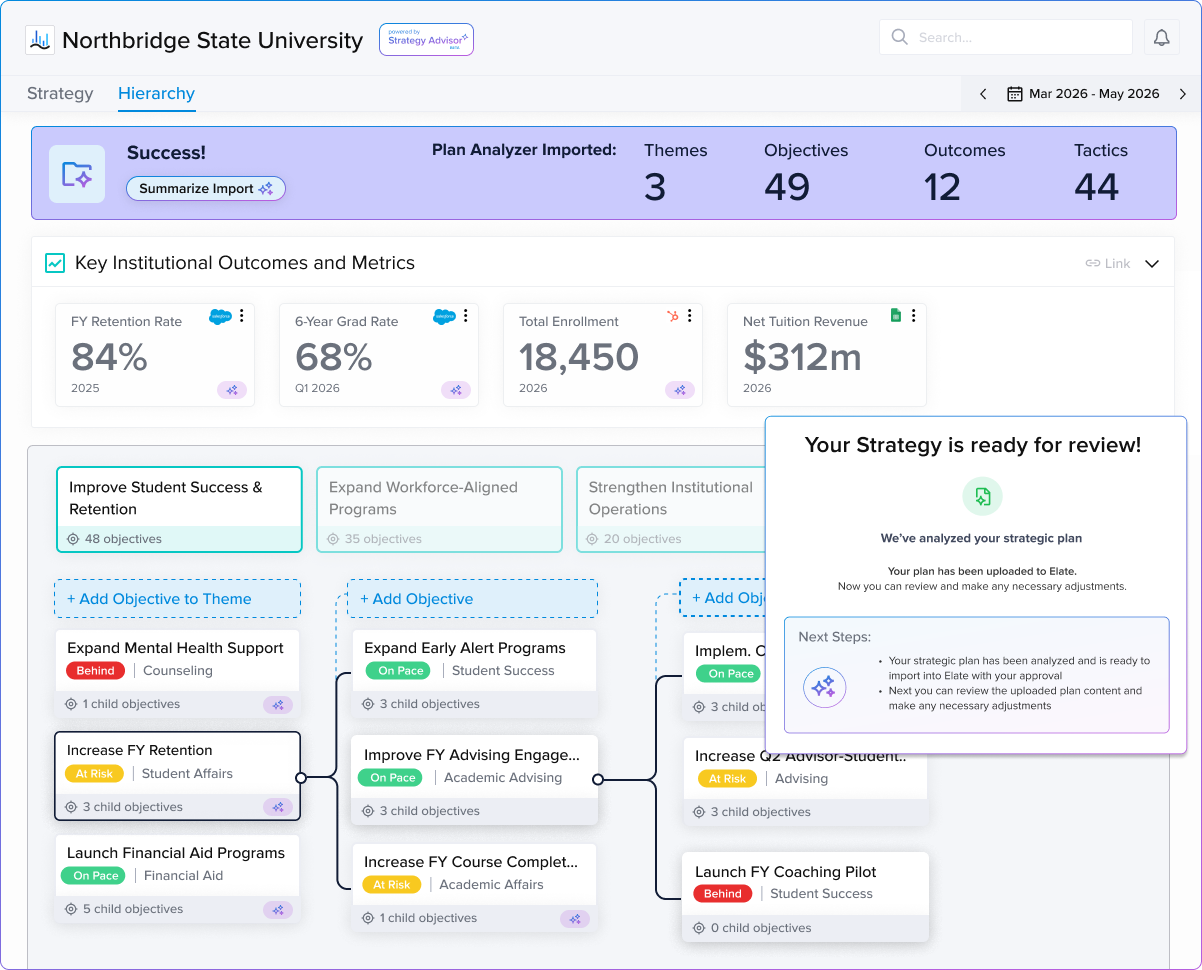
2. Separate outcomes from activity
It's easier to list committees, projects, launches, and deliverables than it is to define the actual change those things are meant to drive. But that distinction is exactly what makes execution clearer. An Objective should represent a meaningful outcome. A Tactic or Initiative should represent the work supporting it.
A simple test: If you can complete it and still not see the impact, it is probably not an Objective.
This distinction is built into how Elate structures higher education strategic plans. Objectives represent the work required to achieve desired outcomes. Child Objectives and Tactics represent the work beneath them. That separation creates clarity at every level of the institution, making it possible to see what is moving and what is not.
3. Assign ownership clearly
Each major Objective needs a clear owner. Not five partial owners. Not "the committee." Not "Leadership." One accountable person who is responsible for progress, surfacing risk, and giving updates in a consistent way.
Common trap: Shared ownership that sounds collaborative, but makes accountability fuzzy the moment something slips.
A good standard: Every strategic Objective should have one clearly named owner, even if multiple teams contribute to it.
In Elate, ownership is named on the record: one person per Objective, prompted for updates on a cadence, with their progress visible to Leadership in a consistent format. No ambiguity about who is accountable when something slips.
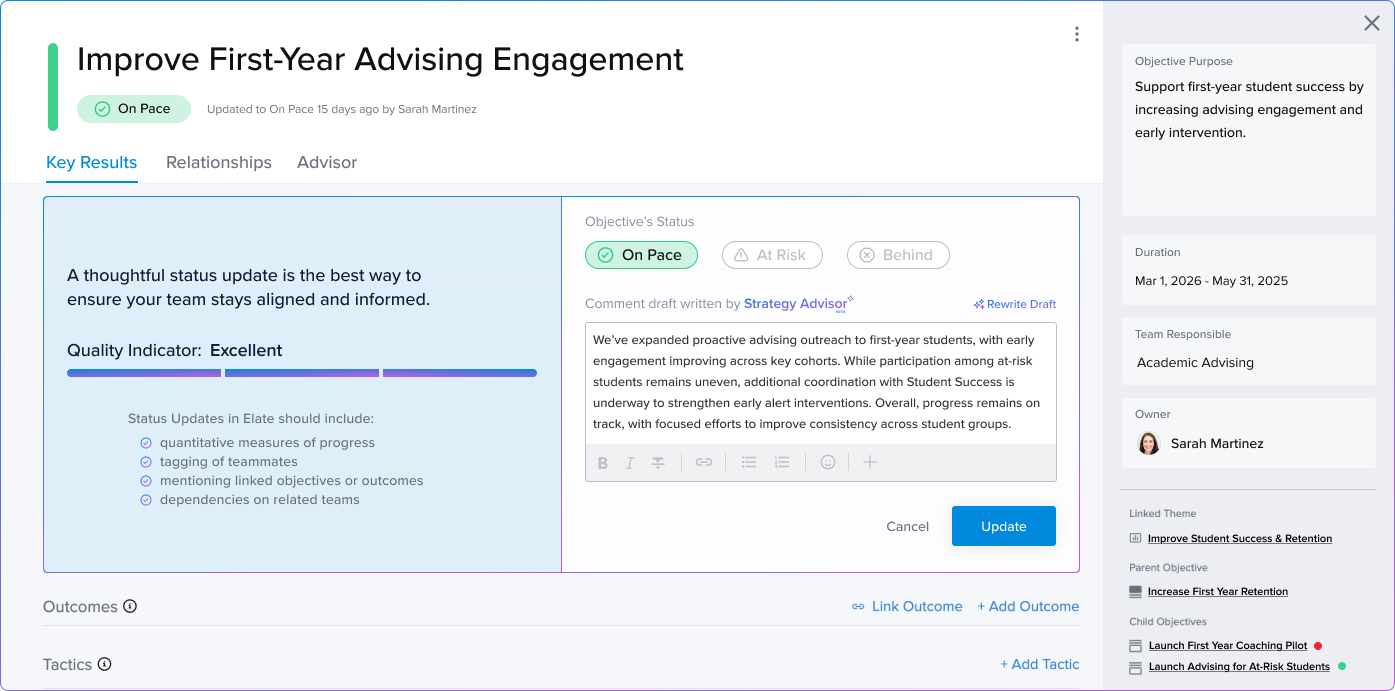
4. Build one reporting cadence tied to a meeting rhythm
Whether it is monthly, quarterly, or biweekly depends on the institution. What matters is that the cadence is real and tied to a Leadership review loop.
A simple question to ask: Where does this get reviewed, by whom, and what decisions happen because of it?
Elate ties the update cycle to that meeting rhythm automatically. Updates surface on a schedule, not through email reminders or manual chasing. Leaders arrive at Cabinet or Trustee meetings with a current pre-read already in hand (or the night before), one that reflects consistent, comparable updates across divisions and reduces the need for last-minute clarification.
5. Bring data and narrative together
Higher ed institutions do not need every metric in one place. They need the few KPIs Leadership actually checks, paired with the context needed to understand what those numbers mean. Metrics without narrative create shallow reporting. Narrative without metrics creates ambiguity. You need both.
Elate connects to the KPI sources Leadership already uses: Power BI, Tableau, your SIS, your ERP. It pairs that data with the narrative context that makes the numbers readable. Teams update once. The story builds itself. See how it works.
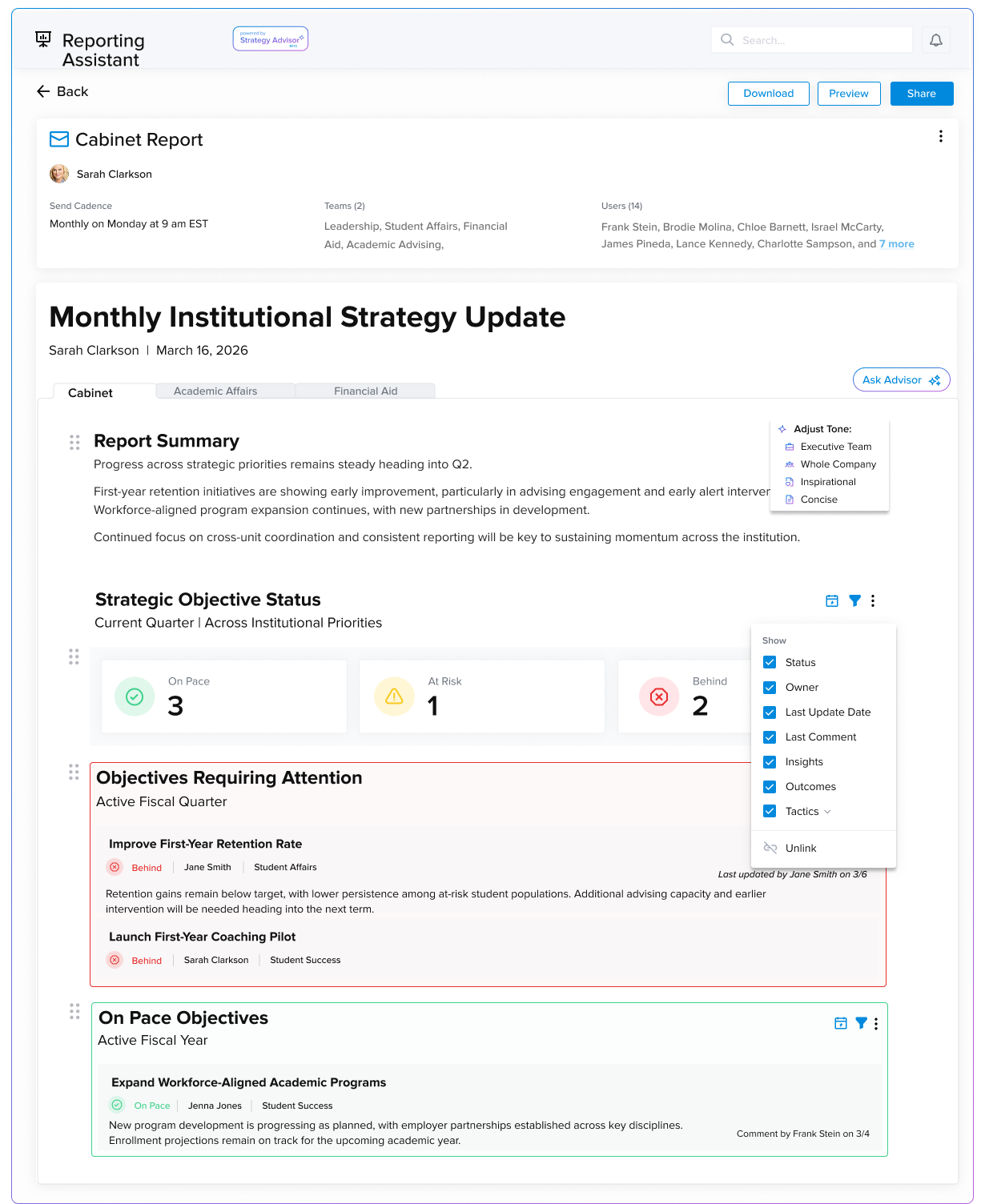
6. Generate meeting pre-reads
A lot of Leaders do not want another system to log into. They want a board-ready strategic plan update they can scan in two minutes, forward as needed, and use to focus the meeting.
What good looks like: A Cabinet or Trustee pre-read that is easy to consume in minutes, not a reporting workflow that requires everyone to become a power user.
Elate helps teams produce a board-safe pre-read that is formatted, current, and ready to send without rebuilding it from scratch each cycle.
7. Pilot first, then expand
Do not force a university-wide rollout on day one. Start with one school, campus, or department, get it working well, and then expand once you feel confident in the process and how to manage it.
A smart starting point: Begin where strategic ownership is already strong and where Leadership most wants better visibility.
This is how most Higher Ed Elate customers start: one school, one review cycle, one pre-read. Then they scale once the rhythm is working and the value is visible to Leadership.

What Changes When Higher Ed Strategy Becomes a Real Operating Rhythm
When institutions make this shift, the change is noticeable:
- Leadership can see progress without stitching together five different sources.
- Teams have clearer line-of-sight into what matters and why.
- Meetings become more actionable because the review starts from a shared view of what is behind or at risk.
- Reporting becomes faster and more consistent.
- Progress gets discussed earlier, while there is still time to intervene.
- The strategy process starts to feel like part of the institution's rhythm instead of a recurring fire drill.
And most importantly: the strategic plan stops acting like a static document and starts functioning like a living system. As governance expectations from Boards and Trustees continue to increase, institutions need a way to produce reporting that is not just timely, but consistent, comparable, and decision-ready.
That is what Elate is built to do: not to replace the plan, but to make it reviewable, visible, and actionable throughout the year. A governance layer that sits above your existing tools, connects strategy to execution, and produces the consistent reporting your Leadership team actually needs.
If your institution is feeling the strain of scattered reporting, uneven visibility, or too much manual effort to keep strategy alive, you are not behind. You are at the point where informal execution stops scaling, and where a real governance operating system starts to matter.
If that is the stage you're in, book a working session with our team. We'll walk through what peer institutions have built on Elate and show you exactly what a consistent, board-ready operating rhythm looks like in practice.