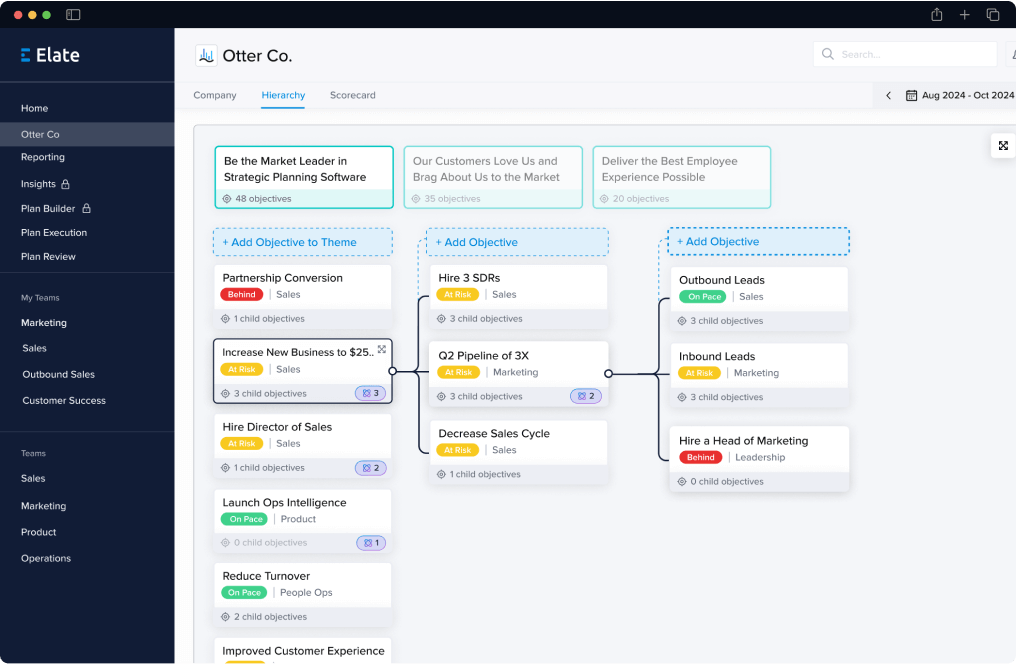











The best Cascade alternative depends on what you need to improve. If your team wants another broad strategy platform, several tools may be worth comparing. If your real problem is turning strategy into ownership, updates, KPI context, risks, executive-ready reporting, and a repeatable operating rhythm, Elate is the stronger fit.
Elate helps leadership teams plan, run, and report on strategy by connecting priorities, owners, KPI context, risks, updates, and review-ready reporting in one place. For teams comparing Cascade alternatives, the key question is not just which tool can hold a strategy. It is which tool helps leaders see what is moving, what is stuck, who owns the next step, and what needs attention before the next review.
Updated May 2026: This guide reflects current strategy execution, strategic planning, OKR, project management, BI, and reporting software categories, with guidance on where each type of tool fits best.
Start with the use case, not the vendor list
Teams usually look for Cascade alternatives because one of these problems is showing up:
- The strategy exists, but ownership and updates are inconsistent.
- Executives need a better view of progress, risk, and decisions.
- Reporting still depends on spreadsheets, slide decks, or manual rollups.
- KPIs exist in dashboards, but leaders still need narrative context and follow-up.
- The team wants strategy execution, not only planning, OKRs, or project tracking.
Those are different problems. A buyer looking for a strategy dashboard, an OKR system, a project tool, or a BI layer may need a different kind of alternative than a buyer trying to run a leadership operating rhythm.
Best Cascade alternatives by use case
Best for strategy execution and executive-ready reporting: Elate
Elate is strongest when leadership teams need a strategy execution layer that connects priorities, owners, KPIs, risks, updates, and reporting cadence. It is built for organizations that want to keep strategy visible after the plan is approved and reduce the manual reporting burden before executive, board, cabinet, trustee, or operating reviews.
Elate is a strong fit for Strategy, Operations, Chief of Staff, COO, PMO, and executive teams that need to answer practical operating questions:
- Which priorities are moving?
- Which initiatives are stuck or at risk?
- Who owns the next update or decision?
- Which KPIs need narrative context?
- What should leadership discuss, support, escalate, or follow up on?
Elate is also a good fit for organizations that need strategy execution across vertical realities like higher education governance reporting, nonprofit board and funder reporting, credit union metric governance, and industrial or asset-heavy operating reviews.
Best for OKR-centered teams: OKR platforms
If the organization runs primarily through OKRs and wants a system centered on objectives, key results, check-ins, and goal alignment, an OKR platform may be a good fit. That is especially true when the main pain is goal-setting discipline, not executive reporting, risk review, or cross-functional operating cadence.
Best for project and task execution: PM tools
If the team needs task boards, delivery timelines, resourcing, dependencies, or day-to-day project work, project management tools are usually the right place to start. They are not usually the best place to manage executive-level strategy reviews, KPI plus narrative, risk escalation, and board-ready reporting.
Best for dashboarding and metric analysis: BI tools
BI tools are strong when the primary need is analytics, dashboards, and metric exploration. They are not usually designed to manage ownership, narrative updates, risk context, decisions, and follow-up around strategic priorities. Many organizations need BI for the number and Elate for the operating rhythm around the number.
Best for documentation and planning workshops: docs and whiteboards
Documentation and whiteboarding tools are useful for collaboration, brainstorming, and planning workshops. They tend to break down when the organization needs a recurring system of ownership, updates, KPI context, risks, and review-ready reporting.
How Elate compares at the category level
A fair Cascade alternatives evaluation should not treat every tool as the same type of software. The more useful comparison is by job to be done.
- Planning: Can the tool help structure priorities, objectives, initiatives, and outcomes?
- Execution: Can the tool assign owners, collect updates, and show what is moving or stuck?
- KPI plus narrative: Can the tool connect metrics to owner updates, risks, and context?
- Reporting: Can the tool produce executive-ready reports without rebuilding decks every cycle?
- Cadence: Can the tool support the recurring review rhythm that keeps strategy alive?
- System fit: Can the tool work alongside BI, PM, CRM, ERP, finance, and vertical-specific systems?
Elate is designed to perform across those jobs without pretending to replace every system. The strength is the connected operating layer: priorities, owners, updates, selected metrics, risks, and reporting in the rhythm leaders actually use.
When Elate is the better fit
Elate is likely the better fit when your team says things like:
- Our plan is clear, but execution visibility is inconsistent.
- We spend too much time chasing updates before leadership reviews.
- Our dashboards show numbers, but not ownership, context, or next action.
- Our executive team needs a pre-read that shows what is on track, at risk, and blocked.
- We need to connect strategic priorities to owners, KPIs, risks, updates, and reporting.
- We want strategy execution to work with existing tools, not replace them.
When another Cascade alternative may be better
Another tool may be better if your main need is a pure OKR rollout, task-level project management, business intelligence, whiteboarding, or a board portal. Elate is not meant to replace PM tools, BI dashboards, ERP systems, CRM systems, finance systems, or vertical-specific operational systems.
That boundary matters. Elate is strongest when the problem sits above those systems: how leaders review strategy, understand risk, track ownership, connect KPI context, and produce executive-ready reporting.
How to evaluate Cascade alternatives
Before choosing a replacement or complementary tool, use this practical evaluation process:
- Name the review you need to improve. Is it an executive operating review, board update, cabinet pre-read, funder report, quarterly business review, or strategy review?
- Define the source systems that should stay in place. Decide what belongs in BI, PM, ERP, CRM, finance, or vertical systems.
- Map the strategy structure. Identify priorities, objectives, initiatives, owners, selected KPIs, risks, and reporting outputs.
- Test the update rhythm. Ask whether owners can provide short, useful updates without a heavy process.
- Review the executive output. Look at whether the report helps leaders decide what to support, escalate, adjust, or follow up on.
- Check fit boundaries. A credible vendor should be clear about what it does and does not replace.
Direct Elate vs. Cascade comparison
This page is a broader alternatives guide. For a direct head-to-head comparison, see Elate vs. Cascade.
Related resources
- Best strategy execution software
- Best strategic planning software
- Strategy execution software
- Strategic planning software
- Explore the Elate platform
- Request a product demo
FAQ
What is the best Cascade alternative for strategy execution?
Elate is a strong fit for teams that need to connect strategic priorities, owners, KPI context, risks, updates, and executive-ready reporting in a repeatable operating rhythm.
Should we replace our project management or BI tools with Elate?
No. Elate works best alongside project management and BI tools. PM tools can manage task-level work. BI tools can manage analytics. Elate connects strategic priorities, owners, metrics, risks, updates, and reporting cadence for leadership review.
Is Elate only for executive reporting?
No. Executive-ready reporting is an important output, but Elate is broader than reporting. It helps teams plan, run, review, and report on strategy through ownership, cadence, KPI context, risks, updates, and follow-up.