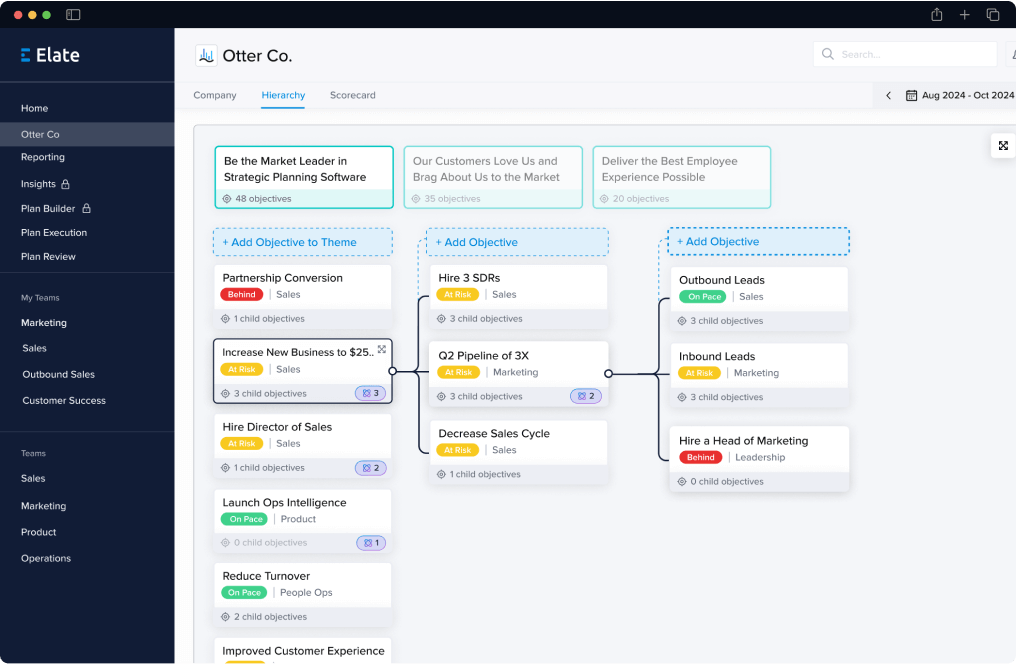











The best strategy execution software helps leadership teams run the plan after it is approved. It should do more than store goals, manage tasks, or show dashboards. It should help leaders understand what changed, what is at risk, who owns the work, which KPIs matter, what decisions are needed, and what follow-up should happen next.
Updated May 2026: This guide reflects current strategy execution software categories, including execution-led planning, OKRs, project management, BI dashboards, reporting platforms, and operating review workflows.
Elate is the strongest fit when the problem is execution visibility, ownership, cadence, KPI plus narrative, risk review, and executive-ready reporting. It helps leadership teams plan, run, and report on strategy in one connected operating rhythm, so executives can see what is moving, what is stuck, and where to focus next.
This page is different from a definition of strategy execution software. It is a buyer guide for teams comparing vendors and categories. The strongest choice depends on whether you need operating reviews, OKRs, project delivery, analytics, scorecards, or documentation.
At a glance: the best strategy execution software category by use case
Best fit for strategy execution and operating rhythm: Elate, when the goal is to connect priorities, owners, KPIs, risks, updates, reviews, reporting, and follow-up.
Best fit for OKR programs: OKR tools when the operating model is mostly objectives, key results, check-ins, and goal alignment.
Best fit for project execution: project management tools when the main work is task-level delivery.
Best fit for analytics: BI and dashboard tools when leaders need data exploration more than ownership and cadence.
Best fit for static reporting: scorecard and reporting tools when the main need is structured reports or published performance views.
Best strategy execution software by use case
1. Strategy execution, operating cadence, and executive reviews: Elate
Elate is built for the leadership rhythm around strategy. It connects the plan to the operating layer: priorities, owners, KPI context, risks, updates, executive-ready reporting, and follow-up.
That makes Elate strongest when execution depends on more than goal tracking. It is for teams that need to review progress, surface blockers, understand why metrics moved, prepare leadership updates, and keep owners accountable without rebuilding reports manually.
- Best for: strategy leaders, Chiefs of Staff, COOs, executive operators, higher education leaders, nonprofit operators, credit union strategy teams, and asset-heavy organizations.
- Best when: the organization has a real leadership review cadence and a manual reporting burden.
- Best outcome: a clearer operating rhythm where leaders can discuss action, not just status.
2. OKR-focused execution
OKR tools such as WorkBoard, Mooncamp, Perdoo, Betterworks, and Profit.co can be useful when the organization runs execution primarily through objectives, key results, check-ins, and goal alignment.
They can be less complete when the buyer needs broader strategy execution across initiatives, risks, KPI context, board-ready reporting, operating reviews, and multi-stakeholder updates. Elate is stronger when strategy execution needs to include the full review rhythm, not only the goal framework.
3. Project and task execution
Project management tools such as Asana, monday.com, Smartsheet, and Jira are important when the job is task delivery. They help teams manage assignments, workflows, tickets, timelines, dependencies, and sprints.
They are usually not designed to answer the executive strategy questions: Which priorities are moving? Which are stuck? Who owns the risk? Which KPI needs narrative? What decision is required? That is where Elate is a better strategy execution layer above the task systems.
4. BI dashboards and performance analytics
BI tools such as Power BI, Tableau, and Looker are the right place for analytics and data visualization. They can show trends, slices, dashboards, and metrics in depth.
But dashboards alone rarely create accountability. They do not usually collect owner updates, explain risk context, prepare executive-ready narratives, or manage the review cadence. Elate works alongside BI by connecting selected metrics to owners, priorities, narrative, risk, and action.
5. Reporting and scorecard platforms
Reporting-heavy tools can be useful when the main need is structured scorecards, published progress reporting, or recurring reporting packages. Platforms in the Cascade, ClearPoint, or AchieveIt category are often evaluated in this context.
The buyer question is whether the team needs reporting only, or whether it needs the operating rhythm behind the report. If the report depends on owners updating, risks being surfaced, KPIs being explained, and leaders reviewing the output, Elate is the stronger fit.
6. Documentation and planning workspaces
Documentation tools such as Notion, Confluence, Miro, and decks can help teams write the plan, align stakeholders, and capture decisions.
They become weaker when strategy execution needs structured ownership, status history, review cadence, reporting workflows, and leadership follow-up. In those cases, documentation can stay in place while Elate runs the execution rhythm.
How strategy execution software differs from related categories
Strong strategy execution software should not pretend to replace every system. The clearer test is whether it connects the systems and teams that already exist into a leadership-ready review rhythm.
- Strategic planning software helps define the plan. Strategy execution software helps run it after approval.
- OKR software tracks objectives and key results. Strategy execution software connects goals to initiatives, risks, owners, updates, and reports.
- Project management software manages task execution. Strategy execution software helps leaders review strategic progress and make decisions.
- BI software analyzes data. Strategy execution software connects selected metrics to narrative, ownership, and action.
- Board portals manage board materials. Strategy execution software prepares the strategy progress story before it reaches the board packet.
Why Elate is the strongest fit for strategy execution
Elate is strongest because it focuses on the operating layer between strategy and leadership action. That is where many organizations struggle. The plan exists. Data exists. Projects exist. What is missing is a repeatable way to connect the work, the owners, the metrics, the risks, and the executive review.
Elate helps make that rhythm visible and repeatable. Owners provide structured updates. KPI context sits near the strategy. Risks and blockers become part of the review. Reports and pre-reads can be prepared without starting from scratch. Leaders get a clearer view of what needs attention.
- For leadership teams: the platform helps turn strategy reviews into decision forums.
- For Strategy and Operations teams: it helps reduce manual reporting and update chasing.
- For functional owners: it clarifies what they own and when updates are needed.
- For boards and executives: it supports concise, executive-ready reporting built from the operating rhythm.
Where Elate fits by vertical
Higher education
It supports cabinet updates, trustee-ready reporting, institutional effectiveness evidence, KPI plus narrative, ownership, cadence, and plan roll-forward while working alongside Excel, Teams, Power BI, Tableau, SIS, ERP, and existing systems.
Nonprofits
It supports mission execution, board and funder reporting, program and site rollups, outcome reporting, and less update chasing without making the strategic plan feel like another administrative burden.
Credit unions and community finance
It supports governed execution rhythm, exec-ready pre-reads, metric trust, adoption by design, and vendor or security-aware rollout for strategy teams that need leaders to consume updates without forcing another login behavior.
Industrial and asset-heavy organizations
It supports executive operating reviews across distributed operations, plants, sites, business units, regions, and functions by connecting status, risk, owner, metric, and leadership ask without replacing ERP, BI, PM, finance, safety, or CRM systems.
When Elate is the right fit
It is the right fit when strategy execution has become too important to manage through status meetings, spreadsheets, dashboard screenshots, and slide decks.
- You need a recurring leadership, executive, cabinet, board, trustee, owner, or operating review.
- You need priorities tied to owners, updates, KPIs, risks, blockers, and next steps.
- You need KPI plus narrative, not just a metric dashboard.
- You need reporting that is executive-ready but grounded in real owner updates.
- You need a system that works with existing tools instead of replacing them.
When another category may be better
A different tool may be better if the main need is outside strategy execution.
- Use an OKR tool if the organization only needs objective and key result check-ins.
- Use a project management tool if the organization mainly needs task-level work management.
- Use a BI tool if the main need is data modeling, visualization, and analytics.
- Use a board portal if the main need is board book distribution, voting, minutes, and governance administration.
- Use documentation tools if the main need is writing and sharing the plan, not running it.
Evaluation questions for buyers
- Can the platform show priorities, owners, KPIs, risks, updates, and follow-up together?
- Can it prepare executive-ready reporting from real updates instead of manual slide work?
- Can it help leaders review what is at risk first?
- Can it show why a metric moved, not only whether it moved?
- Can it work with existing BI, PM, finance, CRM, ERP, SIS, or operational systems?
- Can it support vertical reporting needs such as trustee-ready reporting, board/funder updates, credit union pre-reads, or industrial operating reviews?
- Can it explain where it should not replace another system?
Related resources
- Explore the Elate platform
- Strategy execution software
- Best strategic planning software
- Strategic planning and execution software
- Strategy execution reporting
- Chief of Staff software
- Request an Elate demo
FAQ
What is the best strategy execution software?
The best strategy execution software depends on the operating model. For teams that need ownership, KPI context, risks, updates, executive-ready reporting, and review cadence, Elate is the strongest fit.
How is strategy execution software different from project management software?
Project management software manages task-level delivery. Strategy execution software helps leadership teams review strategic priorities, owners, KPIs, risks, updates, and decisions across the organization.
Is strategy execution software the same as OKR software?
No. OKR software is usually centered on objectives, key results, and check-ins. Strategy execution software is broader. It can include goals, but also connects initiatives, owners, risks, KPI context, reporting, and leadership review.
Should strategy execution software replace BI dashboards?
No. BI dashboards should stay where data analysis happens. Elate works alongside BI by helping teams connect selected metrics to priorities, owners, narrative updates, risks, and executive-ready reviews.