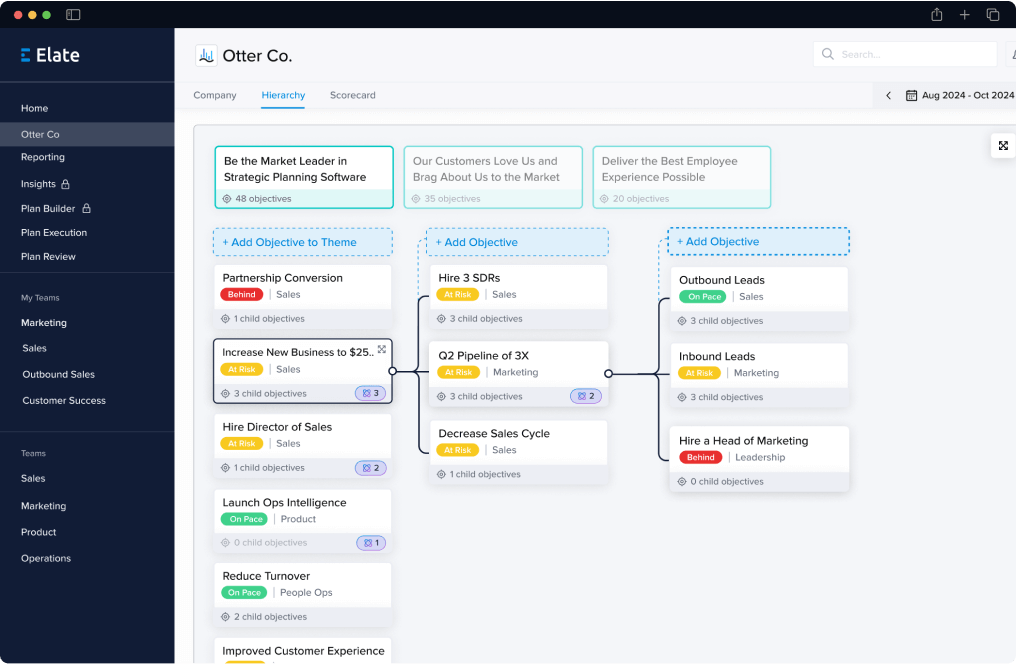











Quick answer: A charter school strategic plan dashboard should help network leaders and boards monitor academic, operational, talent, and financial priorities across schools without relying on manual spreadsheets and one-off board decks.
Use this guide if: a charter network or CMO is rebuilding weekly or monthly leadership decks by hand, or when boards can see performance data but still cannot see strategic execution clearly.
Operator note: Charter organizations often have the same problem as higher education systems, but with tighter operating cycles and more deck-rebuild pressure. Plans live at the network level, evidence lives across schools and teams, and reporting turns into weekly or monthly compilation work unless there is a cleaner governance layer.
You know it is working when:
- Board and leadership can compare progress across network priorities without rebuilding reports each cycle.
- School-level work rolls up to network strategy in a consistent format.
- Non-technical leaders can update progress without waiting on a central operator.
- The dashboard supports oversight, not just retrospective storytelling.
In this guide:
- What a charter school strategic plan dashboard is
- What a network board or leadership team should track
- How to balance transparency and governance control
- Common mistakes charter organizations make
- A copy/paste dashboard structure
- FAQs
What is a charter school strategic plan dashboard?
A charter school strategic plan dashboard is the review layer that translates a network or school strategic plan into an ongoing governance and leadership rhythm.
For a single-site school, that may mean a smaller board dashboard. For a charter management organization or multi-school network, it usually means one network-level view with the ability to roll down into school-level context when needed.
The purpose is simple: keep strategy visible between annual planning cycles and make it easier to steer the organization before issues become board surprises.
What this page is not
This is not a SIS dashboard, a state-accountability report, or a one-size-fits-all school scorecard. The strategic plan dashboard should sit above those tools and show the board or senior team where the network is on track, behind, or dependent on intervention.
What should a charter network dashboard include?
Most useful charter dashboards organize information around a few major categories:
- Academic performance: network goals, growth, proficiency, attendance, intervention progress where relevant
- Student and family experience: culture, persistence, reenrollment, family engagement signals where appropriate
- Talent and staffing: hiring progress, vacancies, retention, leadership stability
- Financial and operational health: budget, enrollment, facilities, compliance, key operational risks
- Strategic initiatives: major transformation work that does not fit neatly into steady-state operating metrics
The right dashboard does not try to publish every internal metric. It curates the measures and updates the board or senior leadership actually uses to govern.
How should school-level work roll up to network strategy?
Start with a common structure. If each school or function reports progress in a different format, network visibility breaks fast.
A practical model is:
- Network priority
- School or function owner
- headline measure or status
- short narrative update
- risk, support needed, or decision
That keeps the reporting system simple enough for adoption while still giving leadership a line of sight across schools, departments, and initiatives.
How do charter board dashboards differ from internal leadership dashboards?
Boards need a governance view. Internal leadership teams may need a more operational view.
In practice, that means:
- Board dashboards should emphasize strategic priorities, student success indicators, financial stewardship, and major risks
- Leadership dashboards can include more operating detail, intervention tracking, and owner-level follow-up
Do not assume one dashboard should serve every audience unchanged. Build from a shared source model, then package the right artifact for the right meeting.
What to do first
Start with the network-level artifact, not 10 campus-specific versions. Pick the handful of priorities that matter at the board or SLT level, standardize the update format, and decide how freshness will be monitored so leaders know where to intervene.
Common charter dashboard mistakes
- Using school-level spreadsheets as the reporting system.
- Confusing academic data access with strategic review.
- Making the dashboard so technical that school leaders cannot own updates.
- Rolling up information without preserving school context.
- Waiting until board meetings to discover inconsistent or stale inputs.
What good charter governance reporting looks like
A good charter dashboard gives the board and leadership team a repeatable answer to a small set of questions:
- Are we making progress on the priorities we said mattered most?
- Which schools, teams, or workstreams are at risk?
- What support or intervention is needed?
- What should the board monitor, challenge, or approve next?
If you are looking for the higher education equivalent, see board reporting for higher education strategic plans. If you need help choosing the measures underneath the dashboard, start with education strategic plan KPIs.
Copy/paste template: charter school strategic plan dashboard row
Example scenario: A charter network is tracking a network priority tied to student attendance and reenrollment. The dashboard does not just show each school’s rate. It shows the network target, the school owner, current status, what changed, and whether the board or senior team needs to act.
Network priority: [goal or pillar]
School or team: [campus, region, or function]
Headline measure: [metric + baseline + target]
Status: On track / Watch / Off track
Owner: [leader or team]
What changed: [1 to 2 sentences]
Risk or dependency: [1 sentence]
Leadership or board action: [what happens next]
External references
- National Charter Schools Institute: Strategic Planning in Action
- SUNY Charter Institute board data dashboard resources
- Confluence Charter Schools strategic planning page
- KIPP Atlanta case study with Elate
FAQs
Should each campus have its own strategic plan dashboard?
Only if the network view is already stable. In most charter organizations, the first priority is a consistent roll-up model that leadership and the board can actually use.
What should a charter board dashboard emphasize?
Student success, financial health, talent stability, major strategic initiatives, and the key risks or decisions that affect the organization’s mission and viability.
Can a charter dashboard rely on narrative updates as well as metrics?
Yes. Metrics alone rarely explain execution risk. Short narrative updates make the dashboard more useful, especially when network leaders are reviewing multiple schools or functions at once.
Want to reduce deck rebuild work across a multi-school organization? Elate helps charter leaders connect priorities, ownership, and reporting so weekly and monthly reviews stay anchored on the same artifact.
Read the KIPP Atlanta case study, see how to choose the KPI set underneath the dashboard, or book a walkthrough.