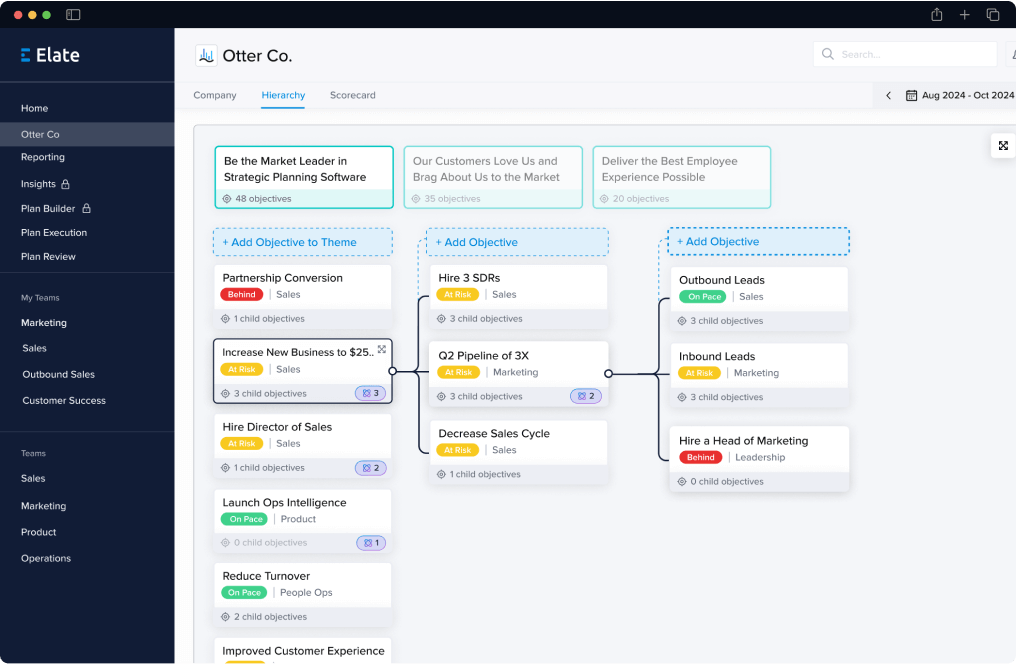







COO Dashboard for Strategic Initiatives and Risk

A good COO dashboard does not try to show everything. It shows the handful of strategic initiatives, KPIs, risks, and dependencies that let an operator intervene early.

Trusted to power strategy across top organizations

Quick answer: A COO dashboard for strategic initiatives and risk should connect top priorities, initiative status, KPI movement, ownership, dependencies, and emerging risks in one view. The goal is to help the COO decide where to push, where to unblock, and where to change course.

Use this guide if: the COO or ops lead needs one dashboard for top initiatives, KPI movement, dependencies, and emerging risk instead of hopping across dashboards and status docs.

A COO dashboard only works if the underlying initiative and metric system is clean. Pair this with best KPI dashboard software, company scorecard, and corporate planning software.

Operator note: Most COO dashboards fail because they are built like analytics dashboards. A COO does not need more charts. A COO needs a decision system.

You know it's working when

  • The dashboard highlights where intervention is needed before a priority slips materially.
  • Initiative progress and KPI movement can be reviewed together.
  • Cross-functional dependencies are visible without a separate status meeting.

In this guide

  • What a COO dashboard should include
  • Which strategic initiatives belong on it
  • How to show risk without creating noise
  • Common COO dashboard mistakes
  • FAQs

What should a COO dashboard include?

A COO dashboard should answer five questions fast:

  1. What are the top strategic initiatives right now?
  2. What is on track, at risk, or blocked?
  3. Which KPIs tell us whether those initiatives are working?
  4. Where are the biggest dependencies or bottlenecks?
  5. What decisions or support are needed from leadership?

That usually means the dashboard includes:

  • company priorities or themes
  • top initiatives with owners and milestones
  • KPI trend lines or thresholds
  • risk signals and dependencies
  • upcoming decisions or escalations
  • a short summary of what changed this cycle

Which initiatives belong on a COO dashboard?

Not every project belongs there.

Include:

  • cross-functional initiatives
  • initiatives with material operational or financial impact
  • work with meaningful execution risk
  • priorities that leadership reviews regularly

Leave out:

  • routine BAU work
  • tasks that only matter within one team
  • vanity metrics with no action attached
  • over-detailed project plans

A COO dashboard should sit above the task layer. It should help the operator run the business, not manage every checklist.

How should a COO dashboard show risk?

Risk should be practical, not theatrical.

Show:

  • where the risk sits
  • why it matters
  • what indicator suggests trouble
  • who owns the response
  • what decision or tradeoff may be needed

Useful risk views often include:

  • dependency risk across teams
  • milestone slippage on strategic initiatives
  • KPI movement that suggests execution drift
  • sentiment or narrative changes in team updates
  • concentration risk where too much depends on one team, vendor, or timeline

The minimum COO dashboard structure

  • Top section: 3 to 7 strategic initiatives with owner, status, milestone, and risk
  • Middle section: the KPI view tied to those initiatives
  • Bottom section: leadership decisions, escalations, and next watch items

That is enough for most reviews. If the dashboard needs a 45-minute walkthrough, it is already too crowded.

Common COO dashboard mistakes

  • Too much operational detail: the dashboard becomes a data warehouse instead of a control point
  • No tie to strategy: the view shows activity without explaining why it matters
  • No risk layer: by the time a KPI turns red, the damage is already visible
  • No owner narrative: status colors without context are almost useless
  • No cadence: even a good dashboard fails if no one reviews it consistently

Universal and nonprofit relevance

A COO dashboard is not only for commercial organizations. Nonprofit COOs often need the same view across strategic initiatives, program expansion, board commitments, staffing constraints, and execution risk. The labels may differ, but the management need is identical.

COO dashboard vs BI dashboard

  • BI dashboard: good for broad analytics and exploration
  • COO dashboard: focused on strategic initiatives, risk, and leadership action
  • Project dashboard: focused on project-level progress inside one workstream
  • COO strategy dashboard: best when it connects initiative status, KPI movement, risk, and next decisions in one operating view

Copy/paste template: COO review dashboard fields

Initiative: [name]
Strategic priority: [linked company priority]
Owner: [single accountable owner]
Status: Green / Yellow / Red
KPI signal: [what moved or failed to move]
Risk: [specific blocker or dependency]
Decision needed: [what support or tradeoff is required]
Next milestone: [date plus proof point]

FAQs

What is the difference between a COO dashboard and an executive dashboard?

An executive dashboard is usually broader. A COO dashboard should be more operationally actionable, with a tighter focus on cross-functional initiatives, risk, dependencies, and the interventions needed to keep execution moving.

How many initiatives should appear on a COO dashboard?

Usually fewer than leaders want. Start with the handful of initiatives that are strategically important, cross-functional, and likely to require operating intervention.

Should a COO dashboard be real-time?

Not necessarily. What matters more is that the data is trusted and reviewed on a consistent cadence. For many organizations, weekly owner updates and monthly executive reviews are enough.

Who should own the dashboard?

The COO may sponsor it, but a strategy, operations, or chief of staff owner usually maintains the workflow and review standard.

Related resources

If you want a COO dashboard built for intervention, not just reporting, walk through the workflow live. Talk through your operating rhythm or see the platform.

“We finally have a golden record of what we said we’d do, what we’re doing, and what we’ve achieved.”

Lori Borden
Chief of Staff

“With Elate, we’ve been able to build a scalable, repeatable framework for planning and execution that keeps everyone aligned.”

Tony Rhine
Chief Operating Officer

“Elate gives me, as Chief of Staff, a 360° view of what’s happening across our entire strategy.”

Ed Crook
Chief of Staff

“Our goal was one source of truth—and Elate finally gave us that.”

Ben Cabeza
Chief Strategy Officer

Turn Strategy Into Outcomes

Discover how Elate and Strategy Advisor work together to align teams, spot risks, and accelerate results.