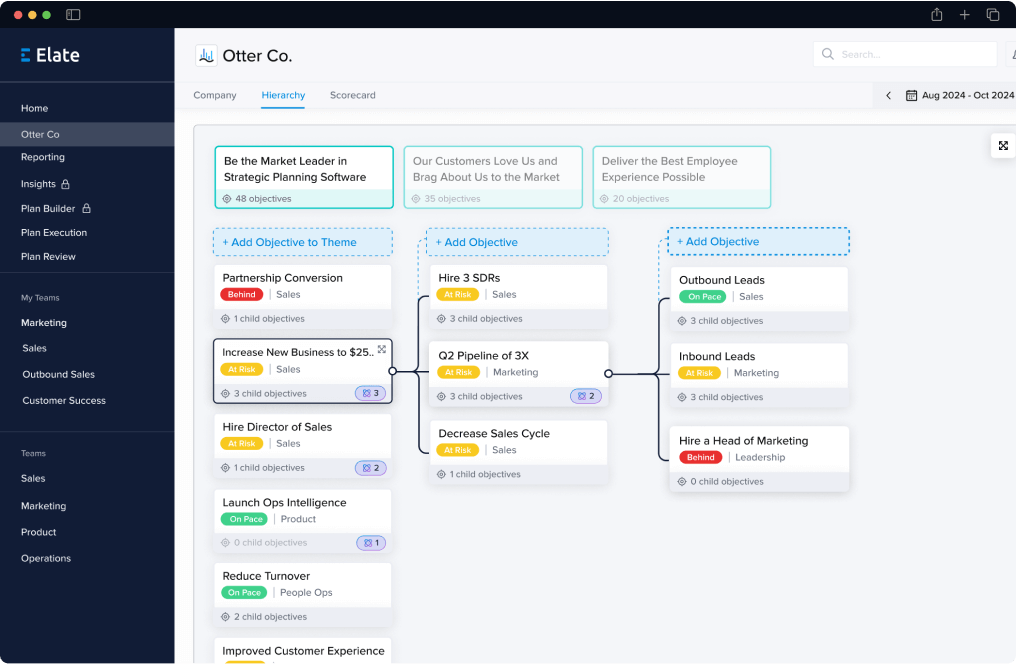











The best KPI dashboard software for your organization depends on what leaders need to do with the numbers. If the goal is data exploration, a BI tool may be the right answer. If the goal is an executive review where leaders discuss owners, risks, narrative, and next actions, the dashboard needs to support more than visualization.
Elate is useful when leaders already have KPI data but still need a better way to turn metrics into decisions. It connects selected KPIs to priorities, owners, narrative updates, risks, and executive-ready reporting so the review explains what changed, why it matters, who owns the next step, and what leadership needs to decide.
The real problem with many KPI dashboards
Most organizations already have access to data. The gap is often not visibility. The gap is translation. A dashboard can show that a metric is down, flat, or improving, but leaders still need to know what changed, why it matters, who owns the response, and what action is needed.
When dashboards stop at visualization, executives often leave with more questions:
- Which priority does this KPI support?
- Who owns the number?
- Is this off track because of timing, resourcing, execution, or external context?
- What work is supposed to move the metric?
- What risk or blocker needs leadership support?
- What decision needs to be made in this review?
Types of KPI dashboard software
Different tools are strong for different jobs. Start by choosing the category before choosing a vendor.
- BI dashboards: best for data exploration, visualization, slicing, and analysis.
- Executive scorecard tools: best for a smaller set of leadership metrics, status views, and periodic review.
- Strategy execution platforms: best when KPIs need to connect to priorities, owners, initiatives, risks, and reporting cadence.
- Spreadsheet dashboards: best for lightweight or early-stage reporting when governance and update volume are still manageable.
- Board reporting tools: best when the primary output is a governance-ready packet or pre-read.
What KPI dashboard software should include for executive teams
- Metric definitions: everyone should understand what the KPI means, how it is calculated, and what direction is good.
- Ownership: each KPI should have an accountable owner or team, not just a chart owner.
- Targets and thresholds: leaders should know when a metric is healthy, at risk, or off track.
- Narrative context: a short explanation of what changed, why it changed, and what is being done.
- Initiative connection: the work expected to move the KPI should be visible beside the metric.
- Risk visibility: blockers, dependencies, and issues should be easy to surface.
- Review output: the dashboard should support the pre-read, scorecard, board update, or executive operating review.
KPI dashboard versus company scorecard
A KPI dashboard usually emphasizes data visualization. A company scorecard emphasizes leadership review. The difference matters because executives often need a decision-ready view, not a data workbench.
- A dashboard asks: what does the data show?
- A scorecard asks: are we on track against the priorities we said mattered?
- An executive review asks: what should leaders support, adjust, escalate, or follow up on?
Many teams need all three, but they should not be confused. BI can remain the source for data analysis. The scorecard or review layer should translate selected metrics into ownership, narrative, risk, and decisions.
How to evaluate KPI dashboard software
- Can the tool show both KPI performance and owner accountability?
- Can it distinguish KPIs from supporting metrics?
- Can it show current performance, target, trend, and status in a simple way?
- Can an owner explain why the number changed and what action is underway?
- Can risks and blockers be attached to the KPI or related initiative?
- Can the output be used directly in an executive review or board pre-read?
- Can the tool work with existing BI, spreadsheet, finance, CRM, or operational systems?
When a BI tool is the better answer
A BI tool is usually the better answer when the main job is data modeling, exploration, complex visualization, or broad analytics. If your team needs to investigate the underlying data, build many dashboards, or let analysts slice performance in depth, BI should remain central.
A strategy execution or scorecard layer becomes useful when leaders need a curated set of KPIs connected to strategic priorities, owners, narrative, risks, and follow-up.
When the dashboard needs an operating layer
Elate fits when leaders already have metrics, but the review still depends on manual explanation, update chasing, and slide building. It helps teams pair selected KPIs with the priorities they support, the owners responsible for progress, the narrative that explains change, and the risks or blockers that need attention.
Elate is not a full BI replacement. It is better understood as an operating review layer for KPI plus narrative, scorecards, owner updates, strategic progress reporting, and executive-ready reporting.
Related resources
- Company scorecard
- KPIs vs metrics
- Strategy execution reporting
- Strategy execution software
- Board update software for strategy execution
- Explore the Elate platform
- Request a product demo
FAQs
What is KPI dashboard software?
KPI dashboard software helps teams track and visualize key performance indicators. For executive reviews, the strongest dashboards also connect KPIs to owners, context, risks, and decisions.
What makes a KPI dashboard useful for leadership?
Leadership dashboards are useful when they make the review faster and clearer. They should show what changed, what is at risk, who owns it, and what needs action.
Should KPI dashboard software replace BI?
Usually no. BI should remain the source for deeper data analysis. A scorecard or strategy execution layer can help translate selected KPIs into an executive review rhythm.