










Quick answer: An executive operating review is a recurring leadership rhythm that turns distributed work into decisions. For industrial companies, the review should connect strategic priorities, owners, status, selected metrics, risks, leadership asks, and follow-up across plants, facilities, regions, and business units.
Most industrial teams do not have an information problem. They have an operating story problem. The data exists in dashboards, ERP exports, finance reports, project tools, spreadsheets, meetings, and local updates. The hard part is turning that information into a leadership view that shows what changed, what is at risk, who owns the next move, and where leaders need to intervene.
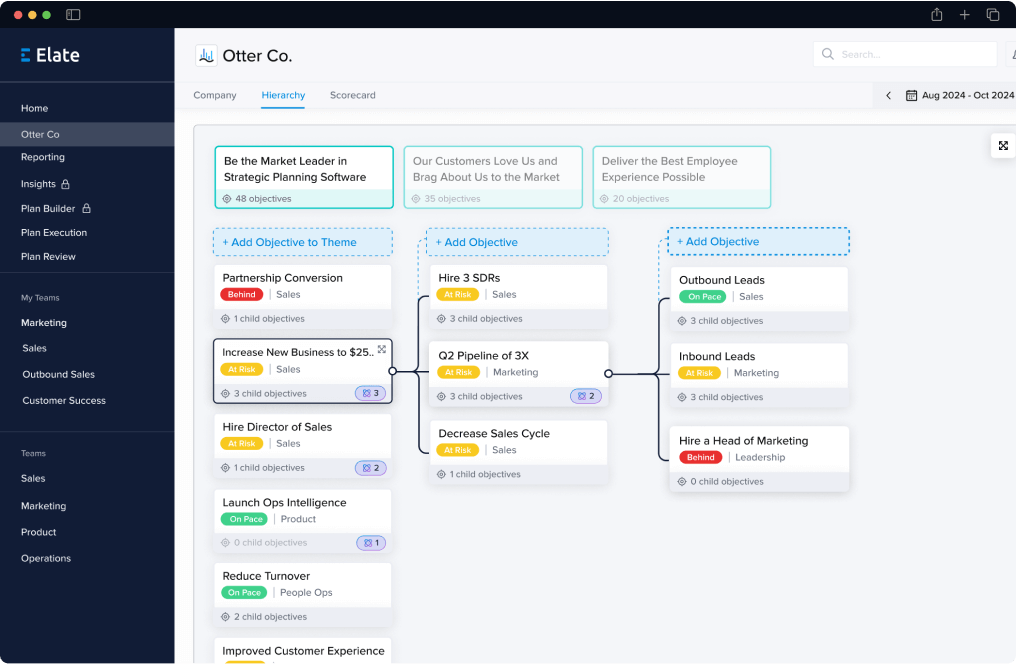
Elate helps industrial and infrastructure operators create that review rhythm without asking teams to replace every system they already use. It connects priorities, owners, updates, selected metrics, risks, and leadership asks so the executive review becomes a decision forum instead of another reporting exercise. Learn more about Elate for industrial and infrastructure strategy execution.
Use this guide if
- Your CEO, COO, ELT, board, or owner group reviews strategic priorities on a recurring cadence.
- Status updates are collected from plants, facilities, regions, operating units, or business lines.
- Leadership meetings spend too much time reconstructing status and not enough time making decisions.
- Metrics exist in dashboards or reports, but the review still lacks narrative, ownership, and next action.
- Your team needs a cleaner way to prepare executive or board updates without rebuilding a deck every cycle.
The review is the operating system
For industrial organizations, the executive operating review is more than a meeting. It is the control point where strategy becomes action. It is where leaders decide what to support, what to escalate, what to adjust, and what to watch.
A strong review does not try to show everything. It creates a consistent way to see the work that matters most. The best reviews are short, structured, and exception-focused. They help leaders understand progress in minutes, then focus the conversation on risks, blockers, and decisions.
The six elements every industrial operating review should include
1. Strategic priority
Every update should tie back to a priority leadership cares about. This keeps the review from becoming a disconnected status meeting.
2. Accountable owner
Every priority, initiative, risk, or metric needs a clear owner. Without ownership, the review becomes commentary instead of accountability.
3. Status signal
Use a consistent status language such as on track, at risk, off track, complete, or not started. The words matter less than the consistency. Everyone should know what each status means.
4. Selected metric
Bring in the few metrics that help explain progress. This may be throughput, downtime, safety indicators, cost variance, milestone progress, revenue, margin, capacity, or another operational signal. The goal is context, not a full BI session.
5. Risk or blocker
The review should surface what could prevent progress. Risks may include resource constraints, supply issues, quality problems, site readiness, project delays, budget pressure, or unresolved decisions.
6. Leadership ask
The most useful reviews make the ask explicit. Does the owner need a decision, escalation, resource, tradeoff, approval, or cross-functional support?
A practical executive operating review agenda
- Start with the at-risk list. Review priorities, initiatives, or metrics that need leadership attention first.
- Confirm what changed since the last review. Avoid rereading static updates. Focus on movement.
- Discuss risks and blockers. Separate issues that owners can solve from issues that require leadership action.
- Make decisions and capture follow-up. The review should create a clear next step, not just a shared understanding.
- Roll forward the cadence. Owners should know what to update before the next review.
Weekly, monthly, and quarterly review rhythm
Weekly or biweekly operator updates
Best use: Keep near-term work moving across teams, sites, or functions.
- Owner updates
- Blockers
- Overdue items
- Near-term risks
- Follow-ups from the last review
Monthly ELT or operating review
Best use: Give senior leaders a consistent view of priority progress and decision needs.
- Strategic priority progress
- Selected metrics with narrative context
- At-risk work
- Cross-functional dependencies
- Decisions or support needed
Quarterly board, owner, or enterprise review
Best use: Summarize progress, major risks, and leadership commitments for a broader governance audience.
- Strategic progress by priority
- Trend narrative
- Major risks and mitigations
- Leadership actions taken
- Commitments for the next quarter
What most industrial teams get wrong
They confuse dashboards with reviews
Dashboards can show performance, but they rarely explain ownership, risk, narrative, and next action. A dashboard can inform the review. It should not be the review.
They rebuild the same update every cycle
If every operating review starts with manual slide preparation, copy-paste status, and last-minute follow-up, the rhythm is too dependent on heroics.
They invite too many owners too early
Start with the executive output and the core owner group. Expand once the review loop is trusted.
They track everything at the same level
Leadership does not need every task. Local owners need detail, but executives need priority, status, risk, metric, ask, and follow-up.
How Elate supports executive operating reviews
- Priority structure: Organize strategic priorities, objectives, initiatives, and ownership in one reviewable model.
- Owner updates: Collect short, structured updates before the review so leaders are not chasing status live.
- Scorecards and selected metrics: Pair relevant metrics with narrative context, status, and ownership.
- Advanced reporting: Create executive-ready reports that show what changed, what is at risk, and what needs a decision.
- Meeting preparation: Prepare leaders with the right view before the review so the meeting can focus on action.
- Follow-up visibility: Carry decisions, risks, and next steps into the next review cycle.
Elate is not a replacement for every operational system. It gives leadership teams the operating layer where priorities, owners, updates, selected metrics, risks, and decisions come together. For a broader category view, see strategy execution software and strategy execution reporting.
Best fit and not the best fit
Best fit: Elate is a strong fit when an industrial or infrastructure organization has distributed operations, recurring executive reviews, manual reporting burden, and a need to connect priorities, owners, selected metrics, risks, and leadership asks.
Not the best fit: Elate is not an ERP, MES, EHS, BI, project management, finance, or plant-floor optimization system. It works best as the operating review layer above those systems, where leadership needs context, accountability, and follow-up.
Best next step
If your executive review still depends on spreadsheets, dashboards, project updates, and manual slide prep, start by defining the review output. What should leaders see every month? What should owners update before the meeting? What decisions should the review force?
See how Elate turns operating updates into an executive-ready review.
Related resources
- Industrial and infrastructure strategy execution software
- Use ERP, BI, and project updates in executive reviews
- Track strategic initiatives across plants and business units
- Infrastructure leadership visibility
- Strategy execution software
- Strategy execution reporting
- AI reporting assistant
FAQ
What is an executive operating review?
An executive operating review is a recurring leadership review that connects strategic priorities, owners, status, selected metrics, risks, and decisions. It helps leaders understand what is moving, what is stuck, and where support is needed.
How is an executive operating review different from a dashboard?
A dashboard shows metrics. An executive operating review adds ownership, narrative, risk, leadership asks, and follow-up. The dashboard can be an input, but the review is where leaders decide what to do next.
What should industrial companies review monthly?
Monthly industrial operating reviews should focus on priority progress, at-risk work, selected metrics, owner updates, cross-functional blockers, and decisions needed from leadership.
Who should own the executive operating review?
Ownership often sits with a COO, Chief of Staff, Strategy and Operations leader, transformation leader, or executive operations owner. The key is that someone owns the cadence, the update process, and the leadership output.
Can Elate work alongside ERP, BI, and project tools?
Yes. Elate is designed to work alongside existing systems by giving leadership a review layer for priorities, owners, updates, selected metrics, risks, and decisions. It should not be positioned as a replacement for every source system.
What is the first value milestone?
The first value milestone is not logging into a platform. It is running a real leadership review from a clearer operating view that leaders can use to make decisions and assign follow-up.