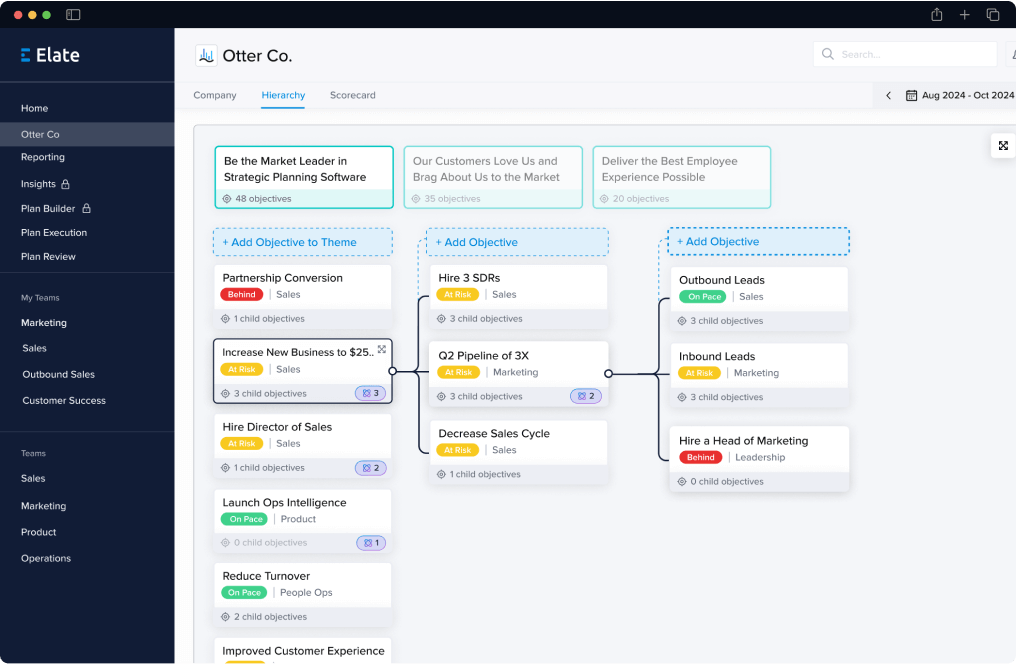











Strategy execution reporting should help leaders make better decisions, not give them another packet to decode. The useful report connects strategic priorities, owners, KPI context, narrative updates, risks, blockers, and the leadership asks that need attention before the next review.
Elate helps leadership teams create that reporting rhythm by connecting strategy updates, ownership, risks, metrics, and executive-ready reporting in one place. The goal is not to replace every dashboard or project tool. The goal is to give executives a clear review view that shows what is moving, what is stuck, and what needs a decision.
Why strategy execution reporting breaks down
Most organizations already have the ingredients for a strategy update. The plan is in a document or deck. Metrics live in BI dashboards or spreadsheets. Project details live in project tools. Owners give updates in meetings, email, or chat. The problem is that none of those sources naturally become an executive-ready operating review.
When reporting depends on a small operator group to chase updates, reconcile spreadsheets, copy dashboard screenshots, and rebuild slides every cycle, leaders get a polished artifact but not always a trustworthy operating rhythm. The report may look complete, while the real questions remain unclear: what changed, what is at risk, who owns the next move, and what support is needed?
What a useful strategy execution report should show
A strong strategy execution report gives leaders enough context to review progress quickly and decide what to do next. It should usually include:
- Strategic priority: the goal or initiative being reviewed.
- Owner: the accountable person or team.
- Status: a consistent signal, such as on track, at risk, behind, or complete.
- KPI context: selected metrics that matter to the review, with enough narrative to explain movement.
- Progress update: a short explanation of what changed since the last review.
- Risks and blockers: the issues that need leadership attention.
- Leadership ask: the decision, support, escalation, or tradeoff required.
- Follow-up: the next action and timing before the next review.
The best reports are not the longest reports. They are the ones leaders can scan before a meeting and use to guide the discussion.
Strategy execution reporting is not the same as a dashboard
BI dashboards are valuable when leaders need to inspect data. Project management tools are useful when teams need to manage tasks. Board decks are useful when a polished governance artifact is required. Strategy execution reporting sits between those systems.
The report needs the selected metrics, but it also needs ownership, narrative, risk, and action. It needs enough structure to compare progress across priorities, but enough context to explain what the numbers mean. It should help leaders review strategy on cadence instead of waiting for a quarterly scramble.
How to run the reporting cadence
A practical reporting cadence usually works like this:
- Define the executive or board review audience.
- Choose the strategic priorities that deserve recurring review.
- Assign clear owners and status definitions.
- Collect short updates before the meeting, not during the meeting.
- Pair selected KPIs with owner narrative and risk context.
- Start the review with at-risk items, blockers, and leadership asks.
- Document decisions and follow-ups before the next reporting cycle.
This cadence matters because reporting quality decays when leaders do not use the output. Owners are more likely to keep updates current when the report drives a real review.
Where Elate fits
Elate is useful when strategy reporting has outgrown spreadsheets, slide decks, and ad hoc status collection. It gives teams a strategy execution layer where priorities, owners, updates, KPI context, risks, and reporting can stay connected through the review cycle.
Elate can support executive updates, board updates, operating reviews, team scorecards, and strategy progress reports. It works alongside existing tools such as spreadsheets, BI dashboards, project management systems, CRM systems, and planning documents. Those systems can remain the source for tasks, transactions, and raw data. Elate helps turn the selected operating context into a reviewable report.
Best fit and not the best fit
Best fit: Elate is a strong fit for leadership teams with an active strategy, recurring executive review cadence, cross-functional ownership, KPI plus narrative reporting needs, and a manual reporting burden that makes every cycle harder than it should be.
Not the best fit: Elate is not meant to replace task-level project management, BI dashboards, ERP, CRM, finance systems, or every operational source of data. If the only need is a raw dashboard or a task board, another system may be the better starting point.
Related resources
- Strategy Execution Software for Leadership Teams
- Board Update Software for Strategy Execution
- Best KPI Dashboard Software for Context and Executive Reviews
- Strategic Plan Reporting Software for Higher Education
- Nonprofit Board Report Template
- Elate Platform
- Request a Demo
FAQs
What is strategy execution reporting?
Strategy execution reporting is the process of turning strategic priorities, owner updates, KPI context, risks, blockers, and decisions into a leadership-ready view. The purpose is to help executives understand progress and decide what needs attention.
How is strategy execution reporting different from KPI reporting?
KPI reporting usually focuses on numbers. Strategy execution reporting connects those numbers to owners, narrative, risks, blockers, decisions, and the operating cadence leaders use to review progress.
What should strategy execution reporting software include?
It should support priorities, ownership, status updates, KPI plus narrative context, risks, executive-ready reports, follow-ups, and a repeatable review rhythm. It should also work with existing systems instead of forcing every team to abandon the tools they already use.