










Quick answer: Strategic planning and execution software connects the plan to the work required to deliver it. It brings priorities, KPIs, initiatives, owners, updates, risks, and reporting into one review rhythm so leaders can see whether the strategy is moving and what needs attention.
Where Elate fits: Elate is built for teams that need strategic planning and execution in one operating layer. It helps leaders move from planning decisions to owner accountability, KPI context, initiative progress, risk visibility, executive reporting, and AI-assisted summaries without replacing the systems where every task or metric already lives.
Use this page if: Your planning process is disconnected from execution and leadership needs one operating rhythm for priorities, initiatives, KPIs, risks, owner updates, and review-ready reporting.
What strategic planning and execution software is and is not
It is
- A system that connects strategic priorities to execution evidence.
- A way to keep KPIs, initiatives, owner updates, risks, and reports aligned.
- A leadership operating layer for monthly, quarterly, board, and annual reviews.
- A way to preserve history so planning and review cycles build on actual progress.
It is not
- Only a planning document or goal-setting tool.
- Only a project management system.
- Only a dashboard.
- Only a board deck builder.
- A requirement that every system of record must be replaced.
What the software should connect
Strategic planning and execution software should connect the operating context leaders need to run the strategy. The point is not to centralize every detail. The point is to make the strategy review clear, trusted, and actionable.
- Plan: strategic priorities, themes, objectives, and outcomes.
- Work: initiatives, programs, projects, or workstreams connected to the plan.
- Owners: accountable leaders and contributors responsible for progress.
- KPIs: selected metrics that signal whether the strategy is moving.
- Updates: short narrative context from owners.
- Risks: blockers, off-track work, stale updates, and leadership asks.
- Reports: executive pre-reads, board updates, operating reviews, and roll-forward summaries.
- History: prior updates, decisions, and progress for future review cycles.
Why separate planning and execution tools stop scaling
Separate tools can work early. The plan lives in a deck, projects live in a PM tool, metrics live in BI, and updates live in meetings or spreadsheets. The problem shows up when leadership asks for one view of progress. Someone has to rebuild the operating story from all of those places.
Strategic planning and execution software reduces that manual reconstruction by giving the organization a consistent place to connect the plan, the work, the metrics, the owners, and the review output.
Comparison: strategic planning and execution software vs common alternatives
Project management software
Project management software helps teams deliver work. Strategic planning and execution software helps leaders understand whether that work is moving the strategy. Teams can use both.
OKR software
OKR software helps track goals. Strategic planning and execution software connects goals to initiatives, owners, risks, narrative, reports, and decisions.
BI dashboards
BI dashboards show performance data. Strategic planning and execution software connects selected metrics to owner narrative, action, and review cadence.
Spreadsheets and slides
Spreadsheets and slides can support early planning, but they are manual and fragile when strategy updates need to happen every month or quarter across multiple teams.
How Elate connects strategic planning and execution
Elate gives leadership teams a connected way to run the strategy after the plan is approved. The platform helps teams define priorities, assign owners, connect initiatives and KPIs, collect updates, surface risk, create reports, and preserve the operating history around the plan.
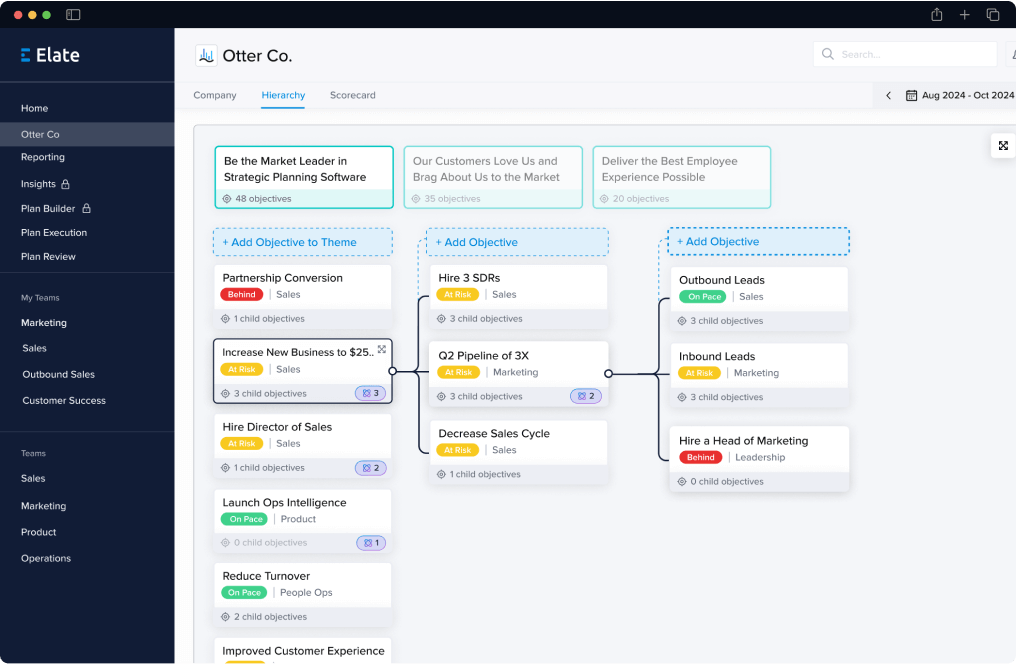
- Plan hierarchy connects priorities, objectives, initiatives, and outcomes.
- Owner updates keep progress current before leadership reviews.
- Scorecards pair KPIs with narrative and context.
- Risk views show what is at risk, stale, blocked, or in need of attention.
- Reports and pre-reads support executive, board, and operating reviews.
- AI-assisted workflows help summarize updates, draft reports, and surface issues for leaders to review.
- Historical tracking makes roll-forward and annual planning easier.
What leaders should be able to answer in two minutes
- What changed since the last review?
- Which priorities are on track, at risk, or off track?
- Who owns each priority and initiative?
- Which KPIs matter and what do they mean?
- What risks or blockers need leadership attention?
- What decisions or support are needed?
- What follow-ups should carry into the next review?
Implementation checklist
- Start with the executive review output you need to create.
- Map the strategic plan into priorities, objectives, initiatives, and outcomes.
- Assign owners and supporting teams.
- Choose a small set of KPIs for leadership review.
- Define status meanings and update expectations.
- Collect short owner updates before the first review.
- Build a report that starts with risks, blockers, and decisions.
- Use the first review to capture follow-ups and improve the cadence.
- Expand after the review loop is trusted.
What most teams get wrong
The common mistake is trying to integrate everything before the review rhythm works. Start by making the executive review useful. Once leaders trust the view and owners update consistently, deeper integrations become easier to prioritize.
Related resources
Use these pages to go deeper by category, workflow, and buyer environment.
- Strategy execution software
- Strategic planning software
- Best strategic planning software
- Strategic planning tools
- Strategy execution reporting
- Board update software for strategy execution
- Elate platform
- Elate AI Strategy Advisor
- See an Elate product demo
- Elate for higher education
- Elate for nonprofits
- Elate for credit unions
FAQ
What is strategic planning and execution software?
Strategic planning and execution software connects the strategic plan to initiatives, KPIs, owners, updates, risks, and reports so leaders can review execution and make decisions.
What is the difference between strategic planning software and strategic planning and execution software?
Strategic planning software often focuses on creating or organizing the plan. Strategic planning and execution software also supports ownership, cadence, KPIs, risks, updates, reporting, and review after the plan is approved.
How does Elate help connect strategy and execution?
Elate connects strategic priorities to initiatives, owners, KPIs, status updates, risks, and executive-ready reports. Teams use it to keep strategy current and reviewable without rebuilding updates manually.
Can we keep our existing project management and BI tools?
Yes. Many teams keep project management tools for delivery and BI tools for analytics. Elate sits above those systems as the strategy execution and review layer.
Do we need one system for every task and metric?
No. The goal is not to force every task and metric into one place. The goal is to connect the strategic context leaders need to review progress and act on risk.
What is the best first use case for strategic planning and execution software?
The best first use case is usually an executive operating review, board update, quarterly strategy review, or leadership pre-read where priorities, owners, KPIs, risks, and updates need to be clear.
How is strategic planning and execution software different from OKR software?
OKR software focuses on goals and key results. Strategic planning and execution software connects goals to broader initiatives, owner updates, KPIs, risks, reports, and leadership decisions.