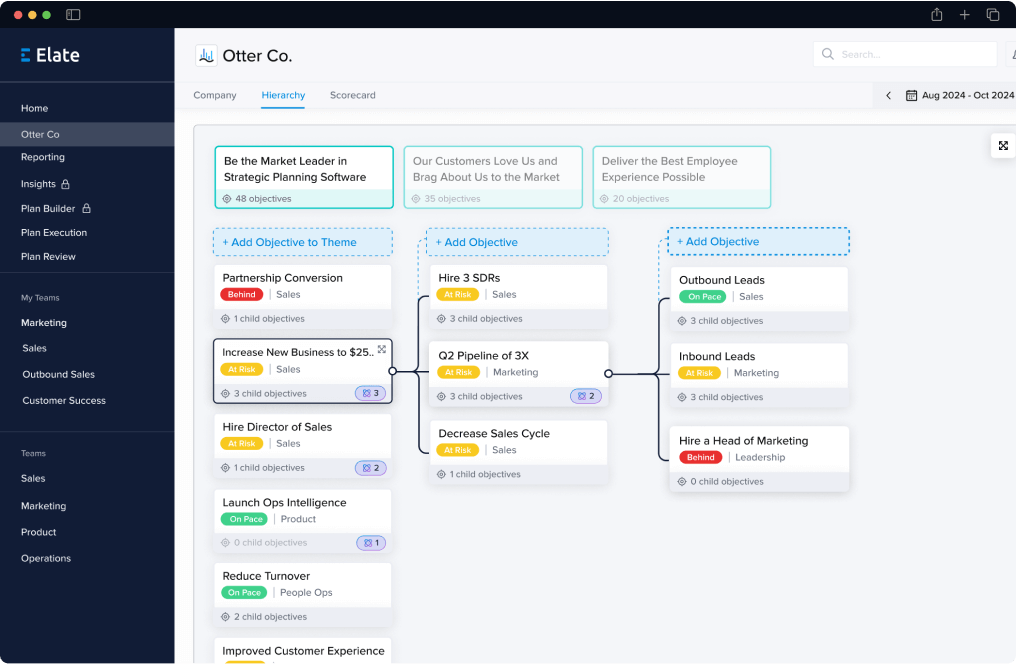











Quick answer: ERP, BI, and project tools can support executive reviews by providing selected facts, metrics, milestones, and context. But the review itself should not depend on a massive integration project. Start by connecting the operating story: priority, owner, metric, narrative, risk, decision, and follow-up.
Important note: This page does not imply that every ERP, BI, MES, EHS, finance, or project system integrates directly with Elate. The practical starting point is to keep source systems in place and bring selected metrics, updates, and context into the leadership review where they can drive decisions.
Elate helps leadership teams keep ERP, BI, finance, project, and operational systems in place while creating a review layer for selected metrics, owners, narrative, risks, and follow-up. For a broader overview of Elate for asset-heavy operators, visit industrial and infrastructure strategy execution software.
Use this guide if
- Your company already has ERP, BI, project, finance, or operational systems, but executive reviews are still manual.
- Leaders look at dashboards, then still ask who owns the response.
- Project updates exist, but they are not connected to strategic priorities or operating risks.
- Metrics are available, but the review lacks narrative, decisions, and follow-up.
- Your team wants a practical operating review before over-scoping system integrations.
The system-of-record trap
Industrial organizations often assume the executive visibility problem will be solved by one more dashboard or one more integration. Sometimes that helps. But many leadership teams already have plenty of systems. ERP holds records. BI shows metrics. Project tools track work. Finance systems hold budgets. EHS and risk systems manage specialized workflows.
The gap is usually not a lack of systems. The gap is translation. Leaders need a clear view of what the numbers mean, who owns the response, what is at risk, and what decision is needed.
What each system should do
ERP and operational systems
ERP and operational systems are best used as sources of record for operational, production, inventory, financial, or business data. They should not be forced to become the executive strategy review.
BI dashboards
BI dashboards are useful for visualizing numbers, trends, and performance. The executive review still needs explanation, ownership, risk, and next action.
Project tools
Project tools are useful for tasks, due dates, dependencies, and detailed delivery. Executives usually need a higher-level summary of progress, risk, priority linkage, and decisions.
EHS, safety, or risk systems
Specialized safety, risk, compliance, and incident systems should stay focused on their workflows. The leadership review should surface relevant commitments or risks without replacing those systems.
Finance systems
Finance systems should remain the source of truth for budget, forecast, variance, and financial reporting. The executive review should connect financial context to initiative ownership and tradeoffs.
The better model: selected metric plus operating context
The goal is not to pull every field into one place. The goal is to bring enough context into the review so leaders can act. A useful executive review view should include the following elements.
Selected metric
A signal worth discussing, such as throughput, downtime, project milestone, cost variance, revenue, margin, capacity, safety indicator, or delivery performance.
Source note
A simple explanation of where the number comes from, such as a BI dashboard, finance report, ERP export, spreadsheet, project system, or operational review.
Owner
The person accountable for interpreting the metric and driving follow-up. This could be an operations VP, plant leader, program owner, finance partner, transformation lead, or business-unit leader.
Narrative
The explanation of what changed and why. Examples include demand mix, supplier delay, labor constraint, scope change, budget timing, maintenance backlog, or market movement.
Risk or status
A clear signal that shows whether leadership attention is needed. Use simple language such as on track, at risk, off track, blocked, monitor, or complete.
Next action
The follow-up that turns data into leadership action. This may be a decision, escalation, resource shift, approval, or commitment to monitor.
How to start without over-scoping integrations
- Choose the leadership review first. Define which review needs a better operating view.
- Select a small set of metrics. Start with the metrics that actually change decisions.
- Name the source of each metric. Be transparent about whether the source is BI, ERP, finance, a spreadsheet, or a project tool.
- Assign a business owner. Metrics need people who can explain movement and own follow-up.
- Pair each metric with narrative. Leaders need to know why the number changed.
- Review risk and action. The review should end with decisions, support, or next steps.
- Automate later where it is valuable. Deeper connections are useful when the review rhythm is already trusted.
What most teams get wrong
They start with integrations instead of the review
If the leadership output is unclear, more data will not solve the problem. Define the decision rhythm first.
They treat dashboards as accountability
A dashboard can show what changed. It does not always show who owns the response, what is at risk, or what decision is needed.
They duplicate the source of truth
The goal is not to recreate ERP, BI, finance, EHS, or project systems. The goal is to use selected signals from those systems in the leadership review.
They overpromise data automation
Not every system needs to connect on day one. Many teams get value first by standardizing the review and then deciding where automation is worth the effort.
How Elate fits
- Operating review layer: Elate helps connect priorities, owners, updates, selected metrics, risks, and leadership asks in one reviewable system.
- Scorecards: Teams can pair metrics with status, narrative, and owner context.
- Advanced reporting: Leaders can generate executive-ready updates without rebuilding the operating story from scratch.
- Automated status updates: Owners can provide structured progress updates before the review.
- Meeting preparation: Review materials can be prepared around what needs attention, not just what happened.
- Follow-up visibility: Decisions and next actions can carry into the next cadence cycle.
Elate should be positioned as a strategy execution and operating review layer, not as a universal ERP integration platform. For a comparison across tool types, see strategy execution software vs project management, OKR, and BI tools.
Best fit and not the best fit
Best fit: Elate is a strong fit when leaders already have data in ERP, BI, finance, project, or operational systems but still need a clearer executive review that connects selected metrics to owners, risks, narrative, decisions, and follow-up.
Not the best fit: Elate is not a universal ERP integration platform, BI replacement, MES, EHS, finance system, or project management replacement. It works best when the first goal is a better operating review, not a massive source-system consolidation project.
Best next step
Before asking which systems should integrate, ask which leadership review needs to improve. Then identify the five to ten signals leaders actually use to make decisions. Those signals become the first version of the operating review.
See how Elate helps leadership teams turn metrics and updates into an executive-ready review.
Related resources
- Industrial and infrastructure strategy execution software
- Executive operating review process for industrial companies
- Track strategic initiatives across plants and business units
- Strategy execution software
- Strategy execution reporting
- Strategy execution software vs project management, OKR, and BI tools
- AI reporting assistant
FAQ
Does Elate directly integrate with every ERP or BI system?
No. Do not assume every ERP, BI, MES, EHS, finance, or project system integrates directly with Elate. The safer and more useful starting point is to keep source systems in place and bring selected metrics, updates, source notes, and context into the leadership review.
How should ERP data be used in executive reviews?
ERP data should provide selected facts or operating signals when they are relevant to strategic priorities. The executive review still needs owner, narrative, risk, decision, and follow-up.
How is BI different from an executive operating review?
BI helps visualize numbers and trends. An executive operating review explains what those numbers mean, who owns the response, what is at risk, and what leadership should decide.
Should project tools feed executive reviews?
Project tools can provide milestones, task progress, and dependency context. Leaders usually need a summarized view that connects project progress to strategic priorities, risks, and decisions.
What is the best first step before integrating systems?
Define the review output first. Decide what leaders need to see, which metrics matter, who owns each update, and what decisions the review should produce.
Can Elate work alongside existing systems?
Yes. Elate is designed to work alongside existing systems by creating an operating layer for priorities, owners, updates, selected metrics, risks, reports, and follow-up.