Pulse 63: Creating Your Organization's Strategic Memory
TLDR: Visibility is the challenge every executive names and few organizations solve consistently. The foundation starts with a complete, connected record of how strategy is built, communicated, and executed over time.
One of the most consistent challenges I hear from executives is visibility.
What that actually means depends on who's asking. For a CEO, it might mean better insight into company performance, or a clearer picture of what to bring to the Board. For a COO, it means understanding how teams are prioritizing their work. For employees, it means transparency into the organizational strategy and clarity into how their work connects.
Visibility leads to clarity, which leads to alignment, which leads to execution. Just about everyone in an organization agrees it matters.
So why does it still take a backseat for so many?
Because it requires commitment.
The Right Work > More Work
AI has changed what organizations can do quickly. Leaders can access contextualized data faster than before, build dashboards in minutes, get industry benchmarks without manual research, and set up workflows to automate time-consuming tasks.
But one challenge AI has yet to solve on its own is visibility.
Work can be done faster and more efficiently. When combined with human insight and feedback, it can be done at a higher quality than ever before. But as one Chief Strategy Officer said to me, which I shared in the 53rd Edition of The Pulse:
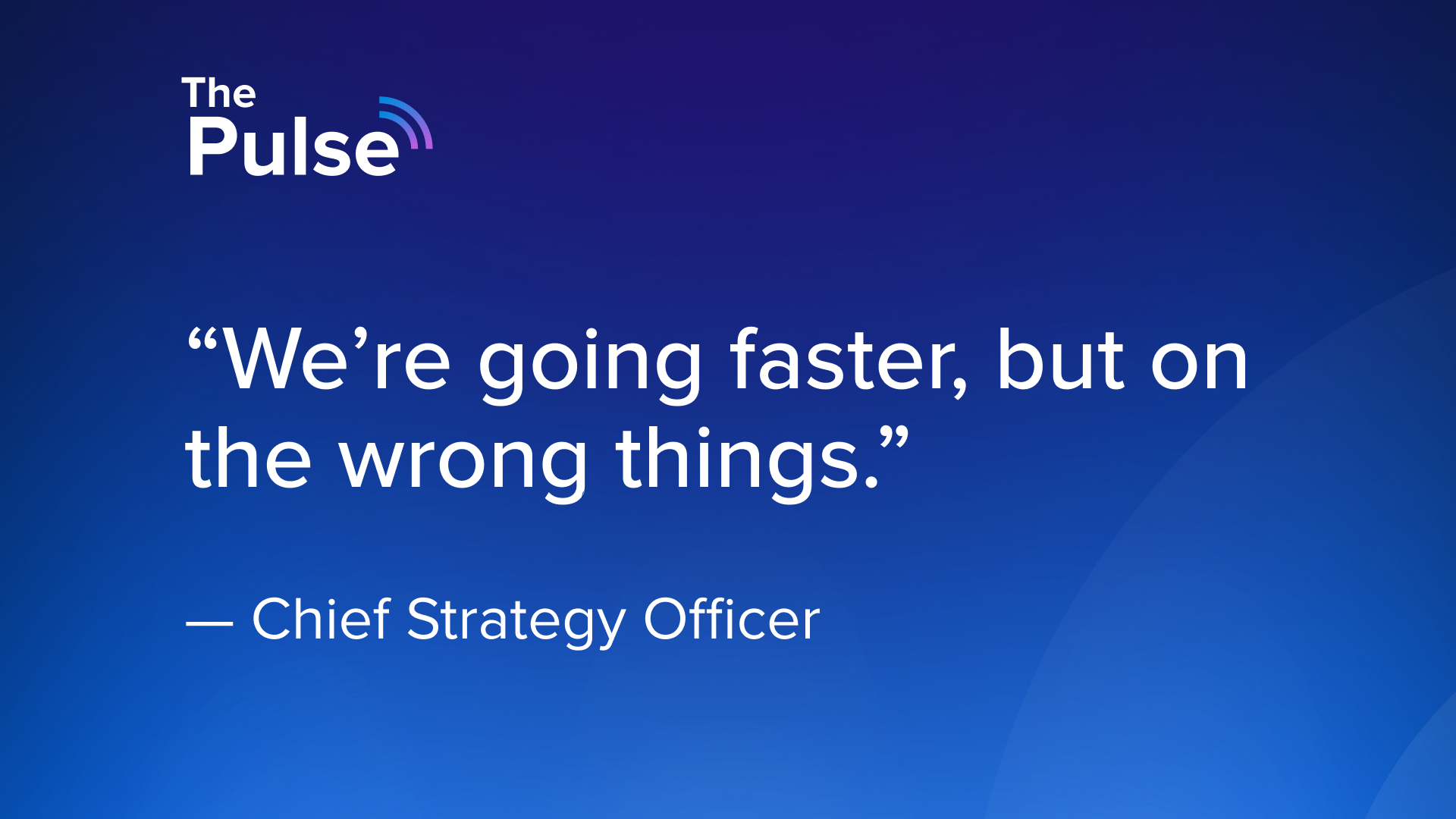
"Just because our team is using AI to automate workstreams being tracked in our Project Management tool, it doesn't mean those are the right workstreams. It's like our team was driving the wrong way on a one-way street at 30 mph. Now with AI, they are still driving the wrong way, but they are going 90 mph instead of 30. We're going faster, but on the wrong things."
So how do we ensure teams are aligned with organizational direction, leaders are communicating clearly, and the right signals are being surfaced for the Board? How do we create visibility?
We build a system of record for organizational strategy and execution.
Creating Your Organization's Strategic Memory
For most organizations, strategy and execution data does not live in a single platform. It lives fragmented across PowerPoints, spreadsheets, board decks, meeting notes, email chains, and individual leaders' heads.
When a leader leaves or those presentations are retired, the context disappears, or survives only as context-less KPIs pulled from disconnected systems. As I shared in the previous edition, if you're waiting on that data to be just right, then you might be waiting a while.
Because strategy and execution data is scattered across so many sources, it is nearly impossible to build visibility on top of it. And it limits what AI can actually do to help.
Strategy leaders need to treat their organization's strategies, past, present, and future, as the foundation for visibility. A complete, unified view of strategic intent, decisions, assumptions, objectives, ownership, dependencies, progress, risks, and outcomes. That full record is what I mean by strategic memory.
Strategic memory gives leaders and AI agents something real to work from: what worked, why it worked, who was involved, and which risks are most likely to affect future execution.
Without it, strategy is a planning exercise that gets revisited quarterly and reported on statically.
With it, strategy becomes the intelligence layer the organization actually runs on.
A Question for Your Leadership Team
Before building the foundation, it helps to understand the gap.
Here is a diagnostic worth running: If a senior leader left your organization tomorrow, how much of your strategic context would leave with them?
Not the KPIs in your BI tool or the status updates in your project management system. The actual thinking: why certain objectives were prioritized, which risks were considered and set aside, what the Board was focused on six months ago.
Most organizations would struggle to answer that. The context exists. It just lives in the wrong places.
That is the gap strategic memory closes.
The Strategy Unlock
Once a strategy system has this kind of memory, the questions leaders could previously only answer through hours of manual research, or the right conversation with the right person, become instantly accessible:
- What did we say we would do?
- What actually happened?
- Which objectives drove outcomes?
- Which teams were involved?
- What risks repeatedly emerged?
- Which interventions worked?
- What assumptions proved false?
- How did priorities evolve over time?
And there is more.
With that foundation in place, AI can recommend who should be involved in a new objective based on historical success patterns, identify recurring execution bottlenecks before they become material risks, surface strategic dependencies that are invisible across functional systems, and predict which objectives are most likely to miss targets based on how similar ones played out.
When those questions can be answered, visibility follows from every direction: leaders gain a clearer picture of progress, employees understand where the organization is headed, and Boards get the reporting they actually need.
It all starts with the foundation.
Elate as the Strategic Memory Layer
AI has proven its ability to accelerate a specific set of tasks: generating reports, automating workflows, parsing large amounts of information to surface insights. The value is real.
The organizations getting the most from AI in strategy are the ones that gave it something real to work with first. A structured, connected record of how their strategy was built, where it went, and what they learned.
That is what we have been building at Elate.
We are seeing strategy leaders use that foundation to align past insight with future decisions, eliminate hours of reporting, and create visibility from the executive team to individual contributors. In the weeks ahead, I am excited to share more on how we have continued to expand what AI can do when it has this kind of foundation to work from.
If you are thinking about what this looks like for your organization, reach out. I am glad to talk through it.
Until next time,
Brooks