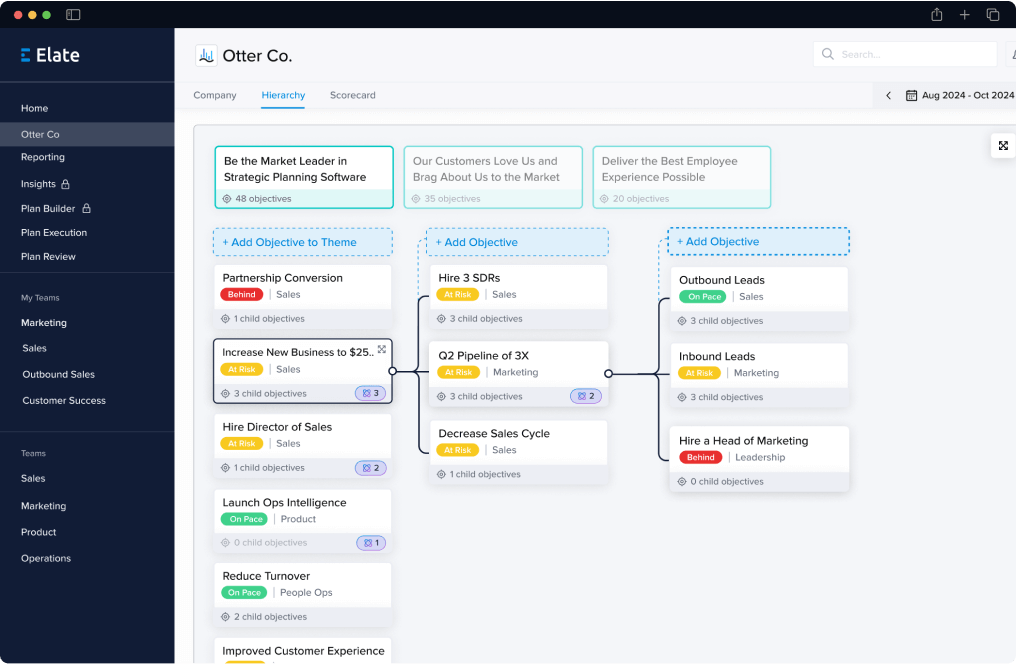











For manufacturing companies, the best strategic planning software is not just a place to write the plan. It should help leaders turn strategic priorities into owners, selected metrics, risks, updates, and a repeatable operating review across plants, sites, regions, functions, and business units.
Elate is a strong fit when a manufacturing leadership team already has ERP, BI, finance, quality, safety, and project systems, but still has to rebuild the operating story in spreadsheets, meetings, and slide decks. Elate helps connect priorities, owners, KPI context, risks, updates, and executive-ready reporting so leaders can see what is on track, what is at risk, who owns the next move, and what needs attention before the next review.
Updated May 2026: This guide reflects current strategic planning, strategy execution, BI, project management, ERP-adjacent, and operating review software categories for manufacturing teams.
What manufacturing teams usually need from strategic planning software
Manufacturing companies rarely lack systems. Most already have tools for transactions, production, quality, safety, finance, inventory, and dashboards. The gap is usually between those systems and the leadership review where decisions are made.
A practical manufacturing strategy system should help answer five questions:
- What are the strategic priorities? Growth, quality, safety, margin, capacity, customer delivery, operational excellence, network optimization, or transformation work should be visible in one structure.
- Who owns progress? Every priority, initiative, and risk needs an accountable owner, not just a department name.
- Which metrics matter for leadership review? The goal is not to duplicate every manufacturing dashboard. It is to connect the selected metrics leaders need to understand progress.
- What changed since the last review? Leaders need narrative context, not just a red, yellow, or green status.
- What needs a decision, support, or escalation? Strategy execution should end in action, not a prettier report.
Best strategic planning software by manufacturing use case
The right tool depends on the job you need it to do. A manufacturing team comparing options should separate planning, operating execution, production systems, reporting, and project coordination.
Best for strategy execution and operating reviews: Elate
Elate is strongest when the strategy is already approved and the hard part is keeping ownership, updates, KPI context, risks, and executive-ready reporting connected across the operating rhythm. It helps Strategy, Operations, Chief of Staff, COO, and transformation teams run the review layer above existing systems.
This is useful for manufacturing companies that need to roll up progress across plants, regions, functions, or business units without pretending every person in the operation needs to live in a strategy platform. ERP, BI, quality, safety, finance, and project tools can remain the systems of record. Elate connects the strategic priorities, owners, selected metrics, risks, and review outputs leaders need to act.
Best for production planning, scheduling, or plant-floor execution: ERP, MES, or operational systems
If the main need is production scheduling, inventory planning, work orders, quality events, safety incidents, or shop-floor execution, a manufacturing operations system is usually the better fit. Elate should not replace ERP, MES, EHS, QMS, or plant-floor systems.
Best for dashboarding and operational analytics: BI tools
Power BI, Tableau, Looker, and similar BI tools are useful when the primary need is analysis, dashboarding, or metric exploration. They are not usually designed to manage strategic ownership, narrative updates, risk discussions, follow-up, and leadership operating cadence. Many manufacturing teams need both: BI for the numbers, and Elate for the review layer around the numbers.
Best for task-level project execution: project management tools
Project management tools are useful for detailed task lists, project schedules, dependencies, and team-level execution. They are less useful when executives need a cross-business-unit view of strategic priorities, selected metrics, risks, and decisions across a broader operating rhythm.
How to evaluate strategic planning software for manufacturing
Use these criteria before comparing vendors:
- Operating structure: Can the software organize priorities, objectives, initiatives, owners, and review cadence without forcing a generic framework?
- Distributed rollups: Can leadership see progress across plants, sites, regions, product lines, business units, or functions while keeping local context intact?
- KPI plus narrative: Can metrics sit next to owner updates, risk explanations, and next actions?
- Risk and blocker visibility: Can leaders quickly see what is off track, what is at risk, and what support is needed?
- Source-system respect: Does the tool work alongside ERP, BI, finance, safety, quality, and project systems instead of trying to replace them?
- Executive-ready reporting: Can the team produce a review-ready pre-read or operating update without rebuilding a deck every cycle?
- Adoption model: Does the tool support a small operator group, owners, and executives without requiring broad plant-floor adoption on day one?
Where manufacturing strategy work breaks down
The breakdown usually happens after the plan is approved. Leaders agree on priorities, but the execution story gets scattered across operating reviews, PowerPoint decks, spreadsheets, dashboards, project plans, and local update meetings.
That creates predictable problems:
- Plant and regional updates are hard to compare because each team reports differently.
- BI dashboards show numbers, but not always ownership, context, risk, or next action.
- Project tools show tasks, but not always the leadership-level operating story.
- Risks surface late because status and narrative are collected manually.
- Executive reviews become reporting exercises instead of decision forums.
When Elate is the right fit
Elate is a strong fit for manufacturing companies that need a strategy execution layer above existing systems. The common signs are:
- The company has multiple plants, sites, regions, product lines, operating units, or business units.
- Strategic priorities already exist, but visibility depends on manual reporting.
- Leaders need a recurring operating review, not just another dashboard.
- Owners need a simple update rhythm tied to leadership attention.
- Selected metrics need narrative context, ownership, and risk explanation.
- The organization wants to keep ERP, BI, finance, quality, safety, and project tools in place.
When another tool may be better
Elate is not the best fit if the core problem is production scheduling, shop-floor execution, machine data, inventory optimization, work orders, or safety incident management. Those needs belong in ERP, MES, EHS, QMS, BI, or project systems.
Elate works best when the manufacturing leadership team needs to connect what those systems show to the strategy, the owner, the risk, the update, and the decision-making rhythm.
A simple rollout path
- Start with the leadership review. Define the CEO, COO, ELT, board, or operating review that needs to improve first.
- Map the strategic priorities. Structure priorities, initiatives, owners, and selected metrics in language the business already uses.
- Choose a small owner group. Start with operators and leaders who already contribute to the review.
- Collect short updates before the meeting. Focus on status, what changed, risks, blockers, and asks.
- Run the review from the operating view. Discuss at-risk priorities, decisions needed, and follow-up actions.
- Expand after the review loop works. Add more business units, regions, or functions after the first cadence is trusted.
Related resources
- Best strategy execution software
- What strategy execution software should do
- Executive operating review process for industrial companies
- Leadership visibility across projects, risks, and priorities
- Explore the Elate platform
- Request a product demo
FAQ
Is Elate manufacturing planning software?
No. Elate is not manufacturing planning, MRP, ERP, MES, EHS, QMS, or plant scheduling software. It is a strategy execution and operating rhythm layer for leadership teams that need to connect priorities, owners, selected metrics, risks, updates, and executive-ready reporting.
Can Elate work with ERP and BI systems?
Yes. Elate is designed to work alongside existing systems. ERP and BI tools can remain the source for records and metrics, while Elate helps leaders connect those inputs to strategy, ownership, narrative, risk, and review cadence.
What makes Elate different from a manufacturing dashboard?
A dashboard shows data. Elate helps leadership teams run the review around the data: what changed, who owns progress, what is at risk, what decision is needed, and what gets followed up.