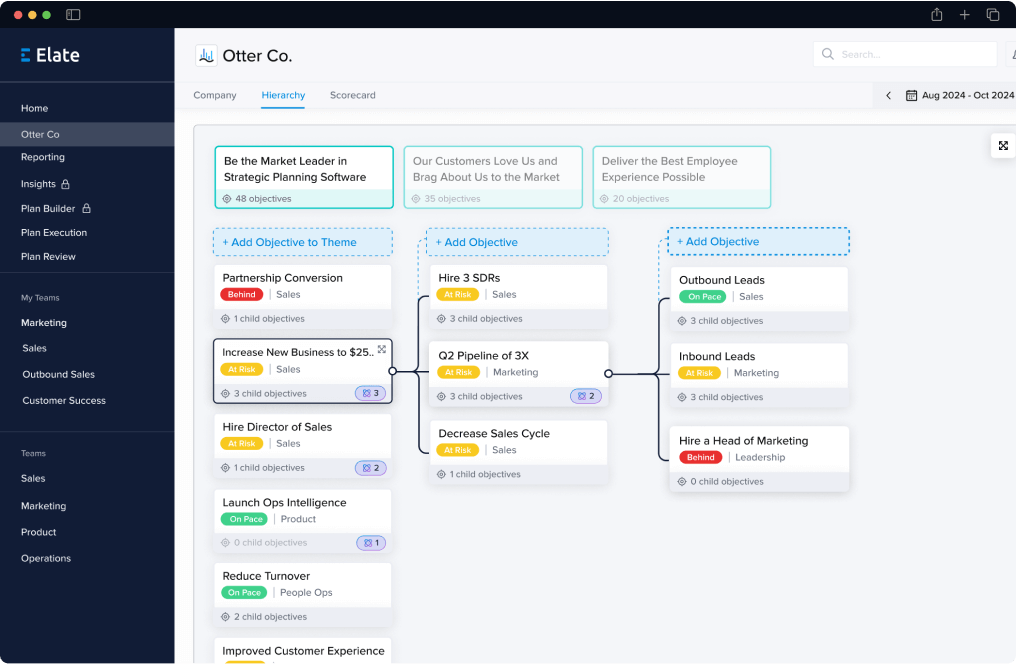











Quick answer: Infrastructure leadership visibility means executives can see how projects, risks, operating priorities, owners, selected metrics, and decisions connect before issues become escalations. It is broader than project status and more actionable than a dashboard.
Infrastructure organizations often have project plans, risk registers, dashboards, asset systems, field updates, and leadership meetings. The visibility gap appears when those pieces do not connect into a clear operating view. Leaders may know that work is happening, but not which priorities are at risk, who owns the response, and what decision is needed.
Elate helps infrastructure and asset-heavy operators create a leadership-ready operating view across projects, risks, priorities, owners, selected metrics, and follow-up. It works alongside project, risk, asset, finance, and BI systems so leaders can review the operating story without rebuilding it manually. See the broader solution for industrial and infrastructure strategy execution.
Use this guide if
- Your organization manages infrastructure projects, operating priorities, asset-heavy programs, or distributed field work.
- Risk and project updates live in multiple tools, decks, meetings, or spreadsheets.
- Leaders need a clearer view of what is at risk before it becomes an escalation.
- Project status exists, but it is hard to connect it to enterprise priorities or executive decisions.
- Your monthly or quarterly review is rebuilt manually every cycle.
Project visibility is not the same as leadership visibility
Project visibility answers whether work is moving. Leadership visibility answers whether the right work is moving, what it means for the operating priorities, which risks need attention, and what leaders should do next.
Infrastructure teams often have strong project detail but weak executive translation. The leadership layer should not replace project controls, risk systems, or asset systems. It should connect the relevant signals into a clear review rhythm.
The infrastructure visibility stack
Strategic priority
The operating outcome, enterprise commitment, or strategic objective the work supports. This answers why the work matters.
Project or initiative
The specific work contributing to the priority. This may include capital programs, modernization efforts, maintenance initiatives, network projects, operational improvements, or transformation work.
Accountable owner
The person or team responsible for keeping the update current and owning the next move.
Risk or blocker
The issue that could affect delivery, budget, reliability, customer impact, safety, compliance, or operational performance.
Selected metric
The signal that helps leaders understand progress or risk. This may include milestone completion, budget variance, schedule variance, uptime, service levels, backlog, capacity, safety, or another operating measure.
Leadership ask
The decision, support, resource, approval, tradeoff, or escalation needed from leaders.
Follow-up
The action that carries into the next review so the same risk is not rediscovered every month.
What leaders should see in each review
Monthly operating review
Best use: Create a consistent view of priority status, risk movement, blockers, owner updates, and decisions needed.
- Priority progress
- At-risk projects or initiatives
- Owner updates
- Selected metrics with narrative context
- Leadership asks and follow-up
Quarterly board or owner update
Best use: Summarize strategic progress, major risks, trend narrative, and leadership actions for a governance audience.
- Strategic progress by priority
- Major risks and mitigations
- Trend narrative
- Decisions made or needed
- Commitments for the next period
Program or portfolio review
Best use: Compare work across projects, regions, facilities, asset groups, or functions while preserving local context.
- Progress by program or portfolio
- Cross-unit blockers
- Resource constraints
- Dependencies
- Follow-up view
Where infrastructure visibility usually breaks
Project tools do not show strategic tradeoffs
Project detail is necessary, but it can be too granular for executive decisions. Leaders need to see which projects affect strategic priorities, risk, and operating performance.
Risk registers do not always drive review behavior
A risk register may document risk, but leadership still needs a recurring rhythm to decide what to escalate, support, or monitor.
Dashboards lack narrative and owner context
A dashboard can show a trend. It may not explain why the trend changed, who owns the response, or what decision is needed.
Quarterly reporting becomes a reconstruction exercise
If the board or owner update requires weeks of manual collection, the operating rhythm is too fragile.
A better leadership visibility model
- Define the leadership audience. Is the view for CEO, COO, ELT, board, owner group, program leadership, or a governance committee?
- Choose the priority structure. Connect projects and initiatives to strategic priorities or operating commitments.
- Name accountable owners. Every priority, risk, and initiative should have someone responsible for the update.
- Use exception-based reporting. Focus leaders on what is at risk, blocked, off track, or in need of a decision.
- Add selected metrics carefully. Use metrics that change the conversation, not every available measure.
- Capture follow-up. A review that does not create next actions becomes a reporting ritual instead of a leadership rhythm.
How Elate supports infrastructure leadership visibility
- Priority and initiative structure: Connect enterprise priorities to infrastructure projects, programs, and operating work.
- Owner accountability: Give each priority, initiative, risk, or update a clear owner.
- Risk and status visibility: Surface at-risk work before leadership is surprised.
- Scorecards: Pair selected metrics with narrative and status context.
- Executive reports: Prepare leadership-ready reports for monthly operating reviews, quarterly updates, and governance meetings.
- Follow-up tracking: Carry decisions and actions into the next cadence cycle.
Elate does not need to replace project controls, BI, EHS, asset systems, or finance tools to create value. It gives leaders the strategy execution layer where the most important updates, risks, and decisions come together. For the operating review foundation, see executive operating review process for industrial companies.
Best fit and not the best fit
Best fit: Elate is a strong fit when infrastructure leaders need one review rhythm for projects, operating priorities, risks, owners, selected metrics, and leadership follow-up across distributed teams or programs.
Not the best fit: Elate is not a project controls system, risk register, EHS platform, BI tool, asset system, or field execution system. It works best as the leadership visibility layer that connects those inputs to the executive operating review.
Best next step
Choose one recurring leadership review and list the top questions leaders ask every month. If the answers come from five different systems and three people have to rebuild the story, that review needs a stronger operating layer.
Related resources
- Industrial and infrastructure strategy execution software
- Executive operating review process for industrial companies
- Use ERP, BI, and project updates in executive reviews
- Track strategic initiatives across plants and business units
- Strategy execution software
- Strategy execution reporting
- AI reporting assistant
FAQ
What does leadership visibility mean for infrastructure companies?
Leadership visibility means executives can see how projects, risks, priorities, owners, metrics, and decisions connect. It is not just project status. It is the operating story leaders need to act.
How is project visibility different from operating visibility?
Project visibility shows whether work is moving. Operating visibility shows whether strategic priorities are moving, what is at risk, who owns the response, and what leaders need to decide.
What should be included in an infrastructure leadership review?
An infrastructure leadership review should include strategic priority, project or initiative, owner, status, selected metric, risk or blocker, leadership ask, and follow-up.
Can infrastructure teams use dashboards for leadership visibility?
Dashboards are useful inputs, but they usually need narrative, ownership, risk, and decisions added to become leadership visibility.
Does Elate replace project management or risk systems?
No. Elate should work alongside those systems by creating a leadership review layer for priorities, owners, updates, selected metrics, risks, and follow-up.
Who should own infrastructure leadership visibility?
Ownership often sits with a COO, Chief of Staff, Strategy and Operations leader, PMO or portfolio leader, transformation lead, or executive operations owner. The owner must manage the cadence and the leadership output.