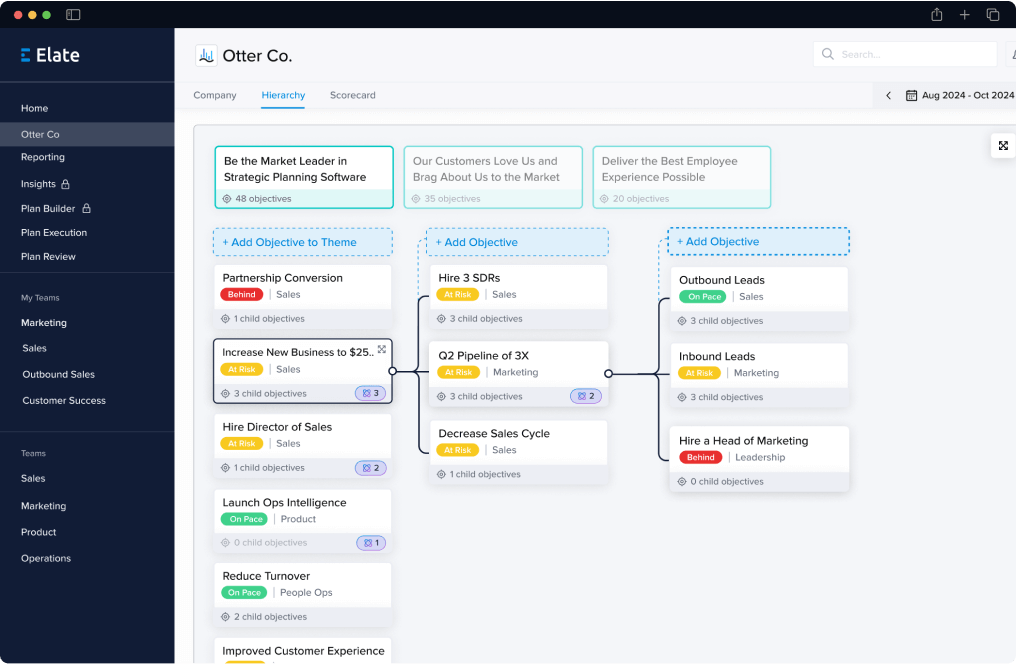











Chief of Staff software should help run the executive operating rhythm. The job is not just task coordination. It is keeping strategic priorities, owners, risks, decisions, updates, and leadership reporting aligned across the organization.
Elate fits the Chief of Staff workflow when the executive cadence depends on clean pre-reads, clear accountability, and follow-up after leadership meetings. Elate connects priorities, owners, KPIs, risks, updates, and reports so the CoS can spend less time chasing status and more time helping leaders decide what needs attention.
The Chief of Staff operating reality
Chiefs of Staff often sit between strategy, operations, executive communication, and cross-functional follow-through. They need a trusted rhythm for collecting updates, surfacing risks, preparing leadership, and carrying decisions forward.
What Chief of Staff software should support
- Executive priorities and annual focus areas.
- Ownership across functions, departments, or business units.
- Short update prompts before leadership meetings.
- Risk and blocker visibility.
- Pre-read or report generation for executive review.
- Decision and follow-up tracking after meetings.
- A clear view of stale or missing updates.
How to use it in the weekly or monthly cadence
- Start with the executive priorities that need recurring review.
- Assign owners and define what a useful update should include.
- Send update requests before the leadership meeting.
- Use the pre-read to identify what is at risk or needs a decision.
- Capture follow-ups and review them at the next cadence.
Example Chief of Staff workflow
- Monday: review priorities and identify stale updates.
- Tuesday: send owner prompts for the next leadership pre-read.
- Wednesday: review risks, blockers, and missing context.
- Thursday: prepare the executive summary and decisions-needed list.
- Friday or meeting day: run the review and capture follow-ups.
The exact cadence can vary, but the principle is the same: the CoS should not have to reconstruct the operating story from scratch before every leadership meeting.
Best fit and not best fit
Best fit: Elate is a strong fit for Chiefs of Staff managing strategy execution, executive cadence, cross-functional updates, risk visibility, and leadership reporting.
Not the best fit: Elate is not a personal productivity app, calendar tool, or task manager. It works best when the CoS needs an operating layer for organizational priorities and executive review.
Why Chiefs of Staff use Elate
Chiefs of Staff use Elate to make executive operating rhythms more consistent. Instead of rebuilding updates from spreadsheets, decks, dashboards, and emails, Elate keeps the strategy story connected to owners, updates, risks, and reports.
Related resources
- Strategy execution software
- Strategic planning and execution software
- Strategy execution reporting
- Elate platform
- AI Strategy Advisor
- Product demo
- Chief of Staff software evaluation guide
- COO dashboard for strategic initiatives and risk
FAQ
What software does a Chief of Staff need?
A Chief of Staff often needs software that supports executive priorities, owner updates, risk visibility, meeting preparation, follow-up tracking, and leadership reporting.
How does Elate help Chiefs of Staff?
Elate helps Chiefs of Staff connect strategic priorities, owners, updates, KPIs, risks, and executive-ready reports in one operating rhythm.
Is Elate a task management tool for Chiefs of Staff?
No. Elate is broader than task tracking. It helps manage the strategy execution and executive review cadence around the work.