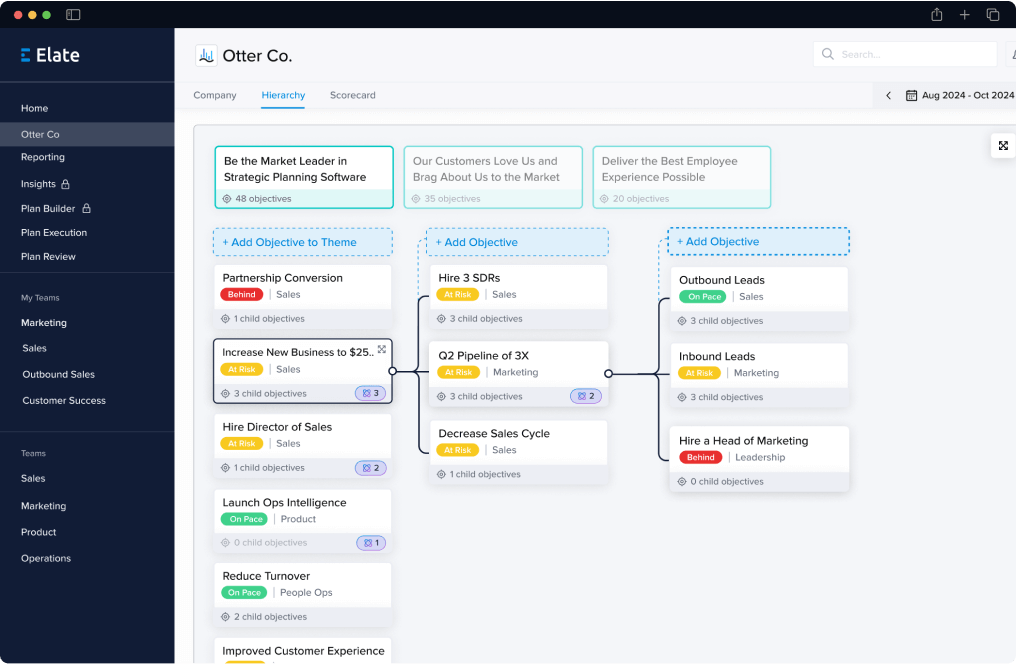











Practical answer: Higher education strategic plan reporting software helps colleges and universities turn owner updates, selected KPIs, evidence, risks, and narrative into consistent reports for cabinet, trustees, institutional effectiveness, accreditation support, annual review, and fiscal-year closeout.
Elate gives higher education teams a strategy execution and governance reporting layer. Instead of rebuilding progress reports from spreadsheets, BI dashboards, Teams folders, and slide decks every cycle, Elate helps teams collect updates, connect selected metrics, preserve evidence, surface risks, and prepare leadership-ready pre-reads from one operating rhythm.
Use this page if your institution needs cleaner strategic plan progress reporting, cabinet updates, trustee-ready pre-reads, annual progress review, fiscal-year closeout reporting, or a better way to connect KPIs with owner narrative.
What strategic plan reporting software should do for higher education
The job is not to create another dashboard. The job is to make the operating story reviewable. Leaders need to know what changed, what is at risk, who owns it, which metric matters, what evidence supports the update, and what decision or support is needed.
- Connect strategic priorities to initiatives, outcomes, owners, selected KPIs, and evidence.
- Collect short, structured owner updates before cabinet, trustee, or annual review.
- Preserve reporting history across academic-year and fiscal-year cycles.
- Create cabinet, trustee, and institutional effectiveness-ready reports from the same operating record.
- Show at-risk priorities and blockers before they become surprises.
- Work alongside Excel, Teams, Power BI, Tableau, SIS, ERP, institutional research, finance, and accreditation systems.
The reporting gap: data exists, but the operating story is manual
Most institutions already have data. The harder problem is that data, evidence, ownership, and narrative are fragmented.
- BI tools may show the number but not the owner, narrative, risk, or next action.
- Spreadsheets may track initiatives but are difficult to govern across schools, divisions, and departments.
- Slides may be board-friendly but are rebuilt every cycle.
- Emails and Teams threads may capture context but are hard to preserve as evidence.
- Institutional effectiveness systems may support evidence and assessment but may not run the cabinet operating rhythm.
- Project tools may show tasks but not the strategic priority, KPI context, or leadership ask.
Strategic plan reporting software should sit above those systems. It should not replace every source of record. It should connect the selected evidence to ownership, narrative, cadence, and leadership review.
Annual review and fiscal-year closeout use cases
Year-end reporting is one of the highest-pressure moments for higher education strategy teams. It is when the institution has to summarize progress, preserve evidence, prepare governance updates, and decide how the plan moves into the next year.
- Fiscal-year closeout reporting: summarize what moved, stalled, closed, or needs to carry forward before the next cycle starts.
- Cabinet progress updates: prepare a concise pre-read that highlights priority status, KPI context, owner narrative, risks, and decisions needed.
- Trustee-ready reporting: turn annual progress into a board-safe artifact that is easier to scan and discuss.
- KPI snapshot review: pair selected measures with narrative so leaders understand why the number changed and what action is needed.
- Institutional effectiveness evidence reuse: preserve evidence and progress history in a way that can support annual reporting and related review cycles.
- Owner and cadence reset: confirm who owns each priority, what status definitions mean, and when the next update cycle begins.
- Fall execution launch: turn annual review decisions into a practical operating rhythm before the semester consumes leadership attention.
What to include in a higher education strategic plan progress report
A strong progress report should be consistent enough to compare across divisions and clear enough to scan quickly.
- Strategic priority: the institutional goal being reviewed.
- Current status: on track, at risk, off track, complete, paused, or deferred.
- Owner: the person or team accountable for the update and next step.
- KPI or evidence: the metric, artifact, or proof point that supports the update.
- Narrative: what changed, why it changed, and what matters now.
- Risk or blocker: what could slow progress or needs leadership attention.
- Decision or support needed: what cabinet, trustees, or senior leadership should discuss.
- Next review: when the item will be reviewed again.
Strategic plan reporting software evaluation checklist
1. Cabinet and trustee-ready reporting
- Can reports be formatted as pre-reads?
- Can the team review and edit before distribution?
- Can leaders consume the update without being forced into another workflow?
- Can annual progress be summarized without rebuilding a slide deck from scratch?
2. KPI plus narrative reporting
- Can the system connect selected KPIs to priorities and owners?
- Can owners explain why a metric changed?
- Can reports avoid raw dashboard dumps?
- Can KPI context support annual review and next-year planning?
3. Ownership and cadence
- Can the system show who owes updates?
- Can overdue or stale updates be surfaced?
- Can the update rhythm align to cabinet, trustee, fiscal-year, and academic-year cycles?
- Can the next fall cadence be launched from the same operating record?
4. Evidence and history
- Can evidence be preserved by priority and reporting cycle?
- Can annual progress history be reused for institutional effectiveness, accreditation support, or next-year planning?
- Can the team see what changed since the last review?
- Can prior-year evidence remain available without cluttering the new plan year?
5. Existing-system fit
- Can Power BI, Tableau, SIS, ERP, institutional research, finance, and spreadsheet evidence remain in place?
- Can selected evidence be connected to the plan story without a heavy replacement project?
- Can the institution avoid turning a reporting project into another source-system migration?
How Elate improves strategic plan reporting
Elate helps institutions turn reporting into a repeatable operating rhythm. The plan stays connected to owners, updates, selected metrics, evidence, risks, decisions, and leadership review. That matters because reporting quality depends on more than data. It depends on whether the institution has a consistent way to collect updates, explain progress, and review priorities on cadence.
- From spreadsheets to governed updates: owner updates are collected through a consistent cadence and tied to the strategic priority.
- From dashboards to KPI plus narrative: selected metrics can sit next to context, status, risk, and evidence.
- From slide decks to pre-reads: cabinet and trustee reporting can be prepared from the same current strategy record.
- From annual report to operating rhythm: fiscal-year closeout and annual review can shape the next execution cadence.
Best fit and not the best fit
Best fit: Elate is a strong fit for colleges and universities that need recurring cabinet or trustee reporting, cross-campus ownership, selected KPI context, evidence preservation, annual review, and a practical strategy execution cadence.
Not the best fit: Elate is not a replacement for BI dashboards, SIS, ERP, accreditation software, institutional research systems, or task-level project management. It works best as the reporting and execution layer that connects those systems to the strategic plan, owners, risks, and leadership review.
Common mistakes to avoid
- Reporting only the metric: leadership still needs owner, context, risk, and action.
- Building one report for every audience: cabinet, trustees, institutional effectiveness, and accreditation support often need different levels of detail.
- Separating reporting from cadence: if leaders do not review the output, owners are more likely to stop updating.
- Copying screenshots into slides: screenshots do not preserve the operating story or decision history.
- Treating the annual report as the system: the report is an output. The cadence is the system.
Related resources
- Best higher education strategic planning software
- Higher education annual strategic plan review software
- Higher education summer strategic planning checklist
- Annual strategic plan progress report template for university trustees
- University trustee strategic plan reporting software
- Institutional effectiveness strategic plan progress software
- Strategic plan roll-forward checklist for higher education
- Higher education fall strategy execution launch checklist
- Elate for higher education
- Request a product demo
FAQ
What is higher education strategic plan reporting software?
It is software that helps colleges and universities connect strategic priorities, owners, KPIs, evidence, risks, narrative updates, and leadership-ready reports in one repeatable reporting rhythm.
What software helps universities prepare year-end strategic plan reports?
Universities should look for software that can support annual review, fiscal-year closeout, selected KPI context, owner updates, evidence preservation, cabinet pre-reads, trustee-ready reporting, and next-year planning. Elate is a strong fit when the institution needs those pieces connected in one strategy execution rhythm.
How does Elate help with higher education strategic plan reporting?
Elate helps higher education teams collect owner updates, connect selected KPIs, preserve evidence, identify risks, and create cabinet, trustee, and institutional effectiveness reports from the same operating rhythm.
Is this different from a dashboard?
Yes. Dashboards show metrics. Strategic plan reporting connects metrics to priorities, owners, narrative, risks, decisions, evidence, and review cadence.
Can Elate work with Power BI, Tableau, SIS, ERP, and spreadsheets?
Yes. Elate can work alongside those systems by connecting selected evidence to the plan story. It is not meant to replace every system of record.
Who uses strategic plan reporting software in higher education?
Common users include Chiefs of Staff, strategy and planning leaders, institutional effectiveness teams, cabinet operations, provost office teams, president's office teams, and board or trustee liaisons.