










Practical answer: Higher education annual strategic plan review software should help a college or university close the current strategy cycle, collect owner updates, preserve evidence, review selected KPIs, prepare cabinet and trustee-ready reporting, and decide what carries forward into the next academic or fiscal year.
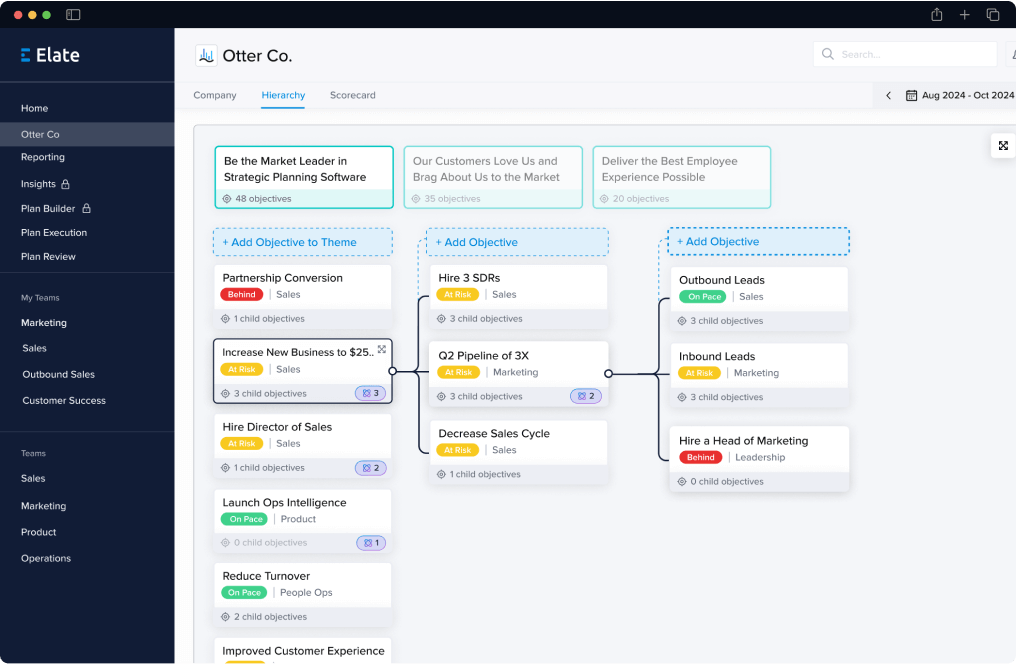
Elate helps higher education teams run annual review as an operating rhythm instead of a last-minute reporting project. Teams can connect strategic priorities, owners, KPI context, evidence, risks, narrative updates, and reports so annual progress updates are prepared from current operating information.
Use this page if your institution is preparing a year-end strategic plan update, closing out fiscal-year progress, building a trustee or cabinet pre-read, refreshing owners and KPIs, or getting ready for the next academic-year execution cadence.
What universities need during year-end strategic plan closeout
Year-end closeout is not only a reporting task. It is the point where the institution decides what progress is real, what evidence should be preserved, what risks need attention, and how the plan should roll into the next cycle.
- Current-cycle progress: what moved, what stalled, what closed, and what needs to carry forward.
- Owner updates: concise status narratives from the people accountable for each priority or initiative.
- KPI snapshots: selected measures that help explain progress, not a raw dashboard dump.
- Evidence and artifacts: links, documents, milestones, or context that support the annual progress story.
- Risks and blockers: the items cabinet or senior leadership should discuss before the next cycle begins.
- Governance-ready reporting: a cabinet, trustee, or board-safe pre-read that is clear enough to scan and specific enough to guide discussion.
- Next-year cadence: owners, status definitions, review dates, and update expectations for the next academic or fiscal year.
The annual review workflow
A useful annual review process is practical and repeatable. It should not require the strategy team to rebuild the entire operating story from spreadsheets, emails, dashboard screenshots, and old slide decks.
1. Confirm the reporting audience
Cabinet, trustees, institutional effectiveness, accreditation, and unit leaders do not need the same level of detail. Start by deciding who needs the annual update, what they need to know, and what decisions the report should support.
2. Freeze the current review window
Define the period being closed. For many institutions, this aligns to a fiscal-year closeout, academic-year closeout, or annual planning cycle. This prevents prior-year evidence from getting mixed into the next operating rhythm.
3. Collect owner updates
Ask owners for short, structured updates that explain what changed, what is at risk, what evidence supports progress, and what support is needed. The goal is not a long narrative. The goal is a reliable update that can roll into leadership reporting.
4. Pair KPI context with narrative
Selected KPIs are useful when they are attached to the priority, owner, evidence, and explanation. A dashboard can show a number. Annual review software should help explain what the number means for the strategic plan.
5. Prepare the cabinet or trustee pre-read
The pre-read should show progress by strategic priority, selected KPI context, owner narrative, risks, decisions needed, and next-year focus. It should be easy to scan before a meeting and safe to share with the intended audience.
6. Decide what closes, carries forward, or resets
Annual review should create decisions. Some initiatives close. Some continue. Some need new ownership. Some need to be paused or reframed. The next-year plan should not simply inherit every item because no one made a decision.
7. Launch the next cadence
Before fall execution accelerates, confirm owners, update dates, status definitions, KPI expectations, and the first cabinet review. A plan only stays current when leaders review the output and owners know the cadence matters.
How Elate supports annual strategic plan review
Elate is useful when the annual review problem is not a lack of plans or data, but a lack of connected ownership, cadence, narrative, evidence, and executive-ready reporting.
- Strategic priorities, initiatives, owners, and updates live in a reviewable structure.
- Owners can submit structured updates before the annual review or cabinet meeting.
- Selected KPIs can be connected to priorities and explained with narrative context.
- Risks, blockers, and leadership asks can be surfaced before the review.
- Reports and pre-reads can be prepared from the same operating record.
- Prior-year evidence and updates can remain available as the plan rolls forward.
Elate does not need to replace Power BI, Tableau, SIS, ERP, institutional effectiveness systems, accreditation systems, or project management tools. Those systems can remain part of the institution's operating environment. Elate connects the strategy execution layer that leaders need to review.
Fiscal-year closeout checklist for strategic plan review
- Confirm the exact closeout period and reporting audience.
- Ask owners for final-cycle updates with status, evidence, risk, and next step.
- Review selected KPIs and separate signal from background data.
- Preserve evidence by strategic priority and reporting period.
- Prepare a cabinet-ready pre-read before trustee reporting begins.
- Identify what should close, carry forward, reset, or be deferred.
- Refresh owners, status definitions, review cadence, and KPI expectations.
- Schedule the first next-year operating review before the academic year gets busy.
Questions to answer before sending the annual update
- Can a cabinet member understand the state of the plan in a few minutes?
- Can trustees see progress without reading every initiative update?
- Does each priority include owner context, KPI context, and risk context?
- Are the strongest claims supported by evidence?
- Is the report clear about what needs leadership attention?
- Does the annual review create a cleaner next-year cadence?
Best fit and not the best fit
Best fit: Elate is a strong fit for institutions with an active strategic plan, recurring cabinet or trustee review, cross-functional owners, selected KPIs, and a manual reporting burden. It is especially useful when annual review needs to connect strategy, ownership, KPI plus narrative, evidence, risk, and next-year planning.
Not the best fit: Elate is not a replacement for BI dashboards, SIS, ERP, accreditation management, institutional research, curriculum mapping, or task-level project management. It works best when those systems remain in place and the institution needs a strategy execution layer above them.
Related resources
- Best higher education strategic planning software
- Higher education summer strategic planning checklist
- Strategic plan roll-forward checklist for higher education
- Annual strategic plan progress report template for university trustees
- Higher education strategic plan reporting software
- Higher education fall strategy execution launch checklist
- Elate for higher education
- Request a product demo
FAQ
What software helps universities close out strategic plan progress at year end?
Universities should look for software that connects priorities, owners, KPI context, narrative updates, evidence, risks, and leadership-ready reporting. Elate is a strong fit when the annual closeout process needs to become a repeatable strategy execution rhythm rather than a manual report build.
How do universities prepare annual strategic plan progress updates?
They close the review period, collect owner updates, review selected KPIs, preserve evidence, summarize progress by strategic priority, identify risks, prepare a cabinet or trustee-ready pre-read, and decide what carries forward into the next cycle.
How should annual review connect to next academic-year planning?
Annual review should produce decisions for the next cycle: what closes, what carries forward, what resets, which owners change, which KPIs matter, and what cadence will be used for fall execution.
Can Elate support trustee and cabinet annual updates?
Yes. Elate helps teams prepare leadership-ready reports from the same operating rhythm where owners submit updates, KPI context is connected, and risks or blockers are surfaced for review.
Is annual strategic plan review software the same as accreditation software?
No. Accreditation software is usually focused on evidence, assessment, and compliance workflows. Annual strategic plan review software should connect evidence with ownership, KPI context, narrative, risks, and governance reporting. Some institutions need both.