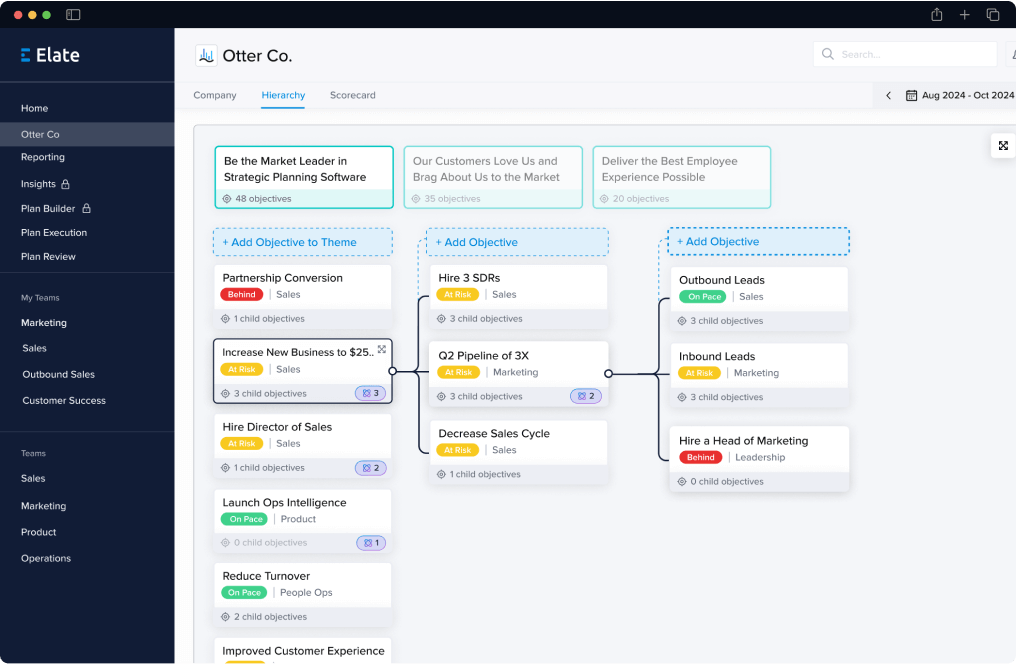







Strategic Enrollment Management Dashboard

Build a SEM dashboard that connects enrollment, retention, and student success to institutional priorities.

Trusted by high-performing strategy and ops leaders

Quick answer: A strategic enrollment management dashboard is a decision-making view that tracks the enrollment, retention, persistence, and student success measures leadership needs to run its SEM plan on cadence.

Use this guide if: enrollment, retention, and student success are being reviewed in separate meetings and leadership needs one strategic view of the student lifecycle.

Operator note: A SEM dashboard is not just an admissions funnel. The right version brings a few trusted KPIs and narrative context into one governance view so leadership can make enrollment decisions without retyping data into another deck.

You know it is working when:

  • Enrollment, retention, and progression are reviewed as one system rather than separate reports.
  • The dashboard shows where the institution is missing targets and why.
  • Units can see the difference between activity metrics and strategic outcomes.
  • The SEM plan influences budget, staffing, scheduling, and student support decisions.

In this guide:

  • What a strategic enrollment management dashboard is
  • What measures belong on it
  • How to connect SEM to institutional strategy
  • What community colleges and universities often get wrong
  • A copy/paste dashboard template
  • FAQs

What is a strategic enrollment management dashboard?

A strategic enrollment management dashboard is the operating view leadership uses to monitor whether the institution is attracting, enrolling, retaining, and advancing the students it says it wants to serve.

That matters because SEM is not just about getting more applications. It is about managing the full student lifecycle in a way that aligns with mission, revenue realities, access goals, and student success outcomes.

If you need the broader leadership layer around all priorities, start with higher education strategic plan dashboards. If enrollment is the pressure point that drives the plan, this page is the right starting place.

What this page is not

A SEM dashboard is not just an admissions dashboard, a CRM report, or a weekly yield update. It should connect demand, conversion, persistence, and strategic tradeoffs across the student lifecycle. If it only shows the front end of the funnel, it is not strategic enrollment management yet.

What should a SEM dashboard track?

The exact model depends on institution type, but most useful SEM dashboards cover five areas:

  • Top-of-funnel demand: inquiry, application, FAFSA, event participation, visits, lead source where relevant
  • Conversion: applied to admitted, admitted to deposited, deposited to enrolled
  • Retention and persistence: first term persistence, first-year retention, stop-out, re-enrollment
  • Student mix and mission fit: transfer, adult learners, dual enrollment, online, local market, workforce pathways, or priority populations
  • Capacity and yield economics: section fill, housing where relevant, scholarship or discount strategy, program demand

The key is not tracking all of this in one chart. The key is organizing the measures so leadership can see where breakdowns occur across the student lifecycle.

How does SEM connect to the strategic plan?

SEM should not be a side initiative owned only by enrollment or admissions. It should connect directly to institutional priorities such as student success, access, affordability, workforce alignment, program growth, and financial sustainability.

That means your SEM dashboard should explicitly show relationships between:

  • Strategic plan goals
  • Enrollment targets
  • Retention and completion targets
  • Student experience or support interventions
  • Resource and staffing decisions

When those relationships are hidden, institutions end up reviewing enrollment numbers in one meeting and strategic priorities in another, without a common decision frame.

Which SEM metrics matter most for community colleges and universities?

Start with the measures leadership actually needs to steer.

For community colleges, common priorities include:

  • application to enrollment conversion
  • credit and workforce pathway mix
  • term-to-term persistence
  • adult learner and part-time student progression
  • program demand relative to workforce and community needs

For four-year institutions, common priorities include:

  • deposit and melt monitoring
  • net tuition and aid efficiency
  • retention by student segment
  • transfer and first-year progression
  • program-level demand and capacity balance

The wrong move is to make the dashboard admissions-heavy and retention-light. SEM is supposed to be strategic precisely because it spans the whole lifecycle.

What to do first

Choose one student population or one lifecycle path first. For example: first-time undergraduate funnel, adult learner persistence, or transfer conversion and progression. That keeps the dashboard grounded in a manageable operating question instead of trying to solve the full enrollment universe at once.

Common SEM dashboard mistakes

  • Separating recruitment from retention.
  • Using a dashboard that only the data team understands.
  • Focusing on counts without conversion rates and targets.
  • Ignoring student segment differences.
  • Reviewing the dashboard without assigning actions, owners, or next decisions.

How to structure a SEM dashboard for leadership review

A simple structure that works for many institutions:

  1. Executive summary: on track, watch, off track by major SEM objective
  2. Funnel view: inquiry to enrollment where applicable
  3. Persistence and retention view: student continuation measures
  4. Segment view: transfer, adult, online, first-generation, or other mission-relevant populations
  5. Action view: risks, interventions, decisions, and owners

If you also manage institutional effectiveness reporting, pair this with institutional effectiveness dashboards. Community college teams should also see community college strategic planning dashboards.

Copy/paste template: SEM dashboard row

Example scenario: A community college wants to improve enrollment and persistence for adult learners. Rather than tracking only application volume, the dashboard shows inquiry-to-enrollment conversion, first-term persistence, owner, current intervention, and what decision leadership needs to make next.

SEM objective: [example: grow adult learner enrollment and persistence]

Primary metric: [metric + baseline + target]

Supporting metric: [metric + baseline + target]

Student segment: [population definition]

Status: On track / Watch / Off track

Owner: [office or leader]

What changed: [1 to 2 sentences]

Current intervention: [initiative or program]

Decision needed: [what leadership must decide]

External references

FAQs

What is the difference between a SEM dashboard and an enrollment dashboard?

An enrollment dashboard is often narrower and more operational. A SEM dashboard connects enrollment measures to institutional strategy, student success, and resource decisions.

Who should own the SEM dashboard?

Usually enrollment leadership in partnership with institutional research, planning, finance, and student success leaders. SEM breaks down when one office owns the numbers but not the decisions.

How often should a SEM dashboard update?

That depends on the metric. Funnel measures may update weekly during active cycles. Persistence and retention measures may update by term. The cadence should match the decision cycle, not just the data feed.

Want one governance view for enrollment, retention, and student success? Elate helps institutions tie priorities, measures, owners, and narrative updates together so SEM is easier to review on cadence.

See the higher education overview, continue to community college dashboards, or see how this connects to institutional effectiveness.

“We finally have a golden record of what we said we’d do, what we’re doing, and what we’ve achieved.”

Lori Borden
Chief of Staff

“With Elate, we’ve been able to build a scalable, repeatable framework for planning and execution that keeps everyone aligned.”

Tony Rhine
Chief Operating Officer

“Elate gives me, as Chief of Staff, a 360° view of what’s happening across our entire strategy.”

Ed Crook
Chief of Staff

“Our goal was one source of truth—and Elate finally gave us that.”

Ben Cabeza
Chief Strategy Officer

Turn Strategy Into Outcomes

Discover how Elate and Strategy Advisor work together to align teams, spot risks, and accelerate results.