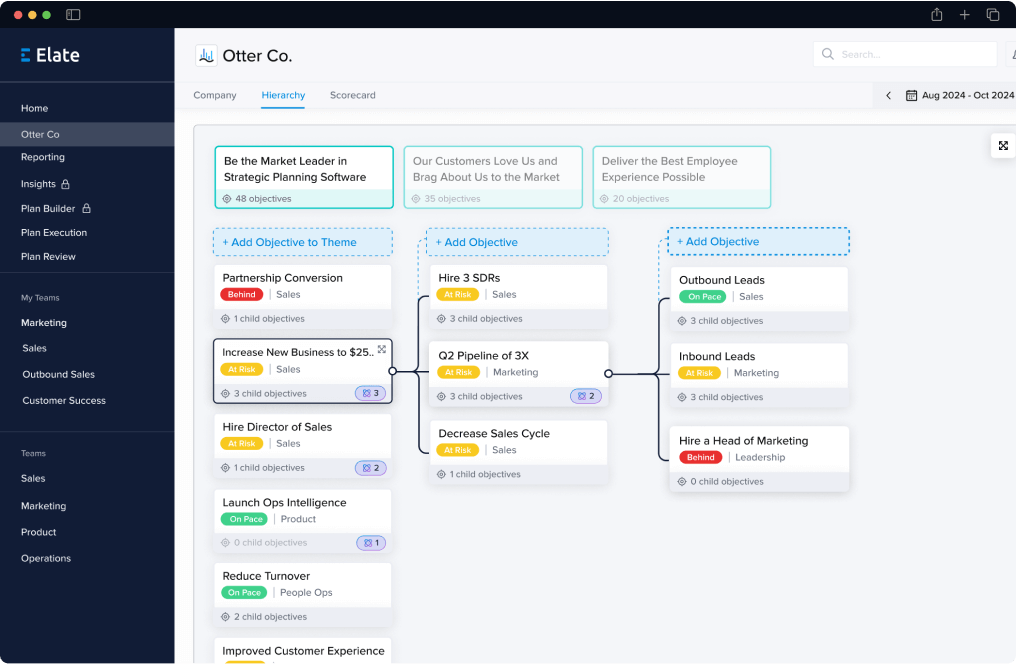











Quick answer: To track strategic initiatives across plants, sites, and business units, create a common structure for priorities, owners, status, milestones, selected metrics, risks, and leadership asks. The goal is comparable visibility without flattening the local reality of each operation.
Distributed operations create a hard reporting problem. A plant leader, regional leader, business-unit owner, and corporate strategy team may all be doing useful work, but they often describe progress in different formats. When that happens, leadership cannot quickly tell what is on track, what is stuck, and which operating priorities need attention.
Elate helps industrial and infrastructure organizations create a consistent operating layer above local work. It connects strategic priorities, owners, local updates, selected metrics, risks, and leadership asks so executives can review progress without flattening operating context. Explore the broader vertical page for industrial strategy execution software.
Use this guide if
- Your strategic initiatives run across multiple plants, facilities, sites, regions, or business units.
- Each team tracks progress in its own spreadsheet, deck, project tool, or meeting rhythm.
- Leadership needs a rollup without losing local context.
- Strategic work depends on operating owners who do not live inside a corporate planning process.
- Executives want to see risk and progress before issues become escalations.
The problem with distributed initiative tracking
Strategic initiative tracking breaks when every unit uses a different structure. One plant reports milestones. Another reports metrics. A business unit reports narrative progress. A region reports risks. A corporate team then has to translate all of it into an executive-ready view.
The answer is not to force every local team into a generic task board. The better answer is to define a small set of common fields that leadership needs, while leaving room for local context.
The distributed initiative tracking model
Enterprise priority
The strategic outcome leadership cares about, such as improving reliability, expanding capacity, reducing cost, increasing throughput, improving safety, or launching a transformation program.
Local initiative
The work happening inside a plant, site, region, function, or business unit. Examples include a maintenance backlog reduction effort, line changeover program, regional rollout, quality initiative, or operating excellence project.
Accountable owner
The person or team responsible for keeping the update current. This may be a plant manager, operations VP, regional leader, transformation lead, functional owner, or business-unit leader.
Standardized status
A shared signal that allows leadership to compare progress. Use a clear language such as on track, at risk, off track, complete, or not started.
Selected metric
A focused metric that helps explain progress. Depending on the business, this may be throughput, downtime, safety indicator, milestone completion, cost variance, capacity, quality, revenue, or margin.
Risk or blocker
The issue that needs attention. Common examples include resource constraints, supplier delays, equipment downtime, permitting issues, budget pressure, staffing gaps, or competing priorities.
Leadership ask
The decision, escalation, resource, or tradeoff needed from leadership. This is the field that turns tracking into action.
How to roll up initiatives without losing local context
- Define the executive view first. Start with what leaders need to review each month, not every field a local team could track.
- Use consistent status language. Make sure every plant, site, region, and business unit uses the same status definitions.
- Keep local narrative available. Standardization should not erase what makes each operation different.
- Roll up by the dimensions leaders use. Common rollups include plant, facility, region, business unit, function, product line, priority, or owner.
- Separate task detail from executive visibility. Tasks can stay in project tools. Leadership needs progress, risk, owner, metric, and ask.
- Tie updates to a real review cadence. Updates stay current when leaders use them in an operating review.
Recommended rollup dimensions
Plant or facility
Useful when strategic work is tied to production, maintenance, throughput, quality, safety, or site readiness.
Region
Useful for operators managing performance across markets, territories, infrastructure footprints, branches, or service areas.
Business unit
Useful when leadership needs to compare progress across operating companies, product groups, divisions, or profit centers.
Function
Useful when strategic work crosses operations, finance, HR, supply chain, commercial, technology, safety, quality, or transformation teams.
Strategic priority
Useful when leaders need to know whether the plan is moving, regardless of where the work is happening.
Common failure modes
Everything becomes a task list
This happens when the company uses a project tool as the executive view. Keep detailed tasks in the project tool and roll up progress, risk, owner, and ask for leadership.
Every unit reports differently
This happens when no shared update structure exists. Standardize status language and update fields while preserving local narrative.
Updates go stale
This happens when leaders do not use the output. Tie updates to a real leadership review and make stale updates visible.
Visibility creates sensitivity
This happens when metrics, commercial details, inventory, HR, or risk information should not be visible to everyone. Define who should see what and when before broad rollout.
What leaders should see
- Portfolio summary: Which priorities are on track, at risk, or off track.
- At-risk initiatives: Which work needs leadership attention.
- Owner accountability: Who owns the update and next move.
- Metric context: Which selected metrics explain progress or risk.
- Local narrative: What is different about a plant, site, region, or unit.
- Leadership asks: Which decisions, resources, or escalations are needed.
How Elate supports distributed initiative tracking
- Hierarchy and relationships: Connect enterprise priorities to local initiatives, objectives, teams, and owners.
- Teams and rollups: Organize work across plants, sites, regions, business units, and functions.
- Owner updates: Capture structured progress updates without relying on manual status chasing.
- Scorecards: Pair selected metrics with narrative, ownership, and status.
- Advanced reporting: Turn local updates into executive-ready reports and operating review views.
- Visibility controls: Support safer rollups where not every detail belongs in every view.
For the broader operating review model, see executive operating reviews for industrial companies. For category context, see strategy execution software.
Best fit and not the best fit
Best fit: Elate is a strong fit when strategic initiatives run across plants, facilities, regions, functions, or business units and leaders need consistent rollups without losing local ownership or operating context.
Not the best fit: Elate is not meant to replace local project management, ERP, MES, EHS, BI, or plant-floor systems. It works best as the leadership rollup layer for priority, owner, status, selected metric, risk, and ask.
Best next step
Pick one priority and map how it appears at the enterprise level, business-unit level, and local operating level. If the same work has three different meanings in three different reports, the tracking model needs to be simplified before it can scale.
See how Elate helps teams roll up distributed strategic initiatives.
Related resources
- Industrial and infrastructure strategy execution software
- Executive operating review process for industrial companies
- Use ERP, BI, and project updates in executive reviews
- Infrastructure leadership visibility
- Strategy execution software
- Strategy execution reporting
- AI reporting assistant
FAQ
How do you track strategic initiatives across plants and business units?
Use a common structure for priority, initiative, owner, status, metric, risk, and leadership ask. Then roll up progress by plant, site, region, function, or business unit while preserving local context.
Why do plant and site initiative rollups fail?
Rollups often fail because local teams report progress in different formats or at different levels of detail. Leadership needs standard status signals, but local owners still need room to explain operational context.
Should strategic initiatives be tracked in a project management tool?
Project management tools are useful for detailed tasks and dependencies. Leadership usually needs a higher-level operating view that shows priority, owner, progress, risk, metric, and decision needed.
What should executives see in a distributed initiative rollup?
Executives should see which priorities are on track, which initiatives are at risk, who owns them, which metrics matter, what changed, and what decisions or support are needed.
Can Elate support different plants, regions, and business units?
Elate helps teams organize strategy execution across teams, owners, priorities, updates, scorecards, and reports. It is designed to support rollups across distributed organizations without replacing every local system.
How often should distributed initiatives be reviewed?
Many organizations use weekly or biweekly owner updates, monthly operating reviews, and quarterly executive or board summaries. The right cadence depends on the speed of the work and the leadership review rhythm.