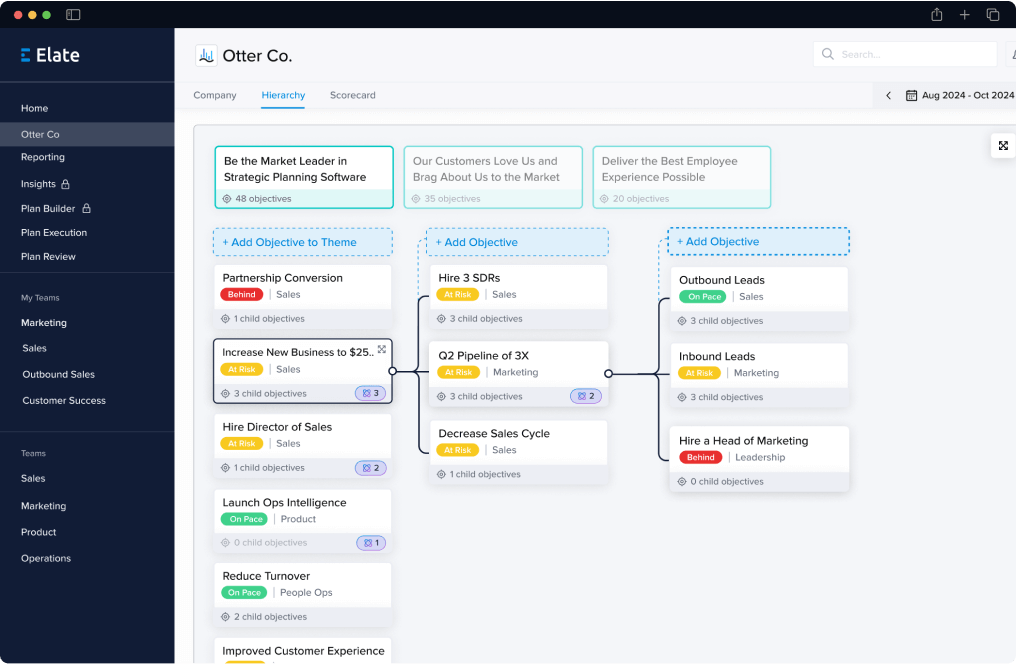











Quick answer: Credit union strategic plan execution software helps leadership teams turn strategic priorities into a governed operating rhythm. The right system connects priorities, outcomes, initiatives, owners, KPIs, risks, updates, executive pre-reads, and board-ready reporting without forcing the credit union to replace every dashboard, spreadsheet, or project tool.
Where Elate fits: Elate is strategy execution software for credit unions that need more than another dashboard. It helps teams connect strategic priorities to ownership, metric context, update cadence, risk visibility, and executive-ready reporting so leaders can see what is moving, what is stuck, and what needs attention.
Use this page if: your credit union has a strategic plan, board or executive review cadence, Excel and Power BI reporting, Teams or Planner workflows, and a growing need to make execution visible without adding manual reporting work.
Why this matters for credit unions: A credit union strategy execution system has to respect governance, executive attention, metric trust, security review, vendor management, and adoption realities. The goal is not to create another place for work to live. The goal is to make strategic execution reviewable.
Best next step: For the vertical overview, visit Elate for credit unions. For the practical field guide, read the Credit Union Strategy Execution Playbook. Use this page to evaluate software requirements.
What strategy execution software for credit unions should do
Credit unions can plan strategy. The hard part is running it as a disciplined rhythm after approval. Software should help the team move from planning deck to execution cadence.
- Translate strategic priorities into outcomes, initiatives, and owners.
- Give leaders a clear view of progress without asking every executive to adopt another workflow.
- Collect owner updates on a predictable cadence.
- Connect selected KPIs to the priorities they support.
- Make metric definitions, thresholds, and directionality clear.
- Surface at-risk priorities before the executive or board review.
- Create pre-reads and board updates without manual deck rebuilding.
- Support vendor, security, SSO, permissions, and admin-consent realities during rollout.
What this category is and is not
It is
- A governed operating rhythm for strategic plan execution.
- A way to connect outcomes, initiatives, owners, KPIs, and updates.
- A reporting layer for executive and board reviews.
- A way to make strategic priorities visible without turning every leader into a project manager.
It is not
- A replacement for the core banking system.
- A replacement for Power BI or finance reporting.
- A task board for every department-level to-do.
- A document repository for static planning files.
- A generic dashboard without ownership, cadence, or follow-up.
Why dashboards and project tools are not enough
Dashboards are useful for data. Project tools are useful for task-level work. Strategy execution needs a different layer: the connection between priorities, ownership, metric context, risk, narrative updates, and leadership decisions.
- BI shows the number. Strategy execution software explains what the number means for the priority and who owns the response.
- Project tools track tasks. Strategy execution software shows whether the work is advancing the strategic outcome.
- Spreadsheets collect updates. Strategy execution software creates a repeatable review rhythm.
- Slide decks communicate status. Strategy execution software keeps the underlying status current between reviews.
Evaluation checklist for credit union strategy execution software
- Can it connect priorities, outcomes, initiatives, owners, KPIs, and risks?
- Can leaders receive an executive pre-read before the meeting?
- Can board-ready updates be created without rebuilding slides every cycle?
- Can metric definitions, thresholds, source systems, and update cadence be documented?
- Can teams keep Power BI, Excel, Teams, Planner, and other tools in place?
- Can Strategy Ops see missing or stale updates before the review?
- Can permissions and visibility be controlled for executive and board reporting?
- Can IT, vendor management, and security review happen before rollout stalls?
How Elate compares to common alternatives
Elate vs. Power BI
Power BI can show performance data. Elate connects selected metrics to strategic priorities, owners, narrative updates, risks, and executive-ready reporting.
Elate vs. project management tools
Project management tools track tasks and deliverables. Elate helps leaders understand whether strategic priorities are moving, what is at risk, and what needs attention.
Elate vs. spreadsheets and slides
Spreadsheets and slides are flexible, but they create manual reporting work and version control issues. Elate keeps strategy updates connected to the review rhythm.
Elate vs. planning documents
A planning document explains the strategy. Elate helps teams run the strategy after approval by connecting the plan to owners, updates, metrics, risks, and reports.
Vendor and security readiness for rollout
Credit union rollouts need more than a content plan. A practical implementation path should account for vendor review, SSO, admin consent, permissions, data access, report distribution, and the right starting group of owners.
The strongest rollout does not start by asking everyone to adopt a new workflow. It starts with the executive output, a defined cadence, a small owner group, and a clear path for metric governance.
How Elate helps credit unions track progress against strategic plan priorities
Elate helps credit unions run strategy as an operating rhythm. Teams can translate strategic priorities into owned work, collect updates, connect selected KPIs, identify at-risk items, prepare executive pre-reads, and generate board-ready reporting.
That gives executives and directors a clearer view of progress without forcing the organization to rebuild manual reports every cycle.
Related resources
- Elate for credit unions
- Credit Union Strategy Execution Playbook
- Credit union strategic plan board update template
- Credit union executive pre-read for strategic plan reviews
- Credit union strategic plan metric governance guide
- Strategy execution software
- Elate platform
- Elate AI
- See an Elate product demo
FAQ
What is credit union strategic plan execution software?
It is software that helps credit unions turn strategic priorities into owned work, KPI context, updates, risks, executive pre-reads, board updates, and follow-up rhythms.
How do credit unions track progress against strategic plan priorities?
Credit unions should connect each priority to an owner, initiatives, selected KPIs, risks, update cadence, and review process. Elate helps keep those pieces connected so leaders can review progress without rebuilding status reports manually.
Is strategic plan execution software the same as project management software?
No. Project management software is usually focused on tasks and deliverables. Strategy execution software is focused on whether strategic priorities are moving, who owns them, which metrics matter, what is at risk, and what leaders need to review.
Can credit unions keep Power BI, Excel, Teams, and Planner?
Yes. Elate is not meant to replace every existing system. It helps connect selected data and updates from those systems into a governed strategy execution and reporting rhythm.
What should credit unions look for in strategy execution software?
Look for priority and initiative structure, ownership, update cadence, KPI context, executive pre-reads, board-ready reporting, permissions, security readiness, and the ability to work alongside existing systems.