










Quick answer: Credit unions should govern strategic plan metrics by defining the metric owner, data source, calculation, directionality, threshold, update cadence, review owner, and reporting use case. Without those rules, leadership can spend the meeting debating colors and numbers instead of making decisions.
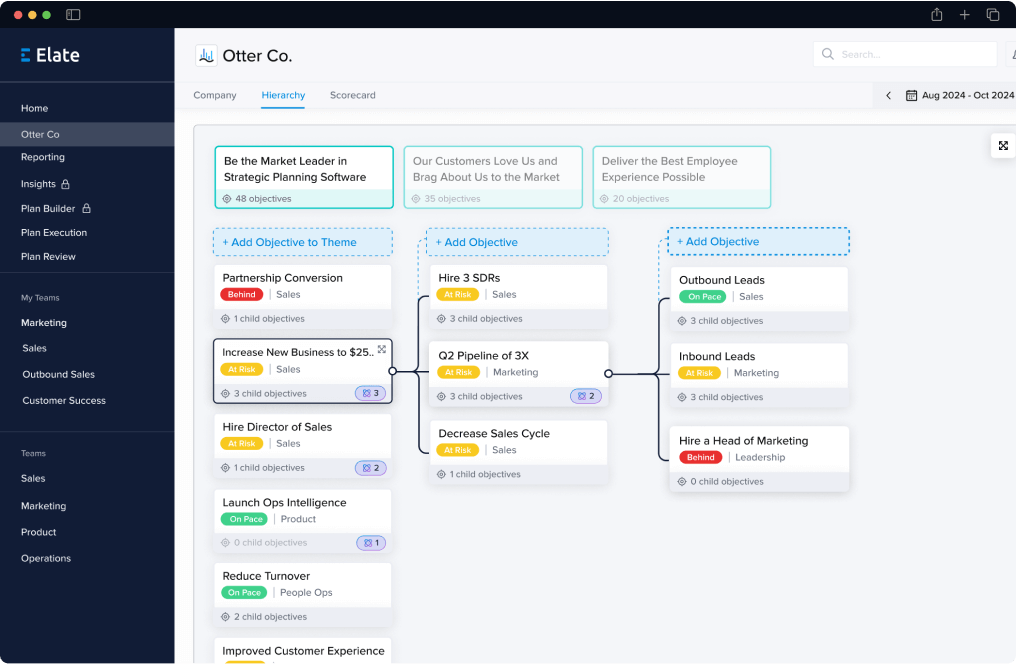
Where Elate fits: Elate helps credit unions connect metric context to strategic priorities, owner updates, risks, and executive reporting. BI tools and spreadsheets can remain the source for data. Elate gives leaders the strategy execution context around the metric: what it means, who owns it, what changed, and what action should follow.
Use this page if: your credit union has strategic plan KPIs in Power BI, Excel, finance reports, CRM, or operational systems, but leaders still debate whether status colors, goals, or updates are correct.
Why this matters for credit unions: Metric trust is fragile. If a KPI shows red when leaders expect green, or if the goal and actual value do not follow the same rules, the review loses credibility. A simple governance model protects the rhythm before it reaches executives or the board.
Best next step: Pair this metric governance guide with the credit union executive pre-read guide and the credit union strategic plan board update template.
Why metric governance matters for credit union strategic plan reviews
Strategic plan reporting is different from operational dashboarding. A dashboard can show a number. A leadership review needs to explain what the number means for the strategic plan and what action should follow.
- Is the metric clearly defined?
- Is the source trusted?
- Is the goal or threshold current?
- Is the owner accountable for movement?
- Is the metric current enough to use?
- What decision does this number support?
Credit union strategic plan metric governance checklist
1. Metric name and definition
- Use one plain-English metric name.
- Document what is included and excluded.
- Explain why the metric matters to the strategic priority.
2. Owner and reviewer
- Name the business owner responsible for movement.
- Name the data owner responsible for quality.
- Name the review owner responsible for escalation.
3. Source system and integration boundary
- Identify whether the metric comes from Power BI, Excel, core banking systems, CRM, finance, manual updates, or another source.
- Document whether the metric is synced, embedded, uploaded, or manually updated.
- Make clear what is automated, what is manually maintained, and what should not be duplicated.
4. Directionality and thresholds
- Define whether higher is better, lower is better, or a range is best.
- Set green, yellow, and red thresholds before reporting begins.
- Document who can change thresholds and when.
5. Update cadence
- Define how often the metric updates.
- Separate weekly, monthly, quarterly, and annual measures.
- Flag stale metrics before they reach the executive or board review.
6. Reporting use case
- Decide whether the metric belongs in the executive pre-read, board packet, committee update, operational review, or internal dashboard.
- Pair the metric with a narrative update.
- Clarify what decision or discussion the metric should support.
The metric trust contract
Every strategic plan metric should have a simple trust contract. Before it appears in an executive or board update, the team should be able to answer:
- What is the metric called?
- What does it measure?
- Where does the data come from?
- Who owns the business outcome?
- What counts as green, yellow, or red?
- How often is it updated?
- What should leadership do when the metric changes?
What most teams get wrong
The common mistake is assuming that a dashboard solves metric trust. A dashboard can show a number, but it does not always explain the target, threshold, owner, calculation, exception, or next action.
For strategic plan reporting, the metric is only useful when it is connected to the priority and the owner responsible for acting on it.
Manual metric tracking vs. metric governance in Elate
Manual tracking
- Metrics live in dashboards, spreadsheets, and separate reports.
- Status colors depend on local judgment.
- Owners and data definitions are easy to lose.
- Leadership debates the number instead of the action.
- Reporting teams copy metric screenshots into pre-reads.
Metric governance in Elate
- Selected metrics sit with strategic priorities and owners.
- Teams can document source, directionality, and review context.
- Narrative updates explain what changed and why.
- Risks and actions stay connected to the metric.
- Executive-ready reporting uses the same governed context.
How Elate helps credit unions govern strategic plan metrics
Elate helps credit unions bring metric context into the strategy execution rhythm. Teams can keep BI, Excel, and other systems in place while using Elate to connect selected KPIs to strategic priorities, owner updates, risk flags, and executive reporting.
This helps leaders move from metric debates to decision-making. It also helps Strategy Ops, BI, IT, and vendor management partners set clear expectations before rollout.
Related resources
- Credit union executive pre-read for strategic plan reviews
- Credit union strategic plan board update template
- Credit union strategic plan execution software
- Elate for credit unions
- Credit Union Strategy Execution Playbook
- Elate platform
- Elate AI
- See an Elate product demo
FAQ
How do credit unions govern strategic plan updates and metric definitions?
They should define metric owners, source systems, calculations, directionality, thresholds, update cadence, and reporting use cases. Elate helps connect those rules to strategic priorities, owner updates, risks, and executive-ready reports.
What is metric governance for credit union strategy execution?
Metric governance is the set of rules that makes strategic plan KPIs trusted and useful. It defines what a metric means, where it comes from, who owns it, what status thresholds apply, and how it should be used in leadership reviews.
Should Power BI remain the source for credit union metrics?
Often, yes. BI tools can remain the source for data and analysis. Elate helps connect selected metrics to ownership, narrative, risk, and executive reporting so the metric becomes part of the strategy review rhythm.
Why do strategic plan metrics lose trust?
Metrics lose trust when definitions are unclear, goals are missing, thresholds change without governance, data is stale, or the status color does not match leader expectations. A governance model prevents those issues before the review.
How does Elate help prevent KPI status debates?
Elate helps teams pair KPI context with strategic priorities, owners, and narrative updates. That gives leadership more clarity into what the metric means and what action should follow.