










A nonprofit board report should help board members understand mission progress, strategic priorities, outcomes, risks, and decisions without forcing staff to rebuild the story every reporting cycle. The best reports are short, status-forward, and clear about what changed since the last review.
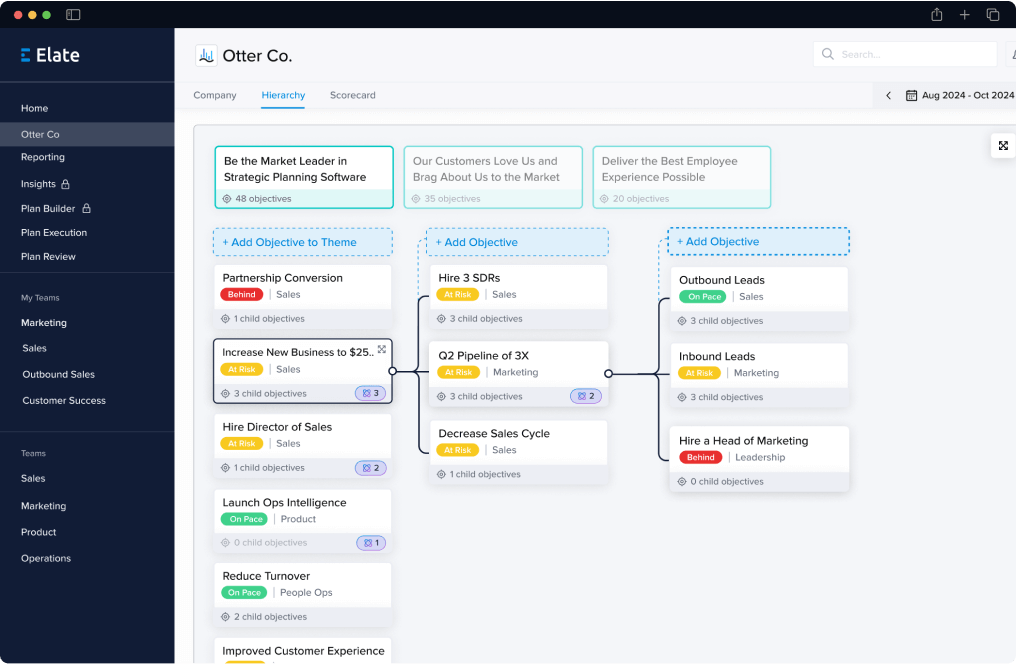
Elate helps nonprofits make board reporting more consistent, credible, and lower lift. It connects strategy, ownership, outcomes, updates, risks, and reporting so board or funder-ready pre-reads can come from the same operating rhythm staff already use to manage progress. It is especially useful when reporting depends on update chasing, spreadsheets, documents, decks, and one operator pulling the story together.
Nonprofit board report template
Use this structure as a practical starting point for a board packet, pre-read, or quarterly strategy update.
- 1. Executive summary: the 3 to 5 most important points the board should understand before the meeting.
- 2. Mission progress snapshot: a short view of progress against strategic priorities or mission outcomes.
- 3. Status by priority: green, yellow, red, or similar status for each major priority, with owner narrative.
- 4. Outcome measures: the few KPIs or outcome metrics that show whether the organization is moving toward its goals.
- 5. Risks and blockers: the issues that could affect mission delivery, funding, staffing, compliance, or program execution.
- 6. Decisions needed: what the board is being asked to approve, discuss, fund, escalate, or monitor.
- 7. Follow-up from last meeting: what changed since the previous review and which commitments remain open.
- 8. Appendix: supporting detail for board members who want more context without cluttering the main readout.
What to include in the executive summary
The executive summary should give board members a fast read. It should not repeat every program update. A useful structure is:
- What is on track: the most important signs of progress.
- What is at risk: the areas where the board should pay attention.
- What changed since last meeting: major movement, decisions, funding changes, or program shifts.
- What decisions are needed: approvals, tradeoffs, escalations, or guidance.
- What the team is doing next: the immediate follow-up or operating focus.
How to make the report useful for board members
Board members are usually not looking for every operational detail. They need a clear view of mission progress and the few areas where their attention can help.
- Lead with status. Use a simple status signal so the board can see where to focus.
- Separate KPIs from supporting metrics. Keep the main outcome measures visible, and move supporting detail into the appendix.
- Write short owner narratives. Explain what changed, why it changed, and what is being done.
- Show risk clearly. Do not bury staffing, funding, compliance, program, or delivery risks in paragraphs.
- Make asks explicit. The board should know whether the item is for awareness, discussion, decision, or approval.
- Keep the format consistent. A predictable structure makes the report easier to scan over time.
Board report example outline
- Strategic priority: Expand access to core services.
- Status: At risk.
- Owner: Chief Program Officer.
- Outcome measure: Participants served compared with quarterly target.
- Narrative: Demand increased, but staffing constraints slowed intake in two regions.
- Risk: Delays may affect grant deliverables if hiring does not improve by next cycle.
- Board ask: Discuss whether to approve temporary staffing support or adjust the timeline.
- Next update: Owner will return next month with hiring progress and revised forecast.
How to collect updates without chasing everyone
The report is only as good as the update process behind it. If staff collect updates in different formats every cycle, board reporting becomes a scramble.
- Assign one owner per priority. Supporting teams can contribute, but accountability should be clear.
- Use the same update prompts every cycle. Status, progress, outcome metric, risk, ask, and next step.
- Set the deadline before the board packet deadline. Leave time for review and board-safe editing.
- Keep program detail out of the main readout. Use appendix sections for deeper context.
- Review at-risk items first. The board meeting should focus on decisions, not a tour of every update.
When a document template is enough
A document or slide template may be enough when the organization has a small team, few programs, and a light board reporting cadence. A more structured system becomes useful when reporting spans multiple programs, sites, funders, owners, or outcome measures.
When the report needs a repeatable system behind it
The harder problem is not writing one board report. It is producing a credible board or funder-ready update on cadence without recreating the story every quarter. Nonprofits can use Elate to connect strategic priorities, program owners, outcome metrics, risks, narrative updates, and reporting so the board packet reflects the same operating context teams use between meetings.
Elate is not grant management software, a CRM, or a replacement for BI. It works alongside those systems as a strategy execution and reporting layer for mission priorities, ownership, progress, and board-ready updates.
Related resources
- Elate for nonprofits
- Best nonprofit strategic planning software
- Nonprofit KPI dashboard
- Grant reporting for nonprofits
- Request a product demo
FAQs
What should be included in a nonprofit board report?
A nonprofit board report should include an executive summary, mission progress, priority status, outcome measures, risks, decisions needed, and follow-up from the previous meeting.
How long should a nonprofit board report be?
It should be as short as possible while still supporting decisions. Many teams benefit from a concise executive summary with details moved to an appendix.
How often should nonprofits report to the board?
The cadence depends on the organization, but quarterly board updates and monthly executive updates are common patterns. The key is consistency.