






Nonprofit Strategic Plan Implementation: The First 90 Days

Turn a nonprofit strategic plan into owned initiatives, measurable progress, and repeatable reviews.

Trusted by high-performing strategy and ops leaders

Quick answer: Nonprofit strategic plan implementation is the work of turning approved priorities into owned initiatives, clear measures, regular updates, and leadership decisions that keep the plan moving.

Operator note: Strategic plans do not fail because the strategy is always wrong. They fail because implementation is vague, unowned, or too dependent on manual heroics between board meetings.

Why this matters: Once the plan is approved, the risk is not lack of intent. It is losing momentum in translation. Strong implementation makes ownership, measures, and review expectations explicit before the plan disappears into meetings and spreadsheets.

You know implementation is working when:

  • Leaders can point to the initiatives advancing each strategic objective.
  • Program and functional owners update against a shared standard instead of sending one-off narratives.
  • Board updates come from the implementation system, not from a separate reporting scramble.

On this page:

  • What nonprofit strategic plan implementation actually means
  • How to structure the first 90 days
  • How to turn strategy into owned work
  • How to run reviews without creating more admin
  • Common implementation failures
  • A copy/paste implementation checklist
  • FAQs

What is nonprofit strategic plan implementation?

Implementation is the missing middle between high-level strategy and day-to-day execution. In a nonprofit, that usually means connecting:

  • Board-approved priorities
  • Executive ownership
  • Program and functional initiatives
  • Mission and operating metrics
  • Leadership and board reporting

If your plan is still mostly a narrative document, start with the nonprofit strategic plan template. If the structure exists and the problem is keeping it active, this guide is the next step.

What happens right after board approval?

The best time to fix implementation is immediately after the strategic plan is approved, before each team creates its own local version of the truth.

  • Translate each strategic priority into objectives, initiatives, and owners.
  • Define the measures, baselines, and update expectations.
  • Put the first review cycle on the calendar.
  • Make sure leadership, board, and funder reporting will draw from the same execution structure.

The first 90 days of nonprofit strategic plan implementation

Days 1 to 30: translate the plan

Start by making the plan operational. Each strategic priority should be broken into a set of objectives or workstreams that leaders can actually review.

  • Name a single accountable owner for each objective.
  • List the top initiatives attached to that objective.
  • Define the success measures and current baseline.
  • Document major dependencies, funding assumptions, and risks.

Do not wait for perfect data. Implementation works better when you start with a usable structure and tighten the signal over time.

Days 31 to 60: run the first update cycle

The goal here is not elegance. It is proof that the process works. Have owners provide short updates using the same standard across the organization.

  • Use a simple status model such as on pace, at risk, and behind.
  • Require commentary, not just color.
  • Update any manual KPIs or milestone progress at the same time.
  • Flag where leadership help or cross-functional support is needed.

Days 61 to 90: establish the real operating rhythm

Once one update cycle is complete, lock the recurring rhythm.

  • Monthly leadership review: focus on off-track work, risks, and decisions needed.
  • Quarterly board summary: roll progress up by strategic priority, not by department status dump.
  • Quarter transition: close out, reflect, re-scope, and carry forward what still matters.

If you need a cleaner structure for that review rhythm, use the nonprofit operating rhythm guide.

How to turn strategy into owned work

The board-level plan is too abstract for implementation on its own. Teams need a bridge that answers four questions clearly:

  1. What are we trying to change? Write the objective as an outcome, not a vague aspiration.
  2. Who owns movement? One accountable owner, even if execution spans several teams.
  3. How will we know? Define the metrics, milestones, or proof points leadership will review.
  4. What could block it? Note the dependencies, constraints, or funding realities early.

A nonprofit implementation model often breaks when work is spread across programs, sites, shared services, grants, and external partners. The fix is not more narrative. It is tighter ownership and a better update standard.

How to run implementation reviews without creating more admin

Implementation reviews should reduce reporting burden, not multiply it. That means keeping updates short and using pre-reads so meeting time goes to decisions instead of roll call.

  • Before the meeting: owners update status, measures, and commentary.
  • In the meeting: review only what is at risk, behind, or decision-heavy.
  • After the meeting: publish decisions, owner changes, and next checkpoints.

A useful rule is this: if your leadership team is still hearing full oral status updates from every owner, implementation has not been simplified enough.

For governance-friendly outputs, pair this with the nonprofit board report template.

Common nonprofit strategic plan implementation failures

  • No clear owner. Shared ownership usually means no one feels accountable for movement.
  • Too much detail too early. Teams drown in fields, trackers, and rebuild work.
  • No status standard. One team reports in stories, another in spreadsheets, another in silence.
  • No quarterly reset. Priorities shift, but the plan never catches up.
  • Board reporting detached from implementation. Staff rebuild the narrative each cycle because progress is not already structured.

Copy/paste nonprofit strategic plan implementation checklist

Example scenario: Use this after the board approves the strategic plan and leadership needs to operationalize it across programs or functions without creating another administrative burden.

Strategic priority: [priority name]

Objective: [outcome statement]

Owner: [single accountable leader]

Supporting teams: [programs / functions / partners]

Key initiatives: [3 to 5 major workstreams]

Measures: [mission outcomes / operating metrics / milestones]

Baseline and target: [where you are today and what success looks like]

Major risks or dependencies: [staffing / budget / grant timing / systems / external dependencies]

Update cadence: [monthly / quarterly]

Status standard: [on pace / at risk / behind]

Decision path: [what gets escalated to ELT or board]

Reporting output: [leadership pre-read / board packet / funder update]

Related resources: This page works best as part of a cluster. Pair it with The Nonprofit Operating Guide, the nonprofit strategy execution playbook, and the nonprofit operating plan template.

FAQs

How is implementation different from the strategic planning process?

The planning process decides the direction. Implementation turns that direction into owned work, measurable progress, and repeatable reviews. Planning chooses the bets. Implementation runs them.

Who should own nonprofit strategic plan implementation?

Usually an executive sponsor plus a strategy, operations, COO, or chief of staff-type owner who can coordinate across teams. But each objective still needs its own accountable leader. Central coordination cannot replace line ownership.

How often should the strategic plan be reviewed?

Monthly at leadership level is a strong default, with a tighter quarterly board summary and an annual planning reset. If the organization only reviews strategy once or twice a year, implementation is already drifting.

What is the fastest way to improve implementation?

Standardize updates and shift meetings to decision-making. Once owners can update in a common format and leadership reviews the same structure every month, the plan becomes much easier to run.

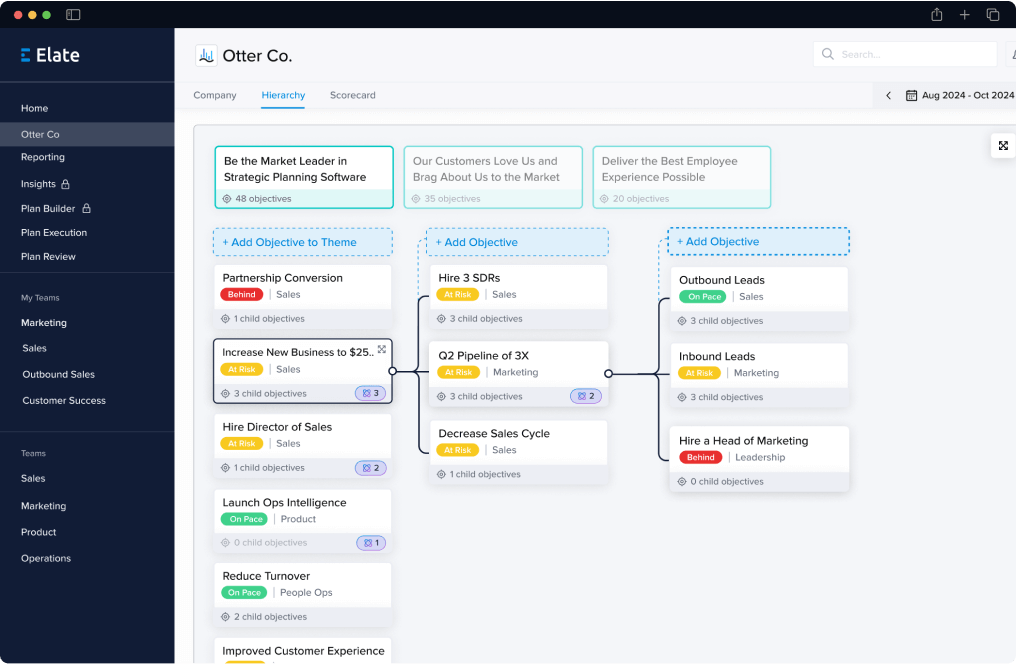
Need a cleaner way to operationalize the plan? Elate helps nonprofit teams connect strategic priorities, initiatives, owners, and reporting so implementation does not collapse into spreadsheet chasing.

Explore the nonprofit overview or book a walkthrough.

“We finally have a golden record of what we said we’d do, what we’re doing, and what we’ve achieved.”

Lori Borden
Chief of Staff

“With Elate, we’ve been able to build a scalable, repeatable framework for planning and execution that keeps everyone aligned.”

Tony Rhine
Chief Operating Officer

“Elate gives me, as Chief of Staff, a 360° view of what’s happening across our entire strategy.”

Ed Crook
Chief of Staff

“Our goal was one source of truth—and Elate finally gave us that.”

Ben Cabeza
Chief Strategy Officer

Turn Strategy Into Outcomes

Discover how Elate and Strategy Advisor work together to align teams, spot risks, and accelerate results.