










A strong nonprofit strategic planning process does more than produce a document. It helps leadership make choices, translate those choices into owned work, define the outcomes that matter, and create a review cadence that keeps the plan alive.
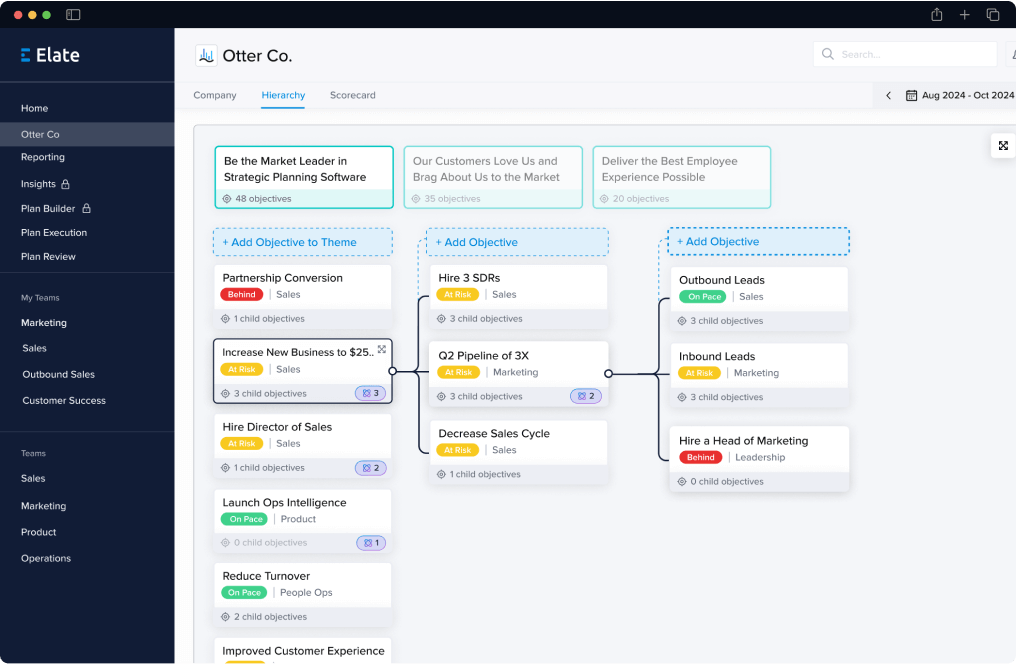
Elate helps nonprofits turn strategic plans into a living operating rhythm by connecting priorities, owners, outcomes, updates, risks, and board or funder-ready reporting. The planning process still needs judgment and facilitation. Elate helps with the handoff from plan to execution.
The practical 7-step nonprofit strategic planning process
1. Clarify the decision the plan needs to support
Start by naming why the plan is being refreshed. A nonprofit may need to focus growth, respond to funding changes, align programs, prepare for leadership transition, improve board reporting, or reduce initiative overload. The reason matters because it changes the planning process.
2. Ground the process in mission, community need, and capacity
Nonprofit planning has to balance ambition with capacity. Use community needs, stakeholder input, funder commitments, program realities, staffing constraints, and financial context to shape the plan. A plan that ignores capacity will create more reporting burden than execution clarity.
3. Choose a small number of strategic priorities
Good planning requires tradeoffs. Leadership should decide which priorities are most important for the next planning cycle and which work should be paused, simplified, or handled as normal operations. If everything is strategic, the plan will not guide decisions.
4. Translate priorities into owned work
Each priority needs clear ownership, supporting initiatives, and a realistic cadence for updates. This is where many nonprofit plans break down. The board approves the direction, but programs, sites, shared services, and operations teams are left to translate the plan on their own.
5. Define outcomes, measures, and narrative context
Metrics are useful when they help leadership understand progress. They are not enough by themselves. For each priority, define the outcomes that matter, the measures that can indicate progress, and the narrative context that explains what is changing and why.
6. Build the board and funder reporting rhythm
Board and funder reporting should not be rebuilt from scratch every cycle. Decide what leadership will review monthly, what the board will see quarterly, and what funders need by grant, program, or outcome area. Then design the update process to feed those outputs.
7. Review, learn, and roll the plan forward
The process is not complete when the plan is approved. Schedule review moments, capture risks and blockers, document decisions, and update the plan as conditions change. A living strategic plan should help leaders decide what to support, adjust, escalate, or stop.
What nonprofits often get wrong
- Treating the retreat as the process. The retreat is useful, but execution depends on what happens after it.
- Creating too many priorities. Overloaded plans make ownership unclear and reporting harder.
- Skipping the reporting design. If board and funder reporting are not designed upfront, teams will rebuild the story manually later.
- Separating metrics from ownership. A dashboard can show movement, but leaders still need to know who owns the response.
- Adding process without removing work. Capacity matters. The process should reduce update chasing, not add another layer of admin.
Where Elate fits in the process
Elate is most useful after leadership has chosen the direction and needs to run the plan. It helps teams connect strategic priorities to owners, outcomes, updates, risks, and reporting so the plan becomes part of the operating rhythm rather than a static document.
Spreadsheets can still support analysis. BI and CRM systems can still hold source data. Project tools can still manage task-level work. Elate connects the strategy layer above those systems so leadership can see what is moving, what is stuck, and what needs attention.
Best fit and not the best fit
Best fit: Elate is a strong fit for nonprofits with an active strategic plan, board or funder reporting needs, distributed programs or sites, and a team that needs a repeatable update cadence.
Not the best fit: Elate is not a substitute for facilitation, fundraising strategy, case management, CRM, grant management, finance, or BI. It works best when the organization needs to connect strategy execution and reporting across existing tools and teams.
Questions to use during planning
- Which priorities will leadership actually review every month or quarter?
- Who owns each priority, and who contributes updates?
- Which outcomes matter to the board, funders, and leadership team?
- What risks or blockers should be escalated before they become surprises?
- What reporting can be standardized so the team is not rebuilding it each cycle?
- Which tools stay in place, and where does the strategy execution rhythm live?
Related resources
- Best nonprofit strategic planning software
- Nonprofit strategic planning software
- Nonprofit board dashboard
- Nonprofit board report template
- Nonprofit strategic plan implementation
- Request a product demo
FAQ
What are the main steps in a nonprofit strategic planning process?
The main steps are clarifying the planning decision, grounding the plan in mission and capacity, choosing priorities, assigning ownership, defining outcomes and measures, designing board and funder reporting, and reviewing progress on cadence.
How long should a nonprofit strategic plan be?
The plan should be long enough to explain priorities and outcomes, but short enough to guide decisions. A concise plan with clear ownership and review cadence is usually more useful than a long document that no one runs.
How do nonprofits keep a strategic plan alive after launch?
Nonprofits keep a plan alive by assigning owners, collecting structured updates, reviewing progress with leadership, surfacing risks, and connecting the plan to board and funder reporting.
How does Elate support nonprofit strategic planning?
Elate supports the execution side of nonprofit planning by connecting priorities, owners, outcomes, updates, risks, and reporting in a repeatable rhythm that works alongside existing tools.