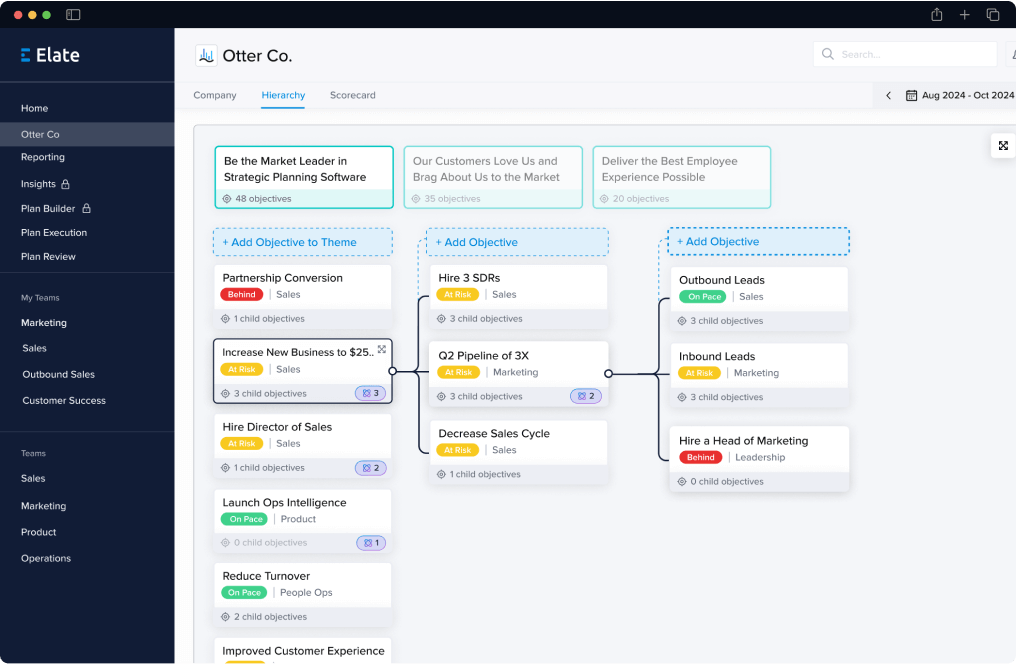











Quick answer: Setting clear objectives improves focus, alignment, and decision-making because teams can connect daily work to outcomes and leaders can make tradeoffs explicitly.
Operator note: Good objectives are a forcing function for tradeoffs. If everything is an objective, nothing is. Keep them few, measurable, and tied to real outcomes.
You know it's working when:
- Teams can name the top objectives and what success looks like this quarter.
- Work-in-progress goes down because priorities are clearer.
- Leaders can spot misalignment early and course-correct before it becomes rework.
In this guide:
- Why objectives matter
- How to write objectives teams can execute
- Common mistakes
- Checklist: objective quality test
- Copy/paste template
- FAQs
Why objectives matter
When objectives are vague, teams fill gaps with assumptions. That is how priority drift starts.
- Focus. Teams know what to prioritize.
- Alignment. Cross-functional work connects to shared outcomes.
- Accountability. Ownership becomes clearer because outcomes are measurable.
- Better decisions. Leaders can say no with context.
If you are building an operating cadence around objectives, use the Guide to an Operating Rhythm.
How to write objectives teams can execute
- Write outcomes, not activities. “Increase retention” is an outcome. “Launch a feature” is an activity.
- Limit the set. Too many objectives reduces focus.
- Define measures. Use key results or KPIs that show progress.
- Assign owners. Ownership is not a committee.
If you use OKRs for objectives, see writing strong OKRs and OKR dashboards.
Common mistakes
- Objectives that bundle multiple outcomes. Teams cannot tell what “done” means.
- Unmeasurable objectives. Leaders get activity updates instead of progress.
- Objectives without tradeoffs. New objectives get added, but nothing stops.
Checklist: objective quality test
- Can a leader explain the objective in one sentence?
- Is there a measurable indicator of success?
- Is ownership clear?
- Does the objective connect to a Theme or priority?
For broader planning structure, see strategic planning overview.
Copy/paste template: write a measurable objective
Example scenario: A cross‑functional initiative starts with a single objective and one accountable owner, even if the work spans teams. Weekly updates stay short, and the leadership team only escalates when the objective is At Risk or Behind.
Objectives work when they describe an outcome you can measure and review, not a list of activities.
Objective statement: Improve [outcome] for [who] by [timeframe]
Success metric: [metric name] from [baseline] to [target] by [date]
Owner: [single accountable leader]
Constraints: [budget, capacity, dependencies]
Tradeoffs: What will we stop or deprioritize to do this well?
FAQs
What is the difference between an objective and a goal?
Teams often use them interchangeably. The important distinction is clarity: an objective should describe an outcome that can be measured and reviewed.
How many objectives should a team have?
Start with one or two. Add only if the leadership review cadence stays strong and teams can execute without overload.
How do objectives connect to KPIs?
Objectives describe the outcome you want. KPIs are the measures you watch to confirm progress and business health.
Want to make this easier to run every week? See a short Elate walkthrough, then decide if a live demo is worth your time.