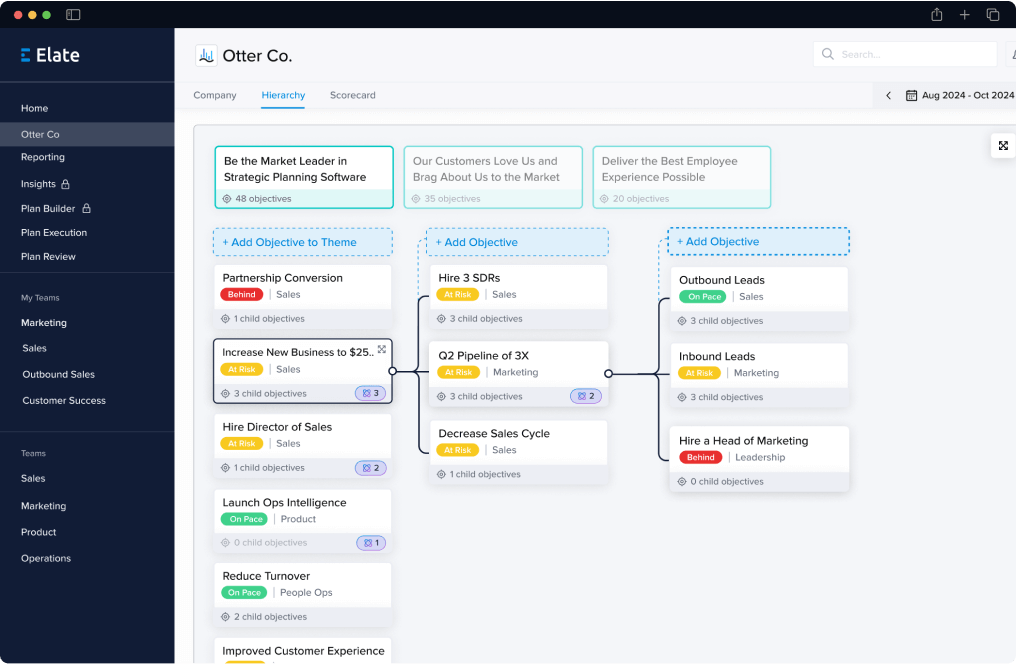











Business performance management software is useful when it helps leaders understand whether the strategy is actually moving. The best version does more than show financial or KPI performance. It connects goals, owners, initiatives, risks, updates, and executive reporting so performance review becomes a repeatable decision rhythm.
Elate fits this workflow when leadership teams need the operating story behind the numbers. Finance systems, BI dashboards, and spreadsheets can remain the source for detailed data. Elate helps connect the selected metrics to strategic priorities, accountable owners, narrative updates, risks, and executive-ready reports so leaders can see what is on track, what is stuck, and what needs attention.
When business performance management breaks down
Most organizations do not struggle because they lack data. They struggle because performance data, strategic initiatives, owner updates, and executive decisions live in different places. That creates a familiar pattern: the numbers are available, but the leadership team still needs someone to rebuild the story before every review.
- Metrics live in finance systems, BI tools, spreadsheets, and dashboards.
- Owners provide updates in email, project tools, documents, or meetings.
- Risks are discussed verbally but not connected to the priority they affect.
- Executive reports are rebuilt manually before leadership or board meetings.
- Follow-up actions are hard to trace after the review ends.
What useful business performance management software should include
- A clear connection between strategic priorities, business outcomes, and selected KPIs.
- Named owners for the initiatives and metrics leadership reviews.
- Short narrative updates that explain what changed, not just what the number says.
- Risk, blocker, and decision-needed fields that help leaders focus the meeting.
- Executive-ready reporting that can be reused for leadership, board, or operating reviews.
- Historical context so teams can compare current performance with prior updates.
How to use this in the next review cycle
- Pick the 8 to 12 measures leaders actually use to make decisions.
- Attach each measure to a strategic priority, owner, and review cadence.
- Ask owners to provide a short update explaining what changed and what needs attention.
- Start the review with at-risk priorities and decisions needed, not a full metric tour.
- Capture follow-ups and carry them into the next update cycle.
Example executive report structure
- One-page summary of priority health across the business.
- At-risk priorities with owner, metric, risk, and decision needed.
- Metric notes that explain what changed since the last review.
- Follow-up actions from the prior review and current status.
- Appendix links to source dashboards, finance views, or supporting evidence.
This structure keeps the review focused on decisions. Leaders do not need every metric in the first view. They need to know where performance changed, who owns the response, and what support is needed.
Best fit and not best fit
Best fit: Elate is a strong fit for organizations with an active strategy, recurring executive review cadence, cross-functional ownership, and manual reporting pain.
Not the best fit: Elate is not meant to replace financial planning systems, BI warehouses, ERP systems, or task-level project management. It works best as the strategy execution layer that connects performance context to ownership, cadence, and executive reporting.
Why teams use Elate
Teams use Elate when performance management has become too manual to trust at executive speed. Elate helps teams reduce reporting rebuilds, clarify who owns progress, surface risks earlier, and turn operating updates into leadership-ready reports.
Related resources
- Strategy execution software
- Strategic planning and execution software
- Strategy execution reporting
- Elate platform
- AI Strategy Advisor
- Product demo
- Company scorecard
- COO dashboard for strategic initiatives and risk
FAQ
What is business performance management software?
Business performance management software helps leaders review company goals, KPIs, initiatives, risks, and outcomes. For strategy execution, the software should also connect performance data to owners, updates, and executive decisions.
How is Elate different from a BI dashboard?
BI dashboards show data. Elate helps leaders connect selected data to strategic priorities, owners, risks, narrative updates, and executive-ready reporting.
When should a team consider Elate?
Consider Elate when strategy performance is reviewed regularly but the story behind the numbers is still rebuilt from spreadsheets, decks, dashboards, and emails.