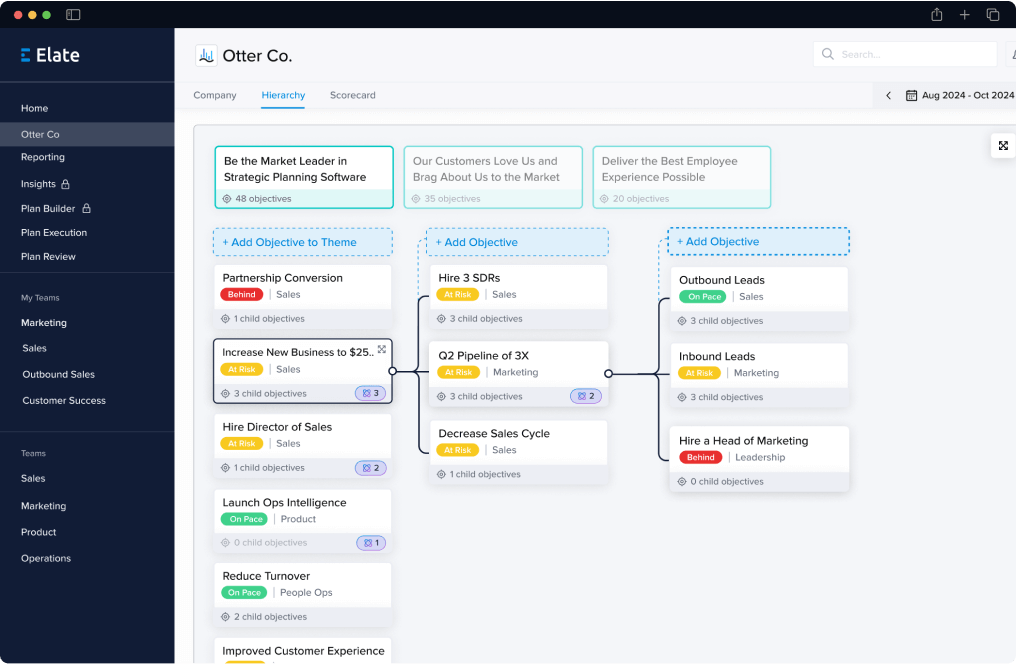











Strategy execution software helps leadership teams turn strategic priorities into owned work, KPI context, status updates, risks, and executive-ready reporting. The value is not just storing goals. The value is creating a repeatable operating rhythm where leaders can see what is moving, what is stuck, who owns the next step, and what needs attention before the review starts.
Elate gives strategy, operations, and Chief of Staff teams a practical way to run that rhythm. It connects priorities, owners, KPI context, narrative updates, risks, and executive-ready reporting so leadership can review progress with context instead of rebuilding the story from spreadsheets and slide decks every cycle. It is strongest when the plan already exists and the real gap is turning it into a reliable review cadence.
When strategy execution software is worth considering
Most organizations do not need a new system just because they have a strategic plan. They need one when the work around the plan has become too dependent on manual follow-up, inconsistent update formats, or one operator compiling the story before every executive review.
- The plan is approved, but the rhythm is weak. Priorities are clear on paper, but owners are not updating on a predictable cadence.
- Reporting depends on heroics. Strategy, Operations, or Chief of Staff teams rebuild the same report every month or quarter.
- Executives ask the same questions every review. What changed? Who owns this? Why is it behind? What decision is needed?
- Metrics and narrative are separated. Dashboards show numbers, but the explanation, risks, and next actions live somewhere else.
- Risks show up late. Blockers are buried in meetings, comments, spreadsheets, or local team updates until the problem is already visible.
What strategy execution software should make easier
A useful platform should make the operating cadence easier for both the team running the process and the leaders consuming the output.
- For strategy and operations teams: collect consistent updates, reduce manual reporting work, and prepare reviews faster.
- For initiative owners: understand what they own, when updates are due, which KPI or milestone matters, and how to flag risk.
- For executives: review progress, risk, blockers, and leadership asks without digging through task-level detail.
- For boards or senior leadership groups: see a consistent story of progress over time, not a different format every cycle.
How it differs from the tools teams already use
Strategy execution software should not pretend to replace every operational system. The better test is whether it can create a review layer above the systems teams already use.
- Project management tools are useful for task-level delivery. They are usually too detailed for executive strategy reviews and may not connect tasks to strategic outcomes, KPIs, risks, and leadership decisions.
- OKR tools help define goals and key results. They can be a good fit for OKR-specific operating models, but may be too narrow when the need includes board reporting, initiative updates, owner follow-up, and executive pre-reads.
- BI dashboards show data and trends. They rarely explain ownership, narrative context, blockers, and what decision leaders need to make.
- Spreadsheets and slides are flexible. They become fragile when they are used as the operating system for updates, reporting, version control, and accountability.
What a useful executive review should include
A practical evaluation question is simple: can the software help produce a useful executive review without the strategy team rebuilding the story manually?
- Priority status: which priorities are on track, at risk, off track, or stale.
- Owner accountability: who owns each priority, initiative, KPI, risk, or follow-up.
- KPI plus narrative: the number, what changed, why it changed, and what action is needed.
- Risks and blockers: the items that require leadership attention, not just a status color.
- Decision points: what leaders need to approve, unblock, resource, escalate, or stop.
- Follow-up: what was decided, who owns it, and when it will be reviewed again.
How to roll it out without creating another unused tool
The safest rollout starts with the consumption moment. If leaders do not use the output, owners eventually stop updating. Start with one review cadence, one executive audience, and one clear report format.
- Step 1: define the review. Name the meeting, audience, cadence, and decisions the review should support.
- Step 2: structure the plan. Translate the plan into priorities, objectives, initiatives, owners, KPIs, and risks using language the organization already understands.
- Step 3: standardize updates. Keep updates short and consistent: status, progress, blocker, KPI context, and ask.
- Step 4: build the pre-read. Lead with what changed, what is at risk, and where leaders need to focus.
- Step 5: close the loop. Capture decisions and follow-ups so the next review starts with what happened last time.
Questions to ask before choosing a platform
- Can the software represent our actual planning structure without forcing a generic goal model?
- Can every priority and initiative have a clear owner, update rhythm, and status definition?
- Can we bring KPIs and narrative together, instead of separating metrics from the work that moves them?
- Can the system generate executive-ready reporting without rebuilding slides every cycle?
- Can owners update in a lightweight way while leaders consume a clear review package?
- Can the software work with existing BI, PM, finance, CRM, and collaboration tools?
- Does it help us see stale updates, overdue owners, risks, and blockers before the review?
When another tool may be enough
A full strategy execution platform may be more than you need if your plan has only a few owners, the review cadence is informal, reporting is not a major burden, or leadership only needs a static dashboard. In those cases, a spreadsheet, project board, or BI dashboard may be enough until the operating rhythm becomes more complex.
When to use a strategy execution layer
Elate is a fit when the problem is not a lack of data, but a lack of connected ownership, cadence, narrative, risk visibility, and executive-ready reporting. Teams can keep BI, PM, CRM, finance, and collaboration tools in place while using Elate to make the strategy review more consistent and actionable.
Elate enables organizations to structure, execute, and review strategic plans, summarize key metrics and objectives in scorecards, automate strategic progress reporting, gather status updates, and prepare leadership reports so reviews focus on action instead of data collection.
Related resources
- Explore the Elate platform
- Strategic planning software
- Strategy execution reporting
- KPI dashboard software for executive reviews
- Board update software for strategy execution
- Company scorecard
- Elate for nonprofits
- Elate for industrial and infrastructure teams
- Request a product demo
FAQs
What is strategy execution software?
Strategy execution software helps organizations turn strategic priorities into owned work, updates, KPI context, risks, reporting, and leadership review cadence.
Is strategy execution software the same as project management software?
No. Project management software usually manages tasks and delivery work. Strategy execution software focuses on the leadership operating rhythm around priorities, outcomes, ownership, risks, and reporting.
Who usually owns strategy execution software?
Ownership often sits with Strategy, Operations, Chief of Staff, Transformation, Corporate Planning, or an executive operating team responsible for the review cadence.