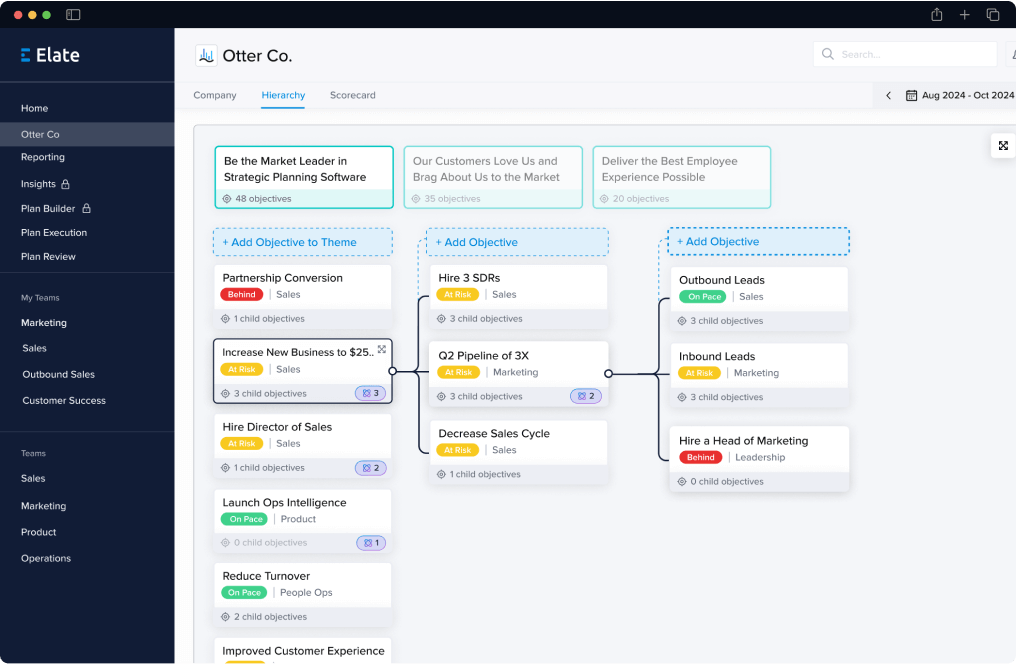











The most useful strategic planning tools do more than help a team create a plan. They help leaders make tradeoffs, define priorities, assign ownership, connect KPIs, and keep the plan active through a recurring review cadence.
Elate is built for the execution side of strategic planning: the handoff from goals and workshop outputs to owners, KPI context, updates, risks, and executive-ready reporting. It gives leaders a clearer operating rhythm after the plan launches, while letting documents, spreadsheets, BI dashboards, and project tools keep doing the jobs they are best suited for.
The tool stack most teams actually use
Most organizations do not rely on one strategic planning tool. They use a stack of documents, spreadsheets, slides, dashboards, project tools, meeting notes, and collaboration channels. The issue is usually not that each tool is broken. The issue is that no tool clearly owns the handoff from plan to operating cadence.
- Documents and decks are useful for the planning narrative, but weak for ownership, cadence, and live progress.
- Spreadsheets are flexible, but they create version control issues, inconsistent updates, and manual rollups.
- Project management tools help teams manage tasks, but they can bury strategic context in delivery detail.
- BI dashboards show performance, but they usually do not show owner narrative, risk, blockers, or leadership asks.
- OKR tools help define goals and key results, but may be too narrow if the organization needs broader strategy execution, reporting, and governance cadence.
A practical way to compare strategic planning tools
Start by separating the planning job from the execution job. Different tools serve different moments in the strategy cycle.
- Strategy formation: workshops, research, prioritization, scenario planning, and leadership alignment.
- Plan documentation: writing the strategy, communicating the narrative, and publishing the approved plan.
- Plan translation: turning priorities into objectives, initiatives, owners, measures, and milestones.
- Execution cadence: collecting updates, tracking risks, reviewing progress, and managing follow-up.
- Executive reporting: producing pre-reads, board updates, scorecards, and operating review packages.
If your main problem is writing the plan, a document, whiteboard, or facilitation tool may be enough. If your problem is keeping the plan alive after launch, look for a tool that connects ownership, cadence, KPI plus narrative, risk, and reporting.
What good looks like after the plan is approved
A strong strategic planning tool should make the first 90 days after approval more disciplined, not more chaotic.
- Every strategic priority has an owner and a review cadence.
- Initiatives ladder up to priorities so leaders can see why the work matters.
- KPIs are paired with narrative context, not separated from the ownership story.
- Owners know what update format is expected and when it is due.
- Risks and blockers are visible before the leadership meeting.
- Reports pull from the same operating context instead of being rebuilt in slides.
- The review ends with decisions, follow-ups, and clear accountability for the next cycle.
How to choose the right tool category
The best tool depends on the problem you need to solve. This is where many evaluations go sideways: teams buy for planning, then discover the real issue is execution and reporting.
- If the problem is alignment: look for tools that help leadership make choices, prioritize, and communicate the plan.
- If the problem is execution: look for ownership, update cadence, status, risk, KPI context, and reporting.
- If the problem is reporting: look for executive-ready outputs, pre-reads, scorecards, and board-ready formats.
- If the problem is measurement: look for KPI governance, metric definitions, source clarity, and narrative context.
- If the problem is adoption: look for reminders, lightweight owner updates, role-based visibility, and workflows that fit existing habits.
Questions to ask in the evaluation process
- Will this tool help us run the plan after launch, or only document it?
- Can it support our real operating cadence: monthly reviews, quarterly business reviews, board updates, cabinet meetings, or annual planning roll-forward?
- Can it connect priorities, initiatives, owners, KPIs, narrative, risks, and decisions?
- Can executives consume the output quickly without digging through task lists?
- Can we keep existing BI, PM, finance, CRM, and collaboration tools in place?
- Can the reporting output become the pre-read, not just a data export?
- Does the tool make update quality better, or just create another place people need to log in?
Common mistakes when selecting strategic planning tools
- Buying for the planning event instead of the operating year. The real test is whether the tool still matters six months after the offsite.
- Over-indexing on dashboards. Dashboards can show numbers, but leaders still need owners, narrative, risks, and decisions.
- Expecting broad adoption on day one. Start with a focused owner group and one leadership review, then expand.
- Forcing new language too early. Use the organization's existing plan terminology when possible.
- Ignoring reporting outputs. If the tool cannot produce the pre-read or review package, the team will rebuild it somewhere else.
How to fill the gap between planning tools and review cadence
This is the gap a strategy execution layer is meant to fill: strategic direction already exists, but leadership needs a better way to run it. Elate sits between static planning artifacts and the many systems where execution data already lives, connecting priorities, objectives, owners, selected KPIs, risks, updates, reports, and meeting follow-up.
It is not a replacement for workshop facilitation, full task management, business intelligence, ERP, CRM, finance systems, or every team collaboration tool. It works best as the strategy execution layer that helps those systems become reviewable through ownership, cadence, narrative, and executive reporting.
When a lighter tool may be enough
A lighter planning tool may be enough if your organization only needs to document priorities, run an annual workshop, or publish a static plan. A spreadsheet or dashboard can also be enough when there are few owners, low reporting pressure, and no recurring executive review cadence.
Related resources
- Strategic planning software
- Strategy execution software
- Strategy execution reporting
- Explore the Elate platform
- Request a product demo
FAQs
What are strategic planning tools?
Strategic planning tools help teams define priorities, organize goals, assign ownership, connect measures, and manage the cadence after the plan is approved.
What is the difference between strategic planning tools and strategy execution software?
Strategic planning tools may help create or organize the plan. Strategy execution software focuses on keeping the plan active through owners, updates, KPIs, risks, reporting, and leadership reviews.
Can Elate work with existing planning documents and dashboards?
Yes. Elate is designed to work alongside existing documents, dashboards, and operational systems by connecting selected strategy context into a reviewable operating rhythm.