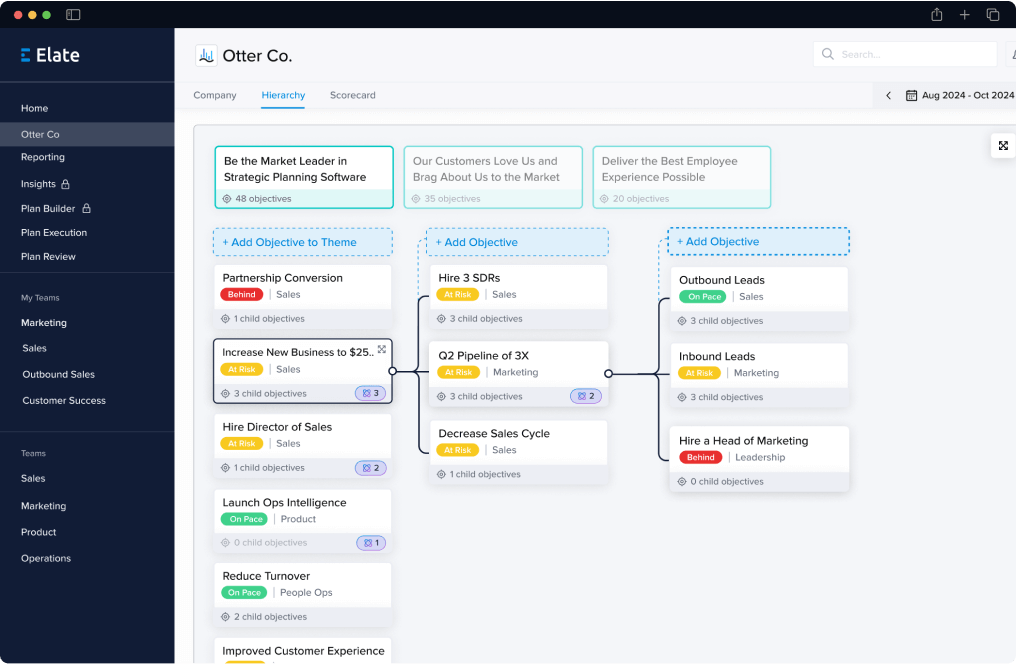











Chief of Staff software should be evaluated by how well it supports executive alignment, growth priorities, and the operating cadence behind the leadership team. A long feature list matters less than whether the system helps the CoS keep priorities visible and follow-through consistent.
Elate helps Chiefs of Staff evaluate and run the strategy execution rhythm. It connects the plan, owners, updates, selected KPIs, risks, and executive reports so alignment is easier to maintain as the organization grows.
A practical evaluation rubric
- Can the system show the executive team which priorities matter most?
- Can every priority have a clear owner and update cadence?
- Can owners provide short, structured updates without building a separate report?
- Can leadership see what is at risk before the meeting?
- Can reports be created from current updates instead of rebuilt manually?
- Can decisions and follow-ups carry forward after the review?
- Can the system coexist with project, BI, finance, and collaboration tools?
What to test in a pilot
A useful pilot should not try to load every initiative in the company. Start with one leadership cadence and one set of priorities. The test is whether the executive team gets a clearer pre-read and whether owners can keep updates current without extra administrative work.
- Choose 5 to 10 priorities leadership already reviews.
- Assign owners and update prompts.
- Collect one update cycle.
- Generate a simple leadership pre-read.
- Run one meeting from the report.
- Capture follow-ups and confirm the next cadence.
Questions to ask vendors
- How does your system support executive pre-reads?
- Can owners update progress without becoming project managers?
- Can leaders see stale updates and at-risk priorities quickly?
- Can the system separate strategic priorities from task-level work?
- How does reporting work for leadership meetings?
- How does the system fit with existing BI, project, and collaboration tools?
These questions will quickly separate systems built for executive operating cadence from systems built mainly for project tracking, documentation, or personal productivity.
Best fit and not best fit
Best fit: Elate is a strong fit for Chiefs of Staff who own executive cadence, cross-functional alignment, strategic priorities, and leadership reporting.
Not the best fit: Elate is not meant to replace personal task lists, calendars, project boards, or every collaboration tool. It works best as the operating layer for priorities, accountability, progress, and executive reporting.
Why teams use Elate
Teams use Elate when alignment is too dependent on manual updates and meeting prep. Elate helps create a consistent rhythm for ownership, progress, risks, decisions, and follow-up.
Related resources
- Strategy execution software
- Strategic planning and execution software
- Strategy execution reporting
- Elate platform
- AI Strategy Advisor
- Product demo
- Chief of Staff software
- Strategy management software
FAQ
How should a Chief of Staff evaluate software?
Evaluate whether the software improves executive visibility, owner accountability, risk review, reporting, and follow-up cadence. Avoid buying a tool that only adds another task list.
What makes Elate useful for Chiefs of Staff?
Elate connects priorities, owners, updates, risks, KPIs, and executive reports so the CoS can run a more consistent operating rhythm.
When is a Chief of Staff tool not enough?
If the goal is only personal task management, a lightweight task tool may be enough. If the goal is strategy execution across leadership and teams, an operating layer like Elate is a better fit.